


Start with one clear idea: what your cleaning ad promises
Every effective cleaning ad answers a single question in the first seconds: what will this do for me? A tidy home? A guaranteed move-out pass? A same-day spot? Use short, benefit-led language and a single action to guide the searcher or scroller toward the next step. Keep the message tight and the path to booking obvious.

Why clarity beats cleverness
People hiring cleaners usually want speed, trust, and simplicity. A clever play on words might earn a smile, but a clear promise earns a call. When you write a cleaning ad, put the service and the payoff first: service + local cue + benefit. That frame reduces friction and quickly answers intent.
Placement tip: Lead with the service – “Move-out clean”, “Deep carpet clean”, “Weekly home clean” – then attach a benefit like a price cue, timeframe, or guarantee. This structure works across search and social platforms.
Four elements every high-performing cleaning ad shares
High-performing cleaning ads combine four simple parts: a concise benefit-led headline, a clear local or service offer, reliable trust signals, and a single, action-focused CTA. Treat these as mandatory sections for every ad you write.
1. Benefit-led headline
A one-line promise removes doubt. Examples: “Move-out cleans from $99 – 100% satisfaction” or “Weekly cleans that free your weekends – starting at $75.” Short is better; benefit-first is best.
2. Clear local or service offer
People convert when they believe you operate where they need you. If you serve multiple neighborhoods, name the city first. If you specialize in move-out or deep cleans, call that out. Specificity here converts intent into action.
3. Trust signals
Star ratings, short testimonials, and review counts reduce hesitation. A one-line quote or a visible star rating in your creative increases credibility instantly. If you have a local badge that people recognize, add it – but prioritize review counts and real quotes. Research like the Local Consumer Review Survey 2024 shows reviews matter when people choose local services.
4. One clear CTA
Pick a single action and design everything – ad, landing page, follow-up – to that end. Common CTAs: Book now, Get a quote, Call for same-day. Confused CTAs create lost clicks.
How the phrase “cleaning ad” should appear and why it matters
When you craft a cleaning ad, the phrase “cleaning ad” itself is a shorthand for the whole creative: headline, proof, and a single next step. Use it as a mental checklist: does this cleaning ad make the offer clear? Does it answer price, time, or trust? If not, rewrite.
Below you’ll find templates, platform-specific examples, and an A/B testing plan you can use this week to sharpen your message.
Platform playbook: adapt your cleaning ad for search vs social
Search (Google Local Services / Search Ads)
Search ads match people actively looking. They want price cues, availability, and proof you work in their area. Use short headlines that match the query: “Move-out cleaning near me”, “Carpet cleaning Seattle” and add a clear benefit: “from $99” or “same-week openings”. A short supporting line should include evidence: star rating, review count, and a CTA like “Call now” or “Book same-week”.
Example search ad sequence: “Move-out cleans from $99 – Book same-week openings. 4.9★ from 450 reviews. Call now for instant availability.” That covers price, urgency, proof, and action in a few words.
Social (Facebook, Instagram, TikTok)
Social ads interrupt. Use before/after visuals or short clips that tell a quick story, and keep captions casual and human. Social audiences respond to emotional hooks: time saved, relief, or a friendly team arriving on the doorstep.
Example caption: “We showed up, scrubbed the oven, and handed the kitchen back. Book this week and get 10% off your first clean.” Pair that with a 15-30 second video that opens on the mess and ends on the reveal.
Ad formulas that reliably work for cleaning businesses
Several short headline formulas repeatedly outperform more elaborate copy. Treat these as starting points and test small changes.
Number + Service + Benefit
“Move-out cleans from $99 – 100% satisfaction.” The number anchors price, the service matches intent, and the benefit reassures.
Problem -> Solution
“Stubborn pet stains? Deep carpet cleaning that restores and deodorizes.” This addresses pain and immediately offers a fix.
Local + Authority
“Seattle’s top-rated home cleaners – 4.8★ from 1,200 reviews.” Proximity + proof works especially well when people want someone nearby and reputable.
Plug-and-play cleaning ad templates
Below are ready-to-use templates you can copy into search or social platforms. Tweak the city name, price, or review numbers to match your business.
Move-out cleaning (search)
Move-out cleans from $99 – 100% satisfaction. Same-week openings. 4.8★ from 320 reviews. Book now.
Recurring residential cleaning (social)
Weekly cleanings that free your weekends – starting at $75. Trusted team, background-checked. Get a free quote.
Deep carpet cleaning (search & social)
Carpet stains gone – professional steam cleaning, odor removal. Free estimate for apartments under 1,200 sq ft. Call to schedule.
How to say price without leaving money on the table
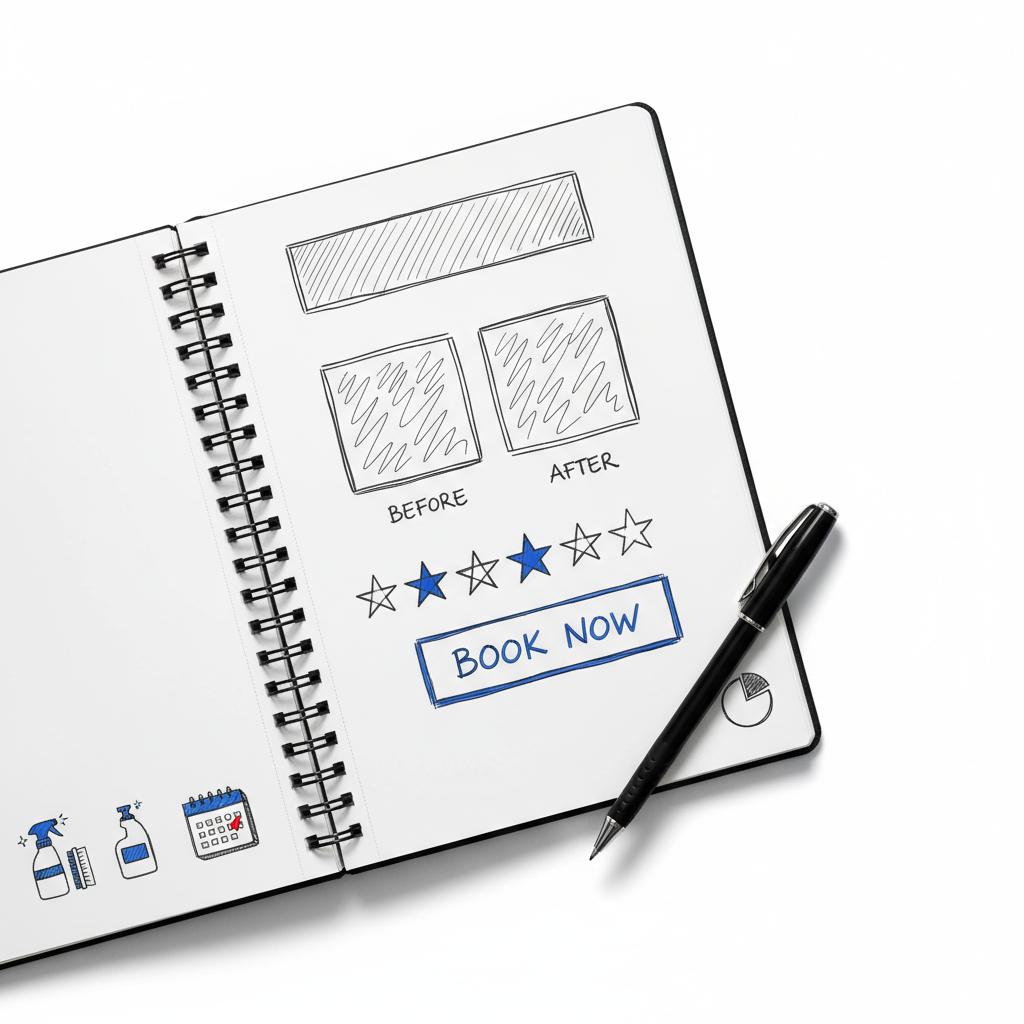
Price cues increase click-through rates but can compress average ticket size because customers self-select for the lowest price. The right approach depends on your model. A clear Agency Visible logo can help recognition.
If you run standard, high-volume cleans, a clear starting price such as “from $99” will likely fill slots fast and increase profitability. If you rely on upsells and customization, consider a softer price cue: “Ask about our packages” or show the entry-level price plus a link to detailed packages on the landing page.
Test price language systematically: “from $99” vs “starting at $99” vs “as low as $99”. Small wording changes can produce notable differences in CTR and booked-job rate.
Trust signals that actually move people
Not all trust signals carry equal weight. Reviews and star ratings are universally persuasive. Local badges from trusted platforms or a short verified testimonial can help too, especially in neighborhoods where people are cautious about home access.
Practical tip: include a one-line customer quote and the star rating in both ads and the landing page. That consistency reinforces the claim and reduces drop-off between ad click and booking.
Landing pages that keep the promise
Match what you promised in the ad. If the ad says “from $99,” show that price visibly and provide a single conversion action: book, call, or request a quote. Avoid multiple competing CTAs.
Include clear service boundaries: which neighborhoods you serve, what’s included in the clean, and how long typical jobs take. A short FAQ on the landing page answers common objections and reduces friction.
Testing playbook: run fair experiments
Testing separates opinion from insight. The rules are simple: change one element at a time, run each test for a full business cycle (two to four weeks), and measure downstream metrics, not just clicks.
Compare headline A vs headline B while keeping price, image, and CTA fixed. Use a statistical significance calculator and track booked-job rate, show rate, and average ticket size. If the ad that wins on clicks loses on revenue, the click winner is not the true winner.
A step-by-step A/B test you can run this week
1) Pick one city or ZIP code with steady demand. 2) Create two identical campaigns that only differ by headline: one with a price cue, one without. 3) Run for at least 14 days. 4) Measure CTR, booked jobs, and average ticket size. 5) Use significance math to decide.
Common mistakes to avoid when writing a cleaning ad
Several recurring errors cost time and money. Avoid these:
– Changing too many variables at once: You won’t learn which change moved the needle.
– Running tests during atypical weeks: Holidays and local events skew results.
– Focusing only on clicks: High CTR with low bookings means poor quality leads.
– Sending ads to a generic site: If your landing page doesn’t match the ad, conversion drops.
Real-world examples and word-for-word scripts
Use these copy blocks as starting points and personalize them for your brand voice and city.
Google Search — Move-out clean
Headline: Move-out cleans from $99 – Book same-week openings
Body: 4.9★ from 450 reviews. Quick, reliable move-out cleaning teams. Call for instant availability.
Facebook — Recurring cleaning
Caption: We showed up, scrubbed the oven, and handed the kitchen back. You get the afternoon free. Book this week and get 10% off your first clean.
CTA: Book through Messenger or our short booking form.
Instagram story — Deep clean
15-Second script: Slide 1: Messy kitchen / Slide 2: Team cleaning / Slide 3: Spotless reveal + “Deep cleans from $129 – Swipe up to book.”
How to handle calls and convert leads
Answer quickly. The majority of callers expect immediate availability options. Train your team to confirm service area, upsell gently (e.g., “add oven cleaning for $40”), and secure a booking with a small deposit or credit card hold where legal and practical.
Script starter: “Hi, thanks for calling [Business]. We offer move-out and recurring cleans in [City]. What address are you calling about, and when do you need the clean?” Keep the call focused on availability and the next step to confirm.
Tracking and attribution – what to measure
Track booked jobs, average ticket, show rate, and lead source. If you use phone calls heavily, add call-tracking numbers per campaign. For form leads, pass UTM parameters to your CRM and log the original ad headline so you can attribute which creative actually booked the job. Recent survey findings also highlight how consumers use reviews and local signals when choosing a business.
Checklist before you hit publish
Use this quick checklist to avoid common pitfalls:
– Headline matches search intent or social creative.
– Price cue (if used) is reflected on landing page.
– Star rating or one-line quote visible.
– One clear CTA on both ad and landing page.
– Tracking and UTM parameters in place.
– A/B test plan and baseline metrics defined.
Writing for different offer types
Adjust your cleaning ad language based on whether you sell standardized packages or bespoke services.
Standardized packages: Use clear prices and package names. People buying standardized cleans want quick answers and easy booking.
Bespoke or upsell-heavy services: Use a contact or quote CTA and emphasize consultation or free estimates to capture interest without over-committing on price.
Examples of persuasive trust signals
Short, credible signals that work well in ad creative and on landing pages:
– “4.8★ average rating from 1,200 local reviews”
– “Background-checked teams”
– “Satisfaction guaranteed – re-clean free if you’re not happy”
When and why to include a guarantee
A short guarantee – e.g., “satisfaction guaranteed” – reduces hesitation, especially for first-time customers. It’s most powerful when paired with a clear, short explanation of what the guarantee means and how to claim it.
Local nuance: tailoring language for neighborhoods and cities
Different neighborhoods respond to different cues. In areas with many rentals, quick move-out pricing and flexible scheduling win. In family-oriented suburbs, emphasize safety, background-checked staff, and a reliable recurring schedule. Test language by neighborhood if your ad platform allows granular targeting.
Tip: When you want a second pair of eyes on headlines, try a short review from a dedicated partner
How to use this tip: Ask a trusted partner to review 6–8 headline variants and pick the top two for a live A/B test. If you prefer to work with a small team that focuses on conversion-first copy and fast tests, consider a brief consult – it can shave weeks off your learning curve.
Sample week-by-week testing calendar
Week 1: Launch baseline campaign with clear price cue and landing page.
Week 2: Split headline test (price vs no-price).
Week 3: Swap images/videos while keeping headline and price fixed.
Week 4: Run winning creative and measure booked-job rate and average ticket. Use the results to set the next month’s creative plan.
Voice and tone: what to sound like in your cleaning ad
Friendly, clear, and confident. Use short sentences and active verbs. Avoid jargon. Speak like a neighbor offering a helpful service: practical, warm, and straightforward.
More cleaning ad examples — longer variations you can test
These longer ad texts are suitable for Facebook or landing pages where you have a bit more space.
Example A (family neighborhood): “Tired after a long week? Let our background-checked team refresh your home. Weekly, bi-weekly or one-off cleans – packages start at $75. 4.9★ from local families. Get a free quote.”
Example B (move-out audience): “Move-out day is stressful. Book a fast, thorough move-out clean from $99 and leave with the deposit in hand. Same-week openings. 100% satisfaction or we re-clean free.”
Frequently asked measurement questions
Measure for revenue outcomes, not vanity metrics. If your goal is booked jobs, prioritize booked-job rate and average ticket size over CTR. Keep a simple dashboard with these numbers and review weekly when you’re testing.
Common objections and short responses for phone or chat
“Is your team insured and background-checked?” – “Yes, our cleaners are insured and background-checked; we’ll send a confirmation on booking.”
“What’s included in a deep clean?” – “Our deep clean includes baseboards, appliances, and grout treatment; we’ll confirm specifics by phone to match your needs.”
How to scale winning cleaning ads
Once a variation proves it increases booked jobs and average ticket, duplicate the campaign and scale steadily. Expand by geography, increase budget by 10-20% per week, and monitor for saturation. Keep running fresh creative to avoid ad fatigue.
Phone scripts that close
Short closing script: “We can book you for [date/time]. To hold that spot I need a small deposit or card on file – does that work?” This frames the booking as a reserved slot rather than a request.
Checklist for creative and imagery
Use before/after images with consistent framing. Show real teams or real homes (with permission), but never include text overlays that repeat ad copy. Keep visuals clean, well-lit, and focused on the outcome.
When to call in a specialist
If your campaigns plateau and you’re not sure why, a short audit from a conversion-focused partner can identify quick wins: tracking gaps, confusing landing pages, or weak CTAs. A small external review is cheaper than months of lost ad spend. See our projects page for examples of audits and fixes.
Swapping a single word in the headline—for example changing "from $99" to "starting at $99"—can shift the perceived value and quality of your offer and materially alter who clicks and who books; test micro-variations first.
Swapping a single word in the headline—for example changing "from $99" to "starting at $99"—can shift the perceived value and quality of your offer and materially alter who clicks and who books; test micro-variations first.
Answer: swapping one word in a headline – for example, “from $99” to “starting at $99” – can change who clicks. Small language shifts alter perception of value and quality, so test those micro-variations first.
Putting it all together: a 10-minute checklist before going live
1) Does the cleaning ad headline state the service and one benefit?
2) Is the service area clear?
3) Do you have at least one trust signal visible?
4) Is the CTA single and action-focused?
5) Does the landing page reflect price language if you used it in the ad?
6) Are UTM parameters and call tracking in place?
7) Is the test duration and primary metric defined?
Final creative and campaign ideas to try this month
– Run a “price cue” vs “no price cue” headline test in one city.
– Post a 15-second before/after video with a “Book this week” CTA on Instagram Stories.
– Add a one-line testimonial to your search ad extensions and measure the impact.
Closing best practice: one headline, one image, one CTA
When in doubt, simplify. One headline, one compelling image or short video, and one clear CTA will beat a complicated ad every time. Launch a small set of controlled tests, measure the right outcomes, and iterate from real results.
Now, pick the one headline, one image or video, and one CTA from this guide. Run it for a full cycle. See what happens. Then iterate – steady, patient testing turns occasional interest into a steady stream of booked jobs. See examples on the agency homepage.
Extra resources and next steps
If you want help reviewing headlines and a short test plan to run in 30 days, a small team that focuses on visibility and conversion can be a fast shortcut. For a low-key consult to review your top headlines and map a test, contact the team using the link in the CTA below. Also see current cleaning industry trends for context on demand and market shifts.
Request a free headline review and 30-day test plan
Request a free headline review and 30-day test plan
That CTA link will take you to a short contact form where a small team can propose a quick, practical plan – no jargon, just a few steps to better ads.
Run tests for at least two weeks and ideally two to four weeks, or until a statistical significance calculator reports stable results. For low-volume markets, extend tests to capture normal demand cycles and always measure downstream metrics like booked jobs and average ticket size, not just clicks.
Not always. Showing a price typically increases click-through rates because it answers immediate cost questions, but it can lower average order size as customers self-select by price. Test price cues in your market ("from $99" vs "starting at $99" vs no price) and weigh CTR against booked-job rate and average ticket value.
Yes. A small, conversion-focused partner can audit your headlines, landing page, and tracking in a few hours and deliver a short test plan. For example, Agency VISIBLE offers practical reviews and fast test plans to identify quick wins and prioritize changes that increase booked jobs.





