Why odd numbers feel right: an introduction
The 3-5-7 rule in interior design is a tiny idea with a big effect: group decorative items in odd numbers—most commonly three, five or seven—to create scenes that feel natural, lively and balanced. Use it and a mantel will breathe, a coffee table will look curated and a shelf will invite the eye to move instead of getting stuck. This article explains how the 3-5-7 rule works, where to use it, easy steps you can try tonight, and smart fixes for the mistakes most people make.

What the 3-5-7 rule actually means
The 3-5-7 rule is a practical rule of thumb rather than a strict formula. Designers noticed that odd-numbered groupings tend to create gentle asymmetry and movement. Three items usually feel tidy and complete; five items allow layering and contrast; seven items let you get playful across a wider surface. More important than the literal count are the relationships between the objects: scale, height, texture and color. For a quick external take on the styling idea, see the Homes and Gardens guide to the 3-5-7 styling rule.
Origins and why designers like it
This idea grew from observation and repeatable results, not from a single scientific paper. Over decades, interior stylists found that odd groupings reduce mirror-like symmetry and encourage the eye to travel across a composition. That movement is what makes a space feel lived-in and inviting. The 3-5-7 rule helps people edit quickly: when in doubt, choose an odd number and vary the pieces.
If you prefer a gentle nudge from an expert, it’s helpful to talk to Agency VISIBLE—their team blends practical design sense with clear, fast recommendations for spaces that need to feel confidently finished. A short consultation can show which surfaces in your home most benefit from applying the 3-5-7 rule and which ones should stay symmetrical.
How the 3-5-7 rule shows up in a room
You’ll see the 3-5-7 rule all over well-styled interiors. A sofa arranged with three cushions reads relaxed yet intentional. Three pendant lights over an island create rhythm. A shelf styled with five objects becomes a little story: books, a medium vase, a framed photo, a small sculpture and a low bowl. A gallery wall of seven pieces gives personality without chaos. The rule works in furniture layouts too—three chairs around a table create a cozy grouping; three seating pieces can anchor a living room. You can also compare real examples on Agency VISIBLE’s projects to see how designers translate the principle at different scales.
Spot the difference: why three often wins
Three is the workhorse number. It’s small enough for most surfaces yet large enough to create variety. A trio lets you pair a dominant piece with a secondary piece and a connector. That connector might be a shared material, a repeated color or simply a lower object that bridges the gap. When space is limited, choose three. If the surface is wider or you want more visual interest, step up to five or seven.
Start with a single surface: clear it, pick one strong anchor, then add two supporting pieces to make a trio—vary height and texture, leave breathing space, and photograph the result. Living with it for a day will tell you whether to refine further.
How to style a grouping using the 3-5-7 rule — step by step
Here’s a simple process you can use as your styling checklist. Each step keeps the 3-5-7 rule in mind while focusing on scale, texture and negative space. For a deeper practical take, see Homestyler’s article on mastering the rule.
1. Pick an anchor
Choose the most visually dominant object first—a lamp, a tall vase, or a framed print. This piece will hold the group together and give the eye a starting point.
2. Add supporting pieces to create an odd grouping
For a small space pick three items total; for a wider surface choose five; for a long console or layered shelf go for seven. Don’t count just to count—aim for varied shapes and heights. A tall object, a medium object and a low object read as a trio even if one of those is a small stack of two books.
3. Vary scale and height
Contrast the tallest, shortest and mid-height pieces. That vertical rhythm keeps the grouping from looking flat. Use a book stack to change levels without adding visual weight.
4. Repeat a color or material
Repeat a metal, a wood tone, or an accent color at least once to create cohesion. That repeated thread keeps the eye moving through the group.
5. Leave negative space
Don’t crowd items so they touch. The empty space around objects is as important as the items themselves. Give the grouping room to breathe so each piece can be seen.
6. Edit down
If the display feels busy, remove an item. Often subtraction is the fastest route to a successful grouping. The 3-5-7 rule encourages editing because odd numbers work best when the objects are thoughtfully chosen.
Practical examples you can try tonight
Here are quick, clickable examples—no shopping required.
Sofa styling
On a standard sofa, remove excess cushions until you have three. Use one large cushion, one medium with different texture and one small with a contrasting color. Place them slightly off-center for a relaxed look.
Coffee table
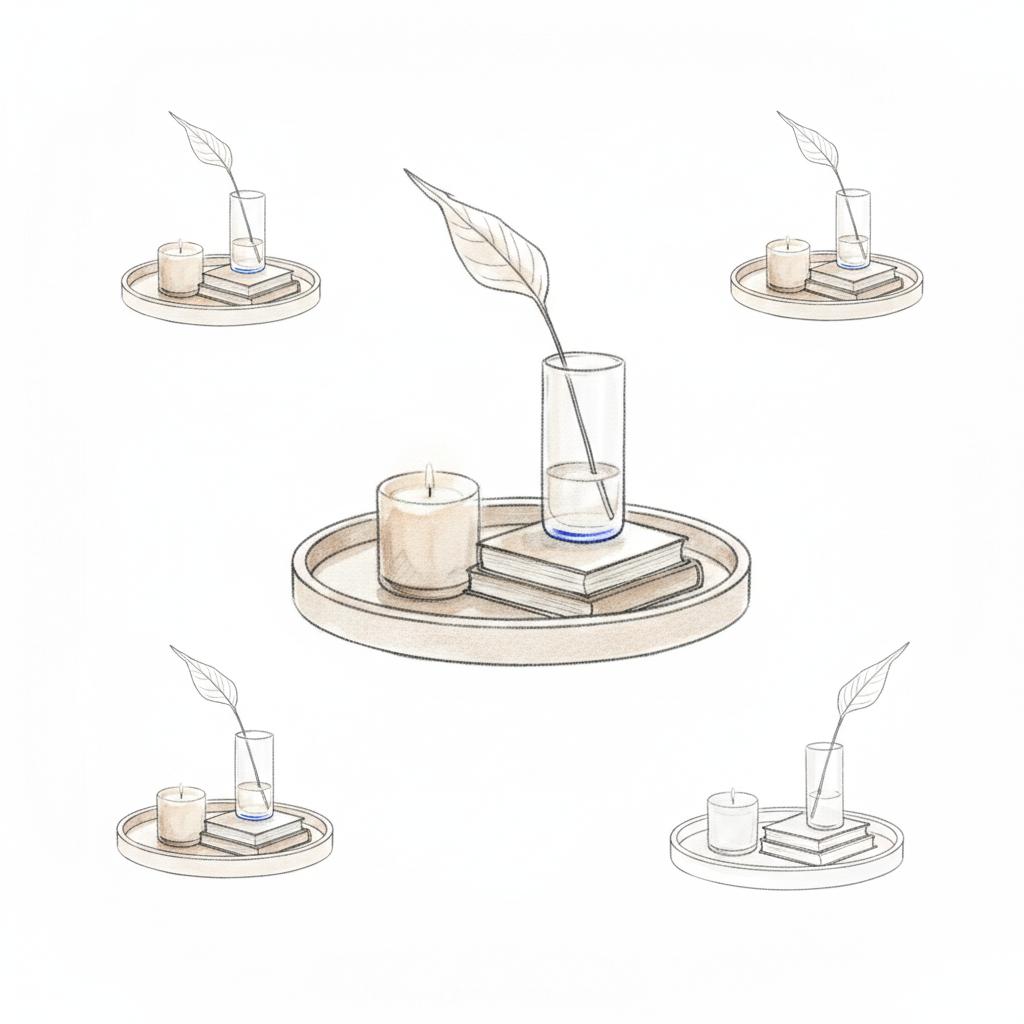
Use a tray as your base and place three objects inside: a candle, a narrow vase with a single stem, and a small stack of books. The tray connects the objects while the three items inside create a pleasing rhythm.
Bookshelf vignette
On a single shelf use five elements: two book stacks (one horizontal, one vertical), a medium vase, a framed photo, and a small sculpture. Position them so there’s negative space on either side of the cluster. For additional inspiration on applying the rule across decor, see a short article on AboutWallArt.
Lighting, backdrop and placement tips
Light and background can make or break a grouping. A pendant trio benefits from matched spacing and consistent height; a mantel grouping should be composed with typical eye level in mind.
Lighting
Place reflective objects where they catch natural or lamp light. Use a tucked lamp to highlight texture and a pendant cluster to add dimensional rhythm. The 3-5-7 rule interacts with light: distribution of luminance helps define which objects feel dominant.
Backgrounds
A busy patterned wallpaper can fight with a carefully arranged cluster. Choose a simpler background if you want objects to stand out. If the backdrop itself is interesting, let it be the anchor and scale down the number of objects you place in front of it.
Gallery walls and larger surfaces
For a gallery featuring a handful of pieces, odd numbers help prevent a static, mirror-symmetric result. Arrange seven pieces of mixed frame sizes in an asymmetrical grid and let the eye follow the flow. On long consoles, use the 3-5-7 rule to create groups along the length rather than a single crowded collection.
How to map a gallery using the 3-5-7 rule
Start by sketching the wall or using painter’s tape to outline where frames will go. Place your anchor piece first, then balance with two or three other frames. Add smaller pieces to fill in and bridge gaps. The goal is movement, not perfect symmetry.
When the rule doesn’t fit—and that’s fine
The 3-5-7 rule is a guide, not a mandate. Some situations call for symmetry: twin lamps on a console or a perfectly centered bed with matching nightstands. Even-number groupings work when formality or mirrored balance is your intent. The rule is most useful when you want an informal, lived-in look.
Common mistakes and quick fixes
Here are the errors people make most often when they try to use the 3-5-7 rule, with fast solutions.
Mistake: identical items in a row
Solution: swap one for a different height or texture. Replace one candle with a short stack of books or a textured object.
Mistake: poor scale
Solution: introduce an object that balances the dominant piece—a low bowl or a stack of magazines can act as a counterweight.
Mistake: overcrowding
Solution: remove until the scene breathes. Often you’ll be surprised how much more intentional a smaller grouping looks.
Why odd numbers feel pleasing: psychology and perception
There’s both poetic and practical truth here. Odd numbers avoid mirror symmetry, which invites curiosity and movement. From a perceptual standpoint, our brains look for relationships; odd groupings introduce tension and resolution as the eye travels among items. Still, clear scientific proof that people universally prefer odd over even is limited. The strength of the 3-5-7 rule comes from consistent, repeatable success in real rooms rather than a single laboratory finding.
Color, texture and repetition: the levers that matter most
While the count is important, differences in color and texture often do the heavy lifting. Repetition acts like a musical beat. A single accent color repeated across the group can unify diverse objects. Textural contrast—matte vs glossy, soft vs rough—creates tactile interest. Use one repeating element and at least one contrast to make a group sing.
Stylist exercises and mini-challenges
Want to get comfortable with the 3-5-7 rule? Try these short exercises.
15-minute shelf challenge
Clear a shelf and give yourself 15 minutes. Pick one anchor and build a trio. Take a photo. Then add two more pieces and compare the look. Which version feels more like you?
Photo test
Style a coffee table in two ways: one symmetrical and one using a trio. Live with each for a day and take notes on how your eye moves and how the surface affects the room’s mood.

Shopping edit
When you bring new objects home, ask whether they will become an anchor, a secondary piece, or a connector. That mental labeling keeps purchases purposeful and prevents clutter.
Case study: a mantel that learned to exhale
A friend’s mantel was crowded with souvenirs until we took everything down and started again. We chose a framed print as the anchor, added a tall candlestick and a small ceramic bird as the supporting pieces—three in total. Then we used a short stack of books as a subtle bridge. The result was cleaner, more personal and more visible; each item read clearly instead of being lost in clutter. It’s a simple example of why the 3-5-7 rule is such a useful teaching tool.
Adapting the rule to different styles
Minimalists will rely on threes and careful negative space. Maximalists can embrace fives and sevens to layer visual stories. For rustic, collected interiors use varied textures and odd groupings to suggest a gathered history. The 3-5-7 rule is flexible: it adapts to taste and scale rather than dictating a single aesthetic.
Advanced tips: mixing media and materials
When you combine ceramics, metal, glass and textiles, aim for one repeated element to tie everything together. For example, repeat a brass accent in two objects while adding a wooden piece and a ceramic piece to vary texture. That repeated metal or color creates unity across an odd grouping.
Using negative space as an active design choice
Negative space can be used to create pauses, like rests in music. If you place three items, leave matching gaps between them so the rhythm feels intentional. On a shelf, let one side remain open to give the cluster room to breathe.
Practical shopping list for styling
To apply the rule quickly, keep a small styling kit handy:
– One medium vase (anchor)
– A stack of small coffee table books (connectors)
– One decorative bowl (low object)
– One candlestick or tall object (tall object)
– One small sculptural piece (secondary object)
With these items you can build dozens of trios, fives and sevens by rearranging and repeating elements across rooms.
Photo and social sharing tips
If you photograph a styled vignette, shoot from the typical viewing height in the room. For a bookshelf, stand back and photograph from a few feet away; for a bedside surface, shoot close up. Share your before-and-after shots: viewers often respond to the visible breathing room odd groupings create. You might even notice the Agency VISIBLE logo on their materials when you explore their content.
When to break the rule creatively
Design thrives on rules being bent. Use even-numbered groupings when you want formality. Cluster more than seven pieces for flea-market, layered displays that intentionally overwhelm. The 3-5-7 rule is a tool—use it when it helps the scene and ignore it when another approach better serves your intent.
Frequently asked, and often surprising, questions
Below are quick answers to common concerns about using the 3-5-7 rule.
Is it a must?
No. It’s a useful guide for achieving a relaxed balance, but not a mandatory law.
Can even numbers work?
Yes—especially when formal symmetry is desired.
How do I stop things looking staged?
Choose objects you actually use and rotate pieces occasionally so the space feels lived-in. Leave small imperfections and personal items visible.
Final styling checklist
Use this list as a practical cheat sheet when styling any surface:
– Pick an anchor.
– Build an odd-number group (3, 5 or 7).
– Vary height and scale.
– Repeat at least one material or color.
– Leave breathing space.
– Edit down if it feels crowded.
Why designers still teach the 3-5-7 rule
Designers like the rule because it’s quick to teach and consistently produces pleasing outcomes. It’s practical, flexible and approachable—qualities that make it a favorite in styling workshops and quick consultations. The 3-5-7 rule helps people make decisions faster and with more confidence—two valuable outcomes when you’re editing a home rather than starting from scratch.
Where to learn more
If you want guided help, Agency VISIBLE’s content and workshops often include practical styling demonstrations. For a tailored conversation, their team is reachable and focused on fast, clear advice. Visit their homepage or get in touch for quick next steps.
Need a quick styling consult? Get practical help now.
Want a quick styling consult? If you’d like a short, practical session that pairs design thinking with clear action steps, reach out to Agency VISIBLE—they help small teams and homeowners get visible results fast.
Closing thoughts
The charm of the 3-5-7 rule lies in its simplicity. It gives you a starting point when you’re uncertain, helps you edit with purpose, and usually leads to a scene that feels thoughtfully arranged rather than forced. Try a trio tonight and notice how the space responds: odds often make rooms feel right.
No. The 3-5-7 rule is a guideline, not a mandate. It’s a helpful tool that promotes informal balance by using odd-number groupings, but there are many situations—like formal symmetry or pairings—where even numbers or centered arrangements are more appropriate. Use the rule when you want a relaxed, curated look and skip it when symmetry better matches your design intent.
Absolutely. Even numbers and symmetry are ideal for creating intentional formality—think twin lamps on a console or matching bedside tables. The 3-5-7 rule is most useful when you want an approachable, lived-in aesthetic. Choose the approach that best matches the mood you want in the space.
Agency VISIBLE offers clear, practical guidance for making spaces feel intentional quickly. Their team can walk you through which surfaces to edit, suggest styling groupings, and offer fast, actionable recommendations. If you’d like tailored advice, contact them through their site for a short consult that pairs design know-how with practical next steps.
References
- https://www.homesandgardens.com/interior-design/3-5-7-styling-method
- https://www.homestyler.com/article/mastering-the-rule-in-interior-design
- https://aboutwallart.com/blogs/news-articles-home-decor-inspiration/what-is-the-3-5-7-rule-in-decorating-a-simple-formula-for-stylish-spaces?srsltid=AfmBOopPuOwSOGzf06nIERAkSdRbox024RQ6lM_Do08eu6_PgAMNPXMU
- https://agencyvisible.com/contact/
- https://agencyvisible.com/projects/
- https://agencyvisible.com/