


Where is the best place to advertise my small business?
Picking where to advertise is less a single verdict and more a small sequence of smart experiments. The right advertising channel depends on who your customer is, how they behave when they look for your product or service, and how much a new customer is worth to your business. In the first few paragraphs below you’ll start to see how to match goals to channels and how to run a 30‑day test that gives reliable signals without wasting cash.
Start with who and why
Before you spend a penny, ask: who is my customer and what action shows they want to buy? Someone typing “plumber near me” has buying intent; a person watching five minutes of TikTok likely doesn’t. Those differences change the entire strategy for where to advertise.
Practical rule: Map customer intent first, then pick channels. If the intent is immediate, start with search and local listings. If it’s discovery or brand-building, start with social and content.
When you want help translating early results into a clear next step, consider a short conversation with Agency Visible. A measured third-party view can save weeks of guessing by helping you set the right KPI, designing a 30‑day test, and creating the tracking you need to know whether your ad spend is working.
Why not just follow a list of “best platforms”?
Many lists claim a single “best” platform. That’s tempting, but often wrong. A locksmith, a coffee shop, and a landscaping firm all need different first tests even if they’re in the same town. The best place to advertise my small business varies by purchase value, urgency, and how customers discover you. For guidance on choosing social platforms, see Wharton’s analysis of which social platforms make sense for business.
Pick the channel that captures buying intent in your market. For immediate leads, that’s usually search or local listings (Google Ads or Google Business Profile). For visual discovery or brand building, start with social. If you’re unsure, run a 30‑day micro‑test on search and one social channel to see which produces paying customers.
Channel guide: what each platform actually delivers
Each channel behaves differently; HubSpot’s summary of top marketing channels in 2025 is a useful reference when you decide where to focus your micro-tests.

Paid search (Google Ads and Local Services Ads)
Paid search captures buying intent. People who search with keywords related to your service are often closer to booking or buying. Expect higher cost-per-click and higher cost-per-lead than social platforms, but also better conversion rates when your offer and landing page match the search query.
For many service businesses in 2024–2025, Google Search and Google Local Services Ads were the most predictable channels for immediate leads. They cost more per click, but those clicks convert at a higher rate – which matters when your goal is calls, booked appointments, or installations.
Social platforms (Meta, TikTok, Instagram)
Social is excellent for awareness, storytelling, and building an audience. Cost per click on social tends to be lower than search, and small budgets can stretch farther in impressions. But users on social are usually in discovery mode, so the path to sale is longer.
Use social to collect emails, promote store visits with redeemable offers, and tell the visual story that makes people remember you later when they have purchase intent.
Local digital channels (Google Business Profile, Yelp, niche directories)
These channels sit between search and social: there’s intent plus geographic relevance. For trades, healthcare, legal services, home services and many other local businesses, a well-maintained Google Business Profile (GBP) and presence in niche directories can deliver steady, low-cost leads.
Offline local tactics (events, radio, flyers)
Offline channels still work – especially for hyperlocal businesses. Their weakness is measurement. Use unique coupon codes, dedicated phone numbers, or custom landing pages to give offline channels measurable outcomes. When tracked, a radio spot or market booth can be an economical way to drive foot traffic or a short-term promotion.
How much should a small business spend?
Benchmarks help. Many small firms aim for roughly 7–10% of revenue for marketing; a recent industry snapshot averaged around 7.7%. That’s a starting point, not a rule. If your margin is thin, phase testing with very small daily budgets and scale only when you see repeatable results. For more tactical strategy ideas, see Top 7 digital marketing strategies for local small businesses.
Run a disciplined 30‑day testing plan
Testing is the fastest, least risky way to answer the question: “Where is the best place to advertise my small business?” A 30‑day micro-test with small daily budgets gives directional data and teaches you how each channel behaves in your market.
Simple 30‑day test template
Follow these steps to run a test you can learn from:
1. Define a lead: phone call, form submit, booked appointment, or sale.
2. Pick one KPI: cost per lead (CPL), cost per acquisition (CPA), or return on ad spend (ROAS).
3. Set small budgets: for example, $10–$30 per day on search; $5–$15 per day on each social platform you test.
4. Limit variables: change only one element at a time — ad copy, landing page, or audience.
5. Track tightly: unique phone numbers, UTM parameters, or landing pages for each campaign.
6. Review weekly: watch early signals but wait for several hundred clicks or a few dozen conversions to stabilize metrics.
What to expect from early data
Early results are noisy. A low CPL in week one can drift upward as campaigns mature. Conversely, early high CPLs can drop as targeting and creative improve. Think in ranges and direction, not a single day’s snapshot.
Three realistic business examples
Locksmith — urgent demand, high intent
Situation: People call a locksmith when they need help now. Best test: search ads and Local Services Ads with a strong call-tracking setup. Budget example: $20/day on search, add local call tracking, and measure calls that result in jobs.
If a typical job brings $150 and a lead costs $30, a 1-in-5 conversion rate means $150 to acquire a paying customer – roughly breakeven before margins. But if repeat or referral business follows, that cost becomes acceptable.
Coffee shop — foot traffic and frequency
Situation: Low-ticket items, high frequency. Best test: social ads with a clear in-store coupon or email capture. Budget example: $50/week on local Instagram and Facebook ads pushing a redeemable offer (e.g., 20% off first espresso) and capturing emails at the till.
Success hinges on turning first-time visitors into returning customers. Track return rate and email open-to-visit conversion to judge whether a social spend makes sense long-term.
Landscape company — higher ticket, seasonal
Situation: Projects have higher average value and peak seasonality. Best test: a mix of local search ads, portfolio-led Facebook ads, and an optimized Google Business Profile with recent photos and reviews. Budget example: scale testing budgets up in season when demand is real and your sales team can handle estimates.
Tracking: the spine of any campaign
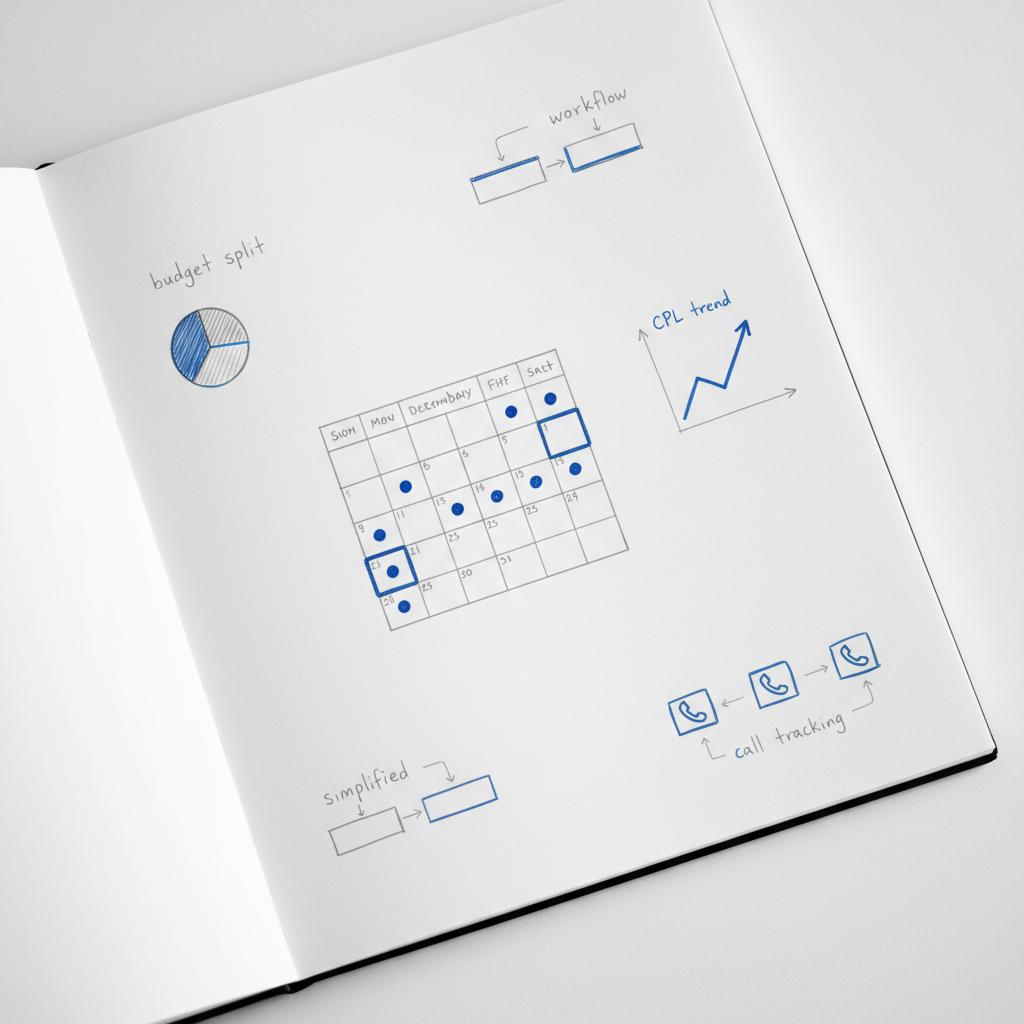
If you can’t measure, you can’t decide. Use simple methods scaled to your business: – Distinct phone numbers for different campaigns. – UTM parameters or unique landing pages per channel. – Promo codes printed on offline materials. – Staff scripts asking “How did you hear about us?” A small, consistent logo helps with brand recall.
Most importantly, connect leads to revenue. Track not just CPL but what proportion of those leads become paying customers and how much they spend.
Calculate customer lifetime value (CLV) — the math that makes CPL meaningful
Use this simple CLV formula to decide if your CPL is acceptable:
CLV = average purchase value × average number of purchases per customer × average customer lifespan (in years)
Then compute estimated acquisition cost per paying customer:
Effective acquisition cost = CPL × number of leads needed to win one customer
Compare CLV to acquisition cost and to gross margin. If acquisition cost is less than CLV and leaves a margin for profit, your campaign is worth scaling.
Budget allocation and scaling
Start by spreading a modest budget across search, social, and local listings for your micro-tests. After 30 days, move budget to the one that produces leads at an acceptable cost relative to margins and CLV.
Scale incrementally. Doubling spend overnight often brings diminishing returns and lower-quality leads. Increase budgets gradually and keep tracking for changes in CPL and lead quality.
Common mistakes small businesses make
1. Treating clicks as the goal. A click is not revenue; a booked appointment is. Track outcomes, not vanity metrics.
2. Testing too many variables at once. If you change ad creative, landing page, and audience at the same time, you won’t know what caused any change.
3. Ignoring local nuance. Benchmarks in national reports hide big differences from town to town. Your local market data matters more than a national average.
Case study: Maria’s salon
Maria had tight cash and big hopes. She listed in a national guide, ran a small Facebook ad, and kept her Google Business Profile lightly updated. After three weeks she had no appointments from the national listing, a little traffic from Facebook, and two bookings from GBP. She stopped the national listing, invested time into updating GBP photos and posts, and ran small search ads for terms like “hair coloring near me.” Within two months Maria had a steady stream of bookings and returning clients. Her lesson: match channel to local intent, test, measure, and stop what doesn’t work.
Practical checklists you can use today
30‑day testing checklist
– Define your lead and KPI.
– Set conservative daily budgets.
– Create one landing page or use clear tracking per channel.
– Use distinct phone numbers or promo codes.
– Run one variable change at a time.
– Review weekly and decide after several dozen conversions.
Tracking setup checklist
– Add UTM parameters to ad links.
– Use unique phone numbers for each campaign.
– Configure conversion tracking in Google Ads and Facebook Ads.
– Record lead outcomes in a simple spreadsheet: source → lead → conversion → revenue.
When to hire an agency
Do it yourself if you enjoy running tests and you have time to learn. Hire an agency if you need faster technical setup, stronger creative, or a partner to run disciplined tests while you keep the business running.
Many agencies over-promise. Choose a partner that understands small budgets, staged tests, and clear KPIs. A good agency will tell you what to test first, set up tracking, run the campaign, and give transparent reporting you can act on. See examples in Agency Visible’s project portfolio to judge fit.
How to judge a channel’s success
Always tie success to business outcomes: leads → sales → margin. A channel that produces lots of cheap leads but zero paying customers is not a win. A channel that produces fewer leads but a high conversion rate may be the best place to advertise my small business.
Scaling a winning channel
Once you find a channel that produces leads at acceptable CPL and quality, move budget slowly. Watch lead quality and conversion rate as spend increases. If conversion drops, test whether creative, audience, or landing page needs updating rather than blindly increasing budget.
Final practical tips
– Keep a weekly review cadence in the first month.
– Don’t kill a test after a single bad day.
– Use small budgets to learn quickly without risking cash.
– Focus on customer value, not just clicks.
Summary checklist: quick decisions to get started
– If people search when they buy: start with search and GBP.
– If people discover visually: start with social and content.
– If you need foot traffic: prioritize GBP, local listings, and community outreach.
– If you’re unsure: run a 30‑day micro-test and measure CPL against CLV.
Next steps you can take this afternoon
– Find your average purchase value and estimate CLV.
– Choose one channel and run a 30‑day test with a $10–$30 daily budget.
– Set up simple tracking (UTMs + phone numbers) and review weekly.

Need a fast, measurable start? Talk with Agency Visible.
If you’d like help designing a test that fits your budget and your market, talk to Agency Visible — they specialize in short, measurable experiments for small businesses and can help you turn early signals into clear next steps.
Frequently asked questions
Q: Where should I advertise a small business on a budget?
A: Start with local digital channels that match buying intent: Google Business Profile and search ads for immediate leads; low-budget social ads for awareness and list building. Complement with directories your customers use, run micro-tests, and scale what produces paying customers.
Q: How long should I test a channel before deciding?
A: A 1–3 week micro-test can give a directional read, but 30 days is better for stable signals. Look for several dozen conversions where possible; if volume is low, extend the test rather than rushing a decision.
Q: How do I know if a CPL is acceptable?
A: Work backward from CLV and margins. Multiply the CPL by the number of leads needed to win a customer, then compare to the customer value. If acquisition cost leaves enough margin for profit and growth, it’s acceptable.
Closing thought
There is no universal single answer to where to advertise. Match channels to intent, test with discipline, and measure value – not just clicks. Over time, your best place to advertise my small business will be the channels that consistently turn tracked leads into profitable customers. Good luck, and have fun learning what works in your market.
Start with local digital channels that match buying intent: optimize Google Business Profile, run small search ads for immediate leads, and use low‑budget social ads for awareness and email capture. Complement with niche directories your customers use, run a 30‑day micro‑test, and scale what produces paying customers.
Run a 1–3 week micro‑test for quick, directional feedback, but plan for a 30‑day test to get more stable signals. If you can, wait for several dozen conversions before drawing firm conclusions; if volume is low, extend the test rather than making a hasty change.
Calculate customer lifetime value (CLV) first: average purchase value × average number of purchases × customer lifespan. Multiply CPL by the number of leads you need to win a customer to get your effective acquisition cost. If acquisition cost is comfortably below CLV and leaves margin for profit, the CPL is acceptable.
References
- https://agencyvisible.com/contact/
- https://executiveeducation.wharton.upenn.edu/thought-leadership/wharton-online-insights/which-social-media-platforms-should-i-use-for-my-business/
- https://blog.hubspot.com/marketing/marketing-channels
- https://www.sproutmedialab.com/top-7-digital-marketing-strategies-for-local-small-businesses-in-2025/
- https://agencyvisible.com/projects/
- https://agencyvisible.com/





