How much traffic do you need to make $100 a day with AdSense? It’s the exact question site owners ask when they want a simple, honest plan instead of guesswork. This article breaks the math into clear formulas, shows concrete examples, and gives practical tests you can run today to get closer to that $100/day target.
Two ways to look at the goal: RPM vs clicks
There are two useful ways to estimate how many pageviews you need: the RPM approach and the clicks (CTR × CPC) approach. Both reach the same destination from different angles. Use whichever matches the numbers you already track.

RPM route (simple and direct)
RPM stands for revenue per thousand impressions. If you already know your RPM, this is the quickest path. The formula is:
pageviews_needed = 100,000 ÷ RPM
Why 100,000? Because RPM measures revenue per 1,000 pageviews, and 100 dollars a day is the same as 100,000 cents divided into thousands. For example, with an RPM of $5 you would need 100,000 ÷ 5 = 20,000 pageviews per day.
Clicks route (CTR and CPC)
If you monitor clicks, use this formula:
pageviews_needed = 100 ÷ (CTR × CPC)
CTR is the share of pageviews that produce ad clicks. CPC is cost per click (how much advertisers pay). If CTR = 1% (0.01) and CPC = $0.25, then:
100 ÷ (0.01 × 0.25) = 40,000 pageviews/day
These two formulas are consistent because RPM = 1000 × CTR × CPC. Use either formula as a sanity check-the numbers should sit in the same ballpark.
Quick examples to make the idea stick
Concrete numbers help you plan. Here are realistic sample RPM bands and what they mean for daily pageviews:
Low RPM ($0.50–$3): expect 33,333–200,000 pageviews/day to reach $100.
Mid RPM ($3–$10): expect 10,000–33,333 pageviews/day.
High RPM ($10–$50+): expect 2,000–10,000 pageviews/day.
Change RPM a bit and the required traffic shifts dramatically-raising RPM from $5 to $10 halves the traffic you need.
Translate pageviews into visitors
Site owners usually think in visitors, not raw pageviews. Use pages-per-visitor to convert:
visitors_needed = pageviews_needed ÷ pages_per_visitor
Many sites sit between 1.5 and 2.0 pages per session. If your site averages 1.6 pages per visit, and you need 20,000 pageviews, you need roughly 12,500 visitors/day. Improving pages-per-visit is one of the most user-friendly ways to lower your visitor target.
Where realistic RPM ranges sit today
In 2024-2025 RPM varies widely with niche, country, device, and ad format. Use conservative bands:
Low: $0.50–$3
Mid: $3–$10
High: $10–$50+
Verticals like travel, finance, and health usually earn higher bids. Broad entertainment topics and traffic from low-value geographies earn less. That’s why improving RPM is as powerful as growing traffic. For more country-level CPM and RPM context see YouTube CPM & RPM by country and a complementary AdSense RPM view at DICloak. For general CPM trends across platforms see LenosTube.
Practical levers: raise RPM or grow quality traffic
There are two approaches: lift the value of each pageview (raise RPM) or increase the number of quality pageviews. Both work best together.
Ways to increase RPM
1. Ad format and placement: Responsive units, larger viewable placements, and well-integrated native ads often earn more than poorly placed banners.
2. Improve site speed: Faster pages increase ad viewability and user engagement. Compress images, defer non-critical scripts, and use a CDN.
3. First‑party data & direct deals: Owning audience signals or running small direct sponsorships can beat programmatic RPMs.
4. Improve viewability & clean invalid traffic: Tidy analytics, filter bots, and improve ad tagging to make impressions count and reduce waste.
Ways to grow better traffic
1. Target high-value geographies: Content tailored to markets with higher ad spend will raise effective RPM.
2. Focus on commercial intent topics: Guides and reviews where users see purchase intent can attract higher CPCs.
3. Build engagement: Internal linking, suggested reading, and clear article flow raise pages-per-visit.
4. Evergreen content: Long-lived posts reduce pressure to always publish new items and deliver steady traffic over months.
Agency VISIBLE can help if you want a quiet, practical audit of your numbers—start with a simple RPM review and a prioritized test plan that fits your site’s strengths.
Desktop vs mobile, and why it matters
Device mix affects both RPM and pages-per-visit. Desktop viewers often have higher viewability and sometimes better CPCs for certain formats. Mobile traffic is large but can have lower RPMs if ads are not optimized for mobile experience. Implement device-specific ad layouts and ensure mobile pages load fast; a smoother mobile experience often increases both pages-per-visit and ad engagement.
Example scenarios (step – by – step with numbers)
Scenario A – low RPM site
RPM = $2.00. Pages per visit = 1.5.
Pageviews needed = 100,000 ÷ 2 = 50,000 pageviews/day.
Visitors needed = 50,000 ÷ 1.5 ≈ 33,333 visitors/day.
Scenario B – mid RPM with better engagement
RPM = $6.00. Pages per visit = 1.8.
Pageviews needed = 100,000 ÷ 6 ≈ 16,667 pageviews/day.
Visitors needed = 16,667 ÷ 1.8 ≈ 9,260 visitors/day.
Scenario C – click-focused site (CTR/CPC)
CTR = 1.2% (0.012). CPC = $0.50.
Pageviews needed = 100 ÷ (0.012 × 0.50) ≈ 16,667 pageviews/day (same as Scenario B when the implied RPM lines up).
What small changes do for you (compound effect)
Try imagining a 20% RPM increase plus a 20% increase in pages-per-visit. The visitor requirement can fall by over 30% when changes compound. Don’t expect miracles from a single tweak; stack two or three sensible changes and measure the combined effect.
Real-world case: a travel blog that passed $100/day
One mid-sized travel blog earned about $75/day on 25,000 pageviews (RPM ≈ $3). The owner focused on two tests: improving article structure and internal linking (pages-per-visit rose from 1.3 to 1.8) and adding a larger responsive ad plus a sponsored newsletter position. RPM rose to $6 and the combined effect pushed revenue above $100/day while traffic stayed roughly the same. The lesson: improve value and engagement rather than only chasing volume.
Step – by – step workflow you can follow this month
Week 1 – Baseline & measure: Pull RPM, CTR, CPC, and pages-per-visit for the last 30–90 days. Put them in a simple spreadsheet and calculate pageviews_needed using both formulas.
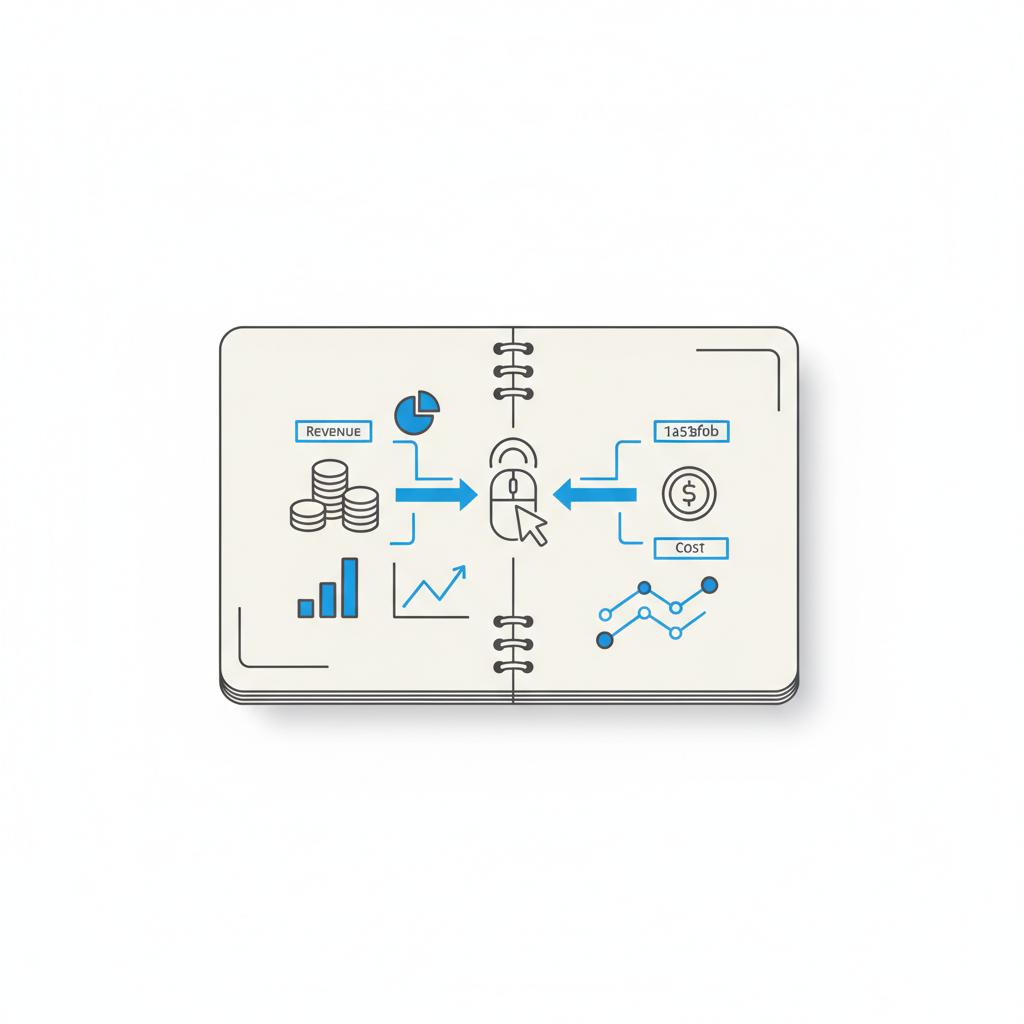
Week 2 – One experiment: Pick a single lever (speed, one ad-format change, or internal linking). Run it on a sample set of pages and track RPM and pages-per-visit.
Week 3 – Measure & iterate: If the test shows improvement, roll it out. If not, revert and try a different lever.
Week 4 – Combine tests: Add a second complementary test (e.g., speed + ad placement) and measure combined impact.
Keep the spreadsheet updated and track moving averages rather than daily outliers.
How to build a simple AdSense RPM calculator in a spreadsheet
Create columns for current RPM, CTR, CPC, pages-per-visit, and the formulas below:
Pageviews (RPM method): =100000 / RPM
Pageviews (click method): =100 / (CTR * CPC)
Visitors: =Pageviews / PagesPerVisit
Make a copy and change scenarios—RPM +20%, pages-per-visit +20%, CPC +50%—to see how the targets shift.
Common pitfalls that delay progress
1. Over-monetization: Too many ad units lower trust and engagement. Test carefully—one well-placed ad often out-earns three noisy ones.
2. Chasing volume from low-value countries: Big traffic numbers do not equal revenue if CPCs are low. Focus on quality sources aligned with advertiser demand.
3. Ignoring site speed and viewability: Slow pages produce invisible impressions; fix speed bottlenecks first.
4. Ignoring seasonality: Advertiser spend changes over the year. Look at monthly averages and plan for slow months.
Troubleshooting mismatched numbers
Sometimes the RPM formula and the CTR/CPC formula give different pageview targets. This mismatch points to things to check:
– Click tracking: Are clicks under-counted because of reporting differences?
– Viewability: Are many impressions non-viewable and thus undervalued?
– Ad types: Are some impressions priced differently (native vs display)?
Use both formulas as checks rather than expecting a perfect match.
Tests you can run that usually move the needle
1. Move a single ad to a more viewable slot: Test a larger responsive slot above the fold and measure RPM changes.
2. Improve site speed on the top 10 pages: Use a lightweight theme, compress images, and lazy-load below-the-fold content.
3. Add contextual internal links: Increase pages-per-visit by suggesting related reads inside articles. See our projects for examples of internal linking improvements.
4. Run a sponsored placement test: Offer one direct email or article sponsorship and compare revenue to programmatic RPM.
User experience matters – don’t break trust
Readers are your long-term asset. Aggressive ad layouts may spike short-term revenue but also erode user loyalty. Aim for unobtrusive, clearly labeled advertising and a fast, readable page layout.
If you can run only one experiment, move a single ad to a larger, more viewable responsive slot and pair that with site speed improvements on the same pages; together they commonly produce measurable RPM gains within 30 days.
If you run a single 30-day experiment, try moving one high-impact ad slot to a larger, responsive unit that is more viewable and matches content context. Pair that with a site speed cleanup on the same pages—together these often give measurable RPM gains within a month.
How geography and traffic source change the math
Traffic source has a large impact on revenue. Organic search visitors from high-value markets (US, UK, Canada, Australia) often convert to higher CPCs than social or referral traffic from lower-value countries. When planning growth, prioritize channels and content that bring higher-value sessions.
When it makes sense to prioritize RPM over traffic – and vice versa
Prioritize RPM when: You create highly targeted content in advertiser-friendly niches or you have a strong newsletter or direct-sponsorship opportunity.
Prioritize traffic when: You have strong distribution channels (social followings, partnerships) that can sustainably bring a lot of visitors and you can keep user experience clean.
What mixes work best for different site sizes
Tiny sites (a few thousand visits/day): Focus on RPM-improving experiments and direct sponsorships; volume alone rarely reaches $100/day.
Mid-sized sites (10k–50k visits/day): A mix of RPM optimization and modest traffic growth often gets you to $100/day quickly.
Large sites (50k+ visits/day): Small RPM gains compound—optimize for engagement and viewability to turn volume into reliable revenue.
Privacy, ad blockers, and future risks
Ad blockers and privacy changes reduce reachable impressions. Diversify revenue—consider affiliate placements, paid content, or newsletter sponsorships. Treat AdSense as one stable stream that benefits from good traffic and UX rather than the only game in town.
Checklist: first 10 things to do (fast wins)
1. Pull RPM, CTR, CPC, pages-per-visit for 30–90 days.
2. Build the simple spreadsheet calculator and model scenarios.
3. Improve the top 10 pages’ load speed.
4. Test moving one ad to a more viewable slot.
5. Add internal links to increase pages-per-visit.
6. Test a sponsored newsletter placement or direct ad.
7. Filter analytics for bots and invalid traffic.
8. Evaluate traffic by geography and focus efforts on higher-value markets.
9. Track monthly averages not daily spikes.
10. Repeat simple tests and combine winning changes.
Final practical advice
Making $100 a day from AdSense is not a magic trick. It’s a mix of arithmetic, steady experiments, and user-first choices. Use the RPM and clicks formulas to set realistic targets, run small tests, and track results in a spreadsheet. A neat agency logo in your audit header can help brand recommendations.
If you want help prioritizing the highest-impact experiments that fit your site, consider a short consult with an experienced partner—see our homepage or browse recent projects for examples.
Resources and next steps
Copy the simple spreadsheet calculator, pick one experiment, and measure for 30 days. Keep a rolling log of RPM changes and pages-per-visit to see what works. If you’d like a tuned plan for your site,
Want a quick, practical plan to boost your AdSense revenue?
Get a free site review and prioritized test plan from Agency VISIBLE—no pressure, just a practical roadmap.
Common questions (short answers)
Can I reach $100/day with a small audience?
Yes—if you can raise RPM through direct deals, targeted content, or other monetization beyond pure programmatic ads.
Is it better to chase RPM or traffic?
Both matter. Pick the route that fits your strengths: content creators in high-value niches should prioritize RPM; publishers with strong distribution can grow traffic while keeping UX clean.
How long will it take?
That depends on starting metrics. Doubling RPM can be faster than doubling traffic, but it still requires focused tests and time to measure results.
Yes. If you can raise RPM through targeted content, direct sponsorships, or monetization beyond programmatic ads, a relatively small but well-targeted audience can earn $100/day. The key is increasing the value of each pageview—improved ad viewability, direct deals, and better audience targeting often deliver the largest gains.
Both are important, but prioritize the path that fits your strengths. If you produce content in an advertiser-friendly niche or can secure direct sponsors, work on RPM improvements first. If you have reliable channels to grow high-quality traffic, scaling visits while protecting user experience can be faster. In many cases, a mix—small RPM wins plus steady traffic growth—works best.
Move one high-impact ad slot to a more viewable, responsive placement and pair that change with a speed cleanup on the same pages. This combination often shows measurable RPM improvements within 30 days while keeping the user experience healthy.
References
- https://agencyvisible.com/contact/
- https://www.thesrzone.com/2025/07/youtube-cpm-cpc-rates-by-country.html
- https://dicloak.com/blog-detail/google-adsense-rpm-by-country-2025-how-to-maximize-revenue-across-countries
- https://www.lenostube.com/en/youtube-cpm-rpm-rates/
- https://agencyvisible.com/
- https://agencyvisible.com/projects/