What is the cheapest way to advertise on TV? – A quick reality check
What is the cheapest way to advertise on TV? If you’ve asked that question, you’re not alone. TV still carries weight, and many small businesses want the credibility and reach it provides without overspending. The real answer depends on your goals and market, but this guide lays out the practical, lowest-cost routes – what they cost, how to run tests, and how to measure results.
Why this matters now
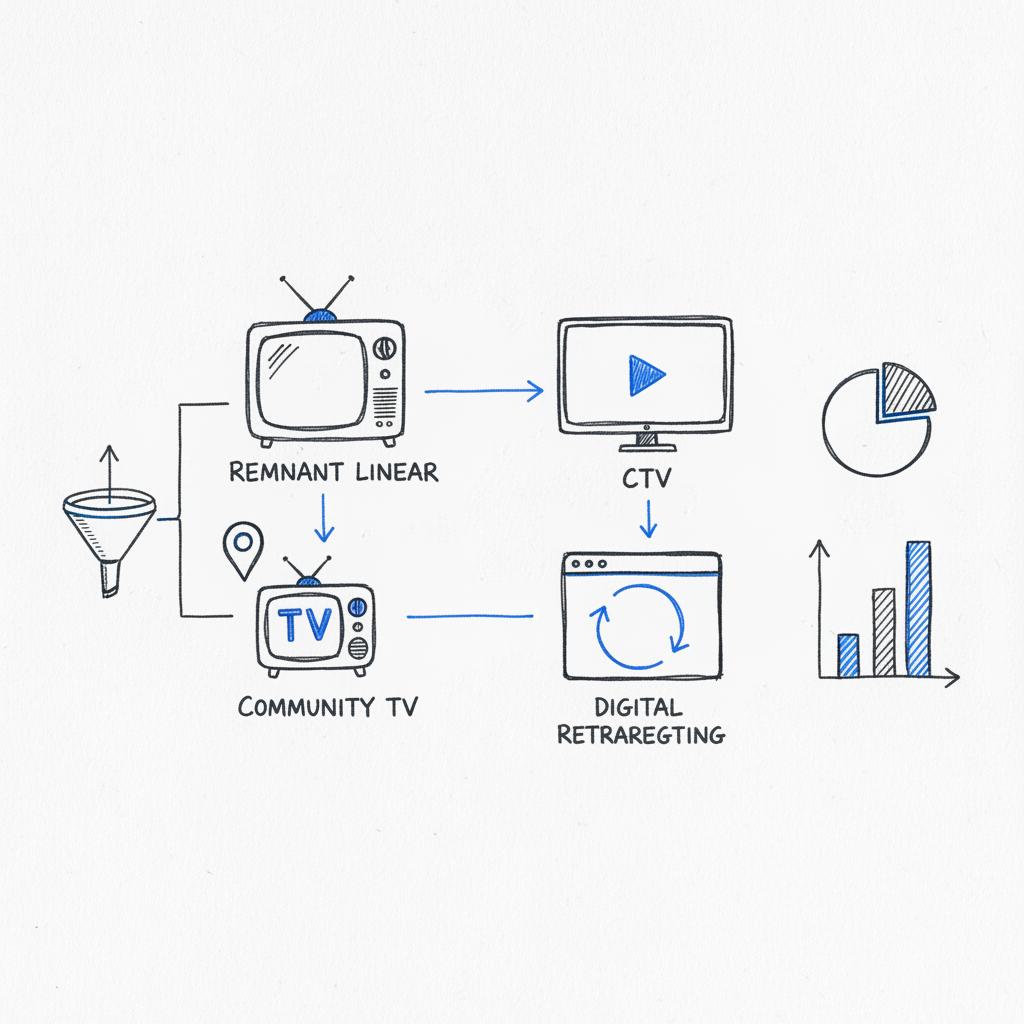
Television isn’t a single channel anymore. Between classic linear stations, local cable, community TV and the streaming era’s connected TV (CTV), there are multiple paths to visibility. That variety is good news for small advertisers because it creates options. If you’re wondering what is the cheapest way to advertise on TV, the short answer is: remnant and off-peak linear buys for raw CPM; programmatic CTV for measurable response. We’ll explain both, plus how to make them affordable.
Tip: If you want guided help setting up a low-cost local test, consider Agency Visible’s practical support for local buys and small-scale campaigns – explore Agency Visible’s local TV buying help.
How to think about “cheapest” (value vs. price)
Cheap isn’t just about the lowest dollar amount. The cheapest way to advertise on TV is the one that costs the least while still delivering measurable value for your goal. That means you must define whether you want broad awareness, foot traffic, or direct online conversions. Your choice changes which option is the true “cheapest.”

Four questions that determine the right cheap option
Ask yourself:
1. How much do I have to spend? Tiny budgets favor remnant local spots; slightly larger budgets can test programmatic CTV.
2. How wide is my desired reach? Neighborhood-level reach is cheap on community cable; DMA-wide reach pushes costs up.
3. How important is measurement? If tracking matters, programmatic CTV or tight digital pairing is usually better. For a practical primer on programmatic video, see this overview of programmatic video advertising.
4. Do I have reusable creative? Repurposed video or a 15-second cut keeps production costs down.
Real cost ranges you can plan around
To answer “what is the cheapest way to advertise on TV” with numbers, here are realistic ranges you’ll see in 2024 – 2025. Local 30-second spots: roughly $200 to $5,000 depending on market and daypart. Remnant/off-peak dayparts: CPMs can fall into the single digits to low double digits. Programmatic CTV CPMs: often higher, commonly in the tens of dollars depending on targeting granularity and inventory quality. Production: DIY or regional houses can produce a 30-second spot for roughly $500-$5,000.
Why remnant and off-peak are often cheapest
Remnant inventory is leftover airtime sold at a discount. That low price drives down the effective CPM and makes the remnant path the frequent winner on cost-per-impression. But remember: lower price can mean less control over exact placement and timing. For deeper reading on remnant and inventory types, consult industry guides like the CTV Advertising Guide.
For a practical CTV reference, the CTV Advertising Guide is a helpful resource.
Choosing between remnant linear and programmatic CTV
If you’re still asking what is the cheapest way to advertise on TV, decide whether you value raw CPM or measurable outcomes. Remnant buys will usually win on raw CPM; programmatic CTV will often win on measurable conversions. If your goal is local foot traffic, start with local remnant or community cable. If you want trackable online visits, test programmatic CTV.
When programmatic CTV is worth paying extra
Programmatic CTV gives precise geographic and audience targeting, frequency control and better reporting – so if your campaign must drive measurable online actions, it can be the more cost-efficient choice when you factor in conversion rates and lifetime value. For guidance on CTV cost factors and optimization, see this note on CTV advertising costs.
Step-by-step plan: run a low-cost TV test in six steps
Here’s a simple plan to test TV without blowing your budget. This structure answers the question what is the cheapest way to advertise on TV with practical action:
1) Set the goal (days 0-1)
Be specific: drive 200 website visits in two weeks; generate 100 morning walk-ins; or collect 50 coupon redemptions. Match measurement – promo code, unique landing page, or QR – to the goal.
2) Inventory creative (days 0-3)
Look for existing video, product clips, or social ads you can repurpose. Create a 30-second version and a 15-second cut. Simple is better: one offer, one CTA, clear visual of product or location.
3) Choose buy type (days 1-4)
For local foot traffic and the cheapest CPM, consider remnant/off-peak linear or community cable. For measurable online results, choose a small programmatic CTV buy aimed at your target households.
4) Plan tracking (days 1-4)
Set up a clean landing page, add UTM tags, use a unique promo code and measure baseline traffic for at least a week before the test.
5) Run a short campaign (2-4 weeks)
Don’t spread a tiny budget across months. Concentrate your spend for frequency – two to four weeks is a sensible burst.
6) Measure and iterate (after two weeks)
Compare cost per desired action (store visit, conversion, coupon redemption) and decide whether to scale, switch channels or tweak creative.
Production shortcuts that keep costs low
Production is part of total cost. Here are ways to keep it affordable without making ads look cheap.
DIY and repurposed video
Use existing product videos, social posts, or a simple phone shoot with a tripod and lavalier mic. Clean audio and steady framing go further than cinematic lighting.
Template edits and short cuts
Make one solid 30-second version and cut clean 15-second and 6-second edits for different placements. Use simple on-screen text for the website or promo code so it’s readable on TV.
Work with local production houses
Regional teams often deliver professional results at a fraction of big-studio prices. Ask for a tightly scoped deliverable: one day of shooting, two edits, and a 15s / 30s / 6s cut. See examples of local work in our projects showcase for typical scopes and outcomes.
Scripts you can use today
Practical scripts reduce decision friction. Here are two starter scripts you can adapt: one for a 30-second local awareness spot and one for a 15-second direct response ad.
30-second local awareness script (template)
Visual: Exterior of shop, logo, smiling staff, product close-up.
Voiceover: “Wake up, [City]! Fresh pastries at Sunny Bakery—hot from 6AM. Show this code SUNNY10 for 10% off your morning coffee. Sunny Bakery—on Main Street, two blocks from the market. Visit yoursite.com or scan the QR.”
15-second direct response script (template)
Visual: Product close-up and single bold offer.
Voiceover/Text: “Limited: 20% off your first order at [Store]. Go to yoursite.com/offer or use code TV20. Offer ends soon!”
How to buy remnant, step by step
Remnant inventory can be the cheapest route. Here’s how to source it:
1. Call the local station’s sales desk and ask for remnant or off-peak inventory.
2. Ask for daypart availability and recent CPMs.
3. Be ready to move fast – the slot may be sold on short notice.
4. Negotiate a small package with guaranteed impressions if possible.
5. Use a simple tracking element – a coupon code, QR, or vanity number – to measure impact.
Negotiation language that works
Use direct, friendly phrasing. Stations like quick, clear asks. Try lines like:
“I have a $1,500 test budget. Can you show remnant morning packages or off-peak bundles that fit this amount? I can be flexible on start date and can run for a two-week burst.”
Ask about added value, such as bonus spots or a low-cost flight extension, and always request a schedule and an invoice that shows actual spots run.
Programmatic CTV: practical setup for small budgets
Programmatic CTV is increasingly accessible for small advertisers. To test CTV on a budget:
– Use a demand-side platform (DSP) or a managed partner that allows small minimum buys.
– Target narrowly to keep CPMs efficient: a single city or zip cluster.
– Keep creative short and living-room friendly – clear audio, strong visuals and an immediate CTA.
– Pair the CTV buy with a retargeting plan on social or search to catch viewers who visited your landing page.
Measurement: what to track and how
Decide metrics before you spend. Useful KPIs include:
– Reach and frequency (how many households saw the ad and how often).
– Website visits and unique landing page traffic.
– Promo code redemptions (for in-store or online).
– Cost per desired action (CPA): cost per store visit, sign-up or sale.
Measurement tactics by buy type
Linear remnant: Use unique promo codes, QR codes, or short survey questions at checkout. Track web traffic lifts using a baseline week. If possible, use local foot-traffic analytics for physical stores.
Programmatic CTV: Use platform reporting for impressions and third-party tracking for landing pages. Configure UTM parameters and pixel-based tracking where allowed.
A two-week sample test budget (realistic examples)
Sample A – Neighborhood bakery, $1,500 total
– Production (DIY edit): $400
– Remnant morning dayparts (local station): $1,100
– Tracking: QR + unique code (free)
Outcome to expect: spike in morning foot traffic, measurable coupon redemptions.
Sample B – Online retailer, $3,000 total
– Production (regional editor): $800
– Programmatic CTV buy (targeted city): $2,000
– Retargeting social ads: $200
Outcome to expect: measurable site visits and direct conversions; higher CPM but better attribution.
Common mistakes that waste budget
Don’t make these errors:
– Buying a single spot with no follow-up. TV needs frequency.
– Spending on glossy creative without a measurement plan.
– Ignoring negotiation – local reps often have flexibility.
– Spreading a tiny budget across months – concentrate spend for frequency.
Advanced: mixing channels to lower overall CPA
Pair a short TV burst with low-cost digital tactics: a QR code in the TV spot that links to a simple landing page, a short promo code that’s redeemable online, and quick retargeting on social platforms. The combined visibility often lowers cost per conversion compared to TV alone.
Case studies you can model
Small bakery (local awareness): a $1,500 two-week remnant buy produced a clear morning uplift with dozens of coupon redemptions. Cost per new morning customer matched a month of paid search, plus added local awareness.
Online retailer (direct response): a $3,000 programmatic CTV test targeted a city and retargeted with social ads. Higher CPMs were offset by traceable conversions and a repeat-purchase lift from retargeting.
Checklist before you hit “buy”
– Goal set and measurable.
– Creative: 30s and 15s cut ready.
– Tracking: landing page with UTMs or unique code.
– Budget: clear split between production and media.
– Timing: two- four week burst planned.
– Reporting: baseline traffic captured for comparison.
Negotiation sample email
“Hi [Rep],
I’m running a two-week test for a local business with a $1,500 budget. Can you share remnant or off-peak packages in the morning or early afternoon that would fit that spend? We’re flexible on start date and can provide creative within 48 hours. Thanks – looking forward to a quick package and schedule.”
Common FAQs (short answers)
What CPM should I expect for remnant airtime? Typically single digits to low double digits, depending on market and daypart.
How much does a 30-second spot cost in local markets? Roughly $200 to $5,000 depending on market and time-of-day.
Can I make a TV ad on a small budget? Yes. DIY and regional production houses can produce a spot for roughly $500-$5,000.
Small mistakes that have big impact
Leaving essential text unreadable on TV screens, not testing the landing page on mobile, or using a long, hard-to-type URL are common small errors that undermine TV effectiveness. Make it ridiculously easy for someone to act after they see your ad.
Pair a remnant spot with a QR-to-offer and a tiny retargeting budget. TV builds awareness; the QR and retargeting capture intent and lower cost per conversion.
Answer: Pair a remnant spot with a short, trackable digital follow-up like a QR-to-offer and a tiny retargeting budget. The TV drives awareness; the QR and retargeting catch intent and lower cost per conversion.
If negotiation, tracking setup or creative edits are outside your comfort zone, a small specialist or agency consult can be a smart investment. Agency Visible, for example, focuses on quick, measurable tests that preserve budget – helping small businesses buy the right inventory and set up tracking properly. Keep an eye out for the Agency Visible logo when seeking a quick local consult.
Three final practical tips
1) Test short bursts, not slow leaks. 2) Make the offer immediate and trackable. 3) Reuse creative across channels to spread production cost.

Closing thought
TV can be affordable when you plan for measurement and choose the right inventory. Whether the cheapest way to advertise on TV is remnant linear or a targeted programmatic CTV buy depends on your goal – choose the path that gives the best cost per outcome.
Next steps
Ready to plan a short, low-cost TV test?
Start a low-cost TV test that delivers measurable results
Let’s build a two-week test that fits your budget – get a free consultation and a clear plan from the team who helps local businesses run smart TV tests: start your test with Agency Visible.
Remnant and off-peak dayparts often push effective CPMs into the single digits or low double digits, though exact numbers vary by market and daypart.
Yes. By using DIY shoots, repurposed video or regional production houses, a 30-second spot can often be produced for roughly $500–$5,000.
For immediate local foot traffic and the lowest raw CPM, remnant or community TV is usually better; if you need measurable online conversions, programmatic CTV is preferable.
References
- https://agencyvisible.com/contact/
- https://www.strategus.com/blog/what-is-programmatic-video-advertising-and-how-does-it-work
- https://videoweek.com/wp-content/uploads/2023/09/CTV-Advertising-Guide-2024.pdf
- https://adsmanager.paramount.com/insights/ctv-advertising-cost
- https://agencyvisible.com/projects/
- https://agencyvisible.com/