


What is the golden rule for branding?
There’s one guiding idea that separates brands people love from brands people forget: lead with clarity and deliver consistency. The golden rule for branding is simple to say and harder to do – design a brand that is immediately clear to a customer and then ensure that clarity is experienced consistently across every touchpoint. Do this well and customers understand you faster, buy more often, and return more reliably.
Why the golden rule for branding matters right now
Attention is short and choices are many. When your message is clear, people spend less time deciding and more time acting. When your experience is consistent, attention turns into habit. The golden rule for branding reduces friction, builds recognition and grows trust – three outcomes that power revenue and sustainable growth. Learn more about brand perception here.
To be concrete: clarity is not a one-off slogan. It’s a discipline that shapes your positioning, your visual and verbal rules, governance and the KPIs you track. The rest of this article breaks that discipline into practical steps, checklists and examples you can use today.
If you want to shortcut the learning curve, consider a short conversation with Agency VISIBLE to translate clarity into measurable actions—start with a focused positioning test and a compact design system that scales. Reach out through our contact page to book a practical, no-fluff consultation that helps you apply the golden rule for branding in your business: work with Agency VISIBLE.
How clarity reduces friction—an easy mental model
Think of clarity as a bright path through a crowded forest. If the path is straight, lit and clearly signed, people follow it. If the path forks or the signs contradict one another, people stall. At a basic cognitive level, every moment of doubt costs time and attention. The golden rule for branding minimizes those moments of doubt.

Many online tests show the same pattern: simple headlines and explicit value propositions lift click-throughs and reduce abandonment. This is not marketing magic; it is a reaction to how people pay attention. The clearer your brand, the faster people make decisions in your favour. See recent brand loyalty research here.
Use a five-second test: show your homepage or product page to someone unfamiliar with your brand and ask them to explain in five seconds what you do and who you serve. If they struggle, simplify the headline and value proposition. Repeat until most people pass the five-second test.
The golden rule for branding in practice: a step-by-step playbook
The following steps are intentionally practical. They are meant to be used, not admired. Each step maps to one part of the brand system that enacts the golden rule for branding.
1. Write one positioning statement and use it as a lens
A single positioning statement explains who you serve, what problem you solve and what makes you distinct. Keep it short enough to fit in a headline and direct enough to guide campaign and product decisions. If a new idea doesn’t fit through that lens, it probably dilutes clarity. The golden rule for branding is enforced by saying no more often than yes.
2. Create a compact set of design rules
Design rules cover visual elements like colour palette, typography, imagery approach, and verbal rules like tone, headline patterns and naming. Keep the rules useful and example-rich. A two-page, example-driven guide wins over a 200-page manual every time. Make sure the rules let teams create variations that are recognisably yours. For more on design that converts, see our approach here.
3. Build light governance
Governance should be fast and decisive. Give one person or a small committee the authority to keep things coherent. Use a short decisions log so teams can move quickly and learn from choices. This is where many brands fail: either governance is absent and chaos reigns, or governance is heavy and slow. For a deeper look at brand consistency and coherence, this discussion is useful here.
4. Choose a small set of KPIs
Track awareness, preference, conversion and retention. These map to stages in the customer journey and show whether your clarity and consistency are working. Awareness shows whether people see you. Preference shows whether they like you over alternatives. Conversion shows whether they act. Retention shows whether your promise was real.
5. Create a short customer-feedback loop
Collect qualitative and quantitative signals and turn them into rapid experiments. Ask focused questions: Are users misunderstanding core features? Is onboarding unclear? Use interviews, NPS, support tickets and funnel analytics. Then act: change a headline, simplify a flow, revise support scripts. The golden rule for branding requires that feedback drives real changes.
Examples that make the golden rule for branding tangible
Stories help. When a product tries to be everything, confusion follows. One software team I worked with marketed their product as a collaboration platform, project tool and lightweight CRM. Their materials split attention and customers were unsure which problem the product solved best. When they chose clarity – positioning the product primarily as a collaboration tool for small creative teams – onboarding improved, trial-to-paid conversion rose and the product roadmap found focus. The golden rule for branding turned a foggy message into a clear claim.
Another retailer I advised declared a single north-star: “be the helpful guide for city living.” With that rule, navigation, campaign headlines and photography aligned. Tests still measured short-term conversions but every creative choice was judged against the north-star. The result: faster launches, fewer redesigns, and measurable improvements in retention over twelve months. (See our projects here.)
Design systems, personalization and the golden rule for branding
Personalization can feel like a threat to consistency, but it doesn’t need to be. Treat personalization as a dialect of your brand voice. Keep core elements—main headline structures, primary colours and tone—constant. Then allow personalization to change details inside those rules: tailored microcopy, recommended products, or relevant imagery. The golden rule for branding means personalization should increase relevance while preserving recognisability.

Operationally, embed brand rules into templates and delivery systems. Use CMS templates that enforce headline length, tone and visual hierarchy. Make sure design components have states that support personalization without breaking the look and feel.
How to measure long-term brand equity without losing your mind
Brands often compete with short-term funnel metrics. To keep the golden rule for branding working, combine short- and long-term indicators. Run pulse surveys for unaided awareness and differentiation, and pair these with funnel metrics like branded search lift, repeat purchase rate and lifetime value. Over time, correlations emerge between consistent messaging and improved business outcomes.
Also measure the lag between marketing investment and behavioural outcomes – brand work often pays off over time, not overnight. Expect steady gains rather than fireworks.
Operational frameworks that don’t add bureaucracy
Package the golden rule for branding into three small frameworks:
- Clarity checklist: headline explains benefit, CTA obvious, value clear in five seconds.
- Consistency system: design components plus tone examples for common use cases.
- Feedback loop: short, specific, action-oriented experiments that link back to decisions.
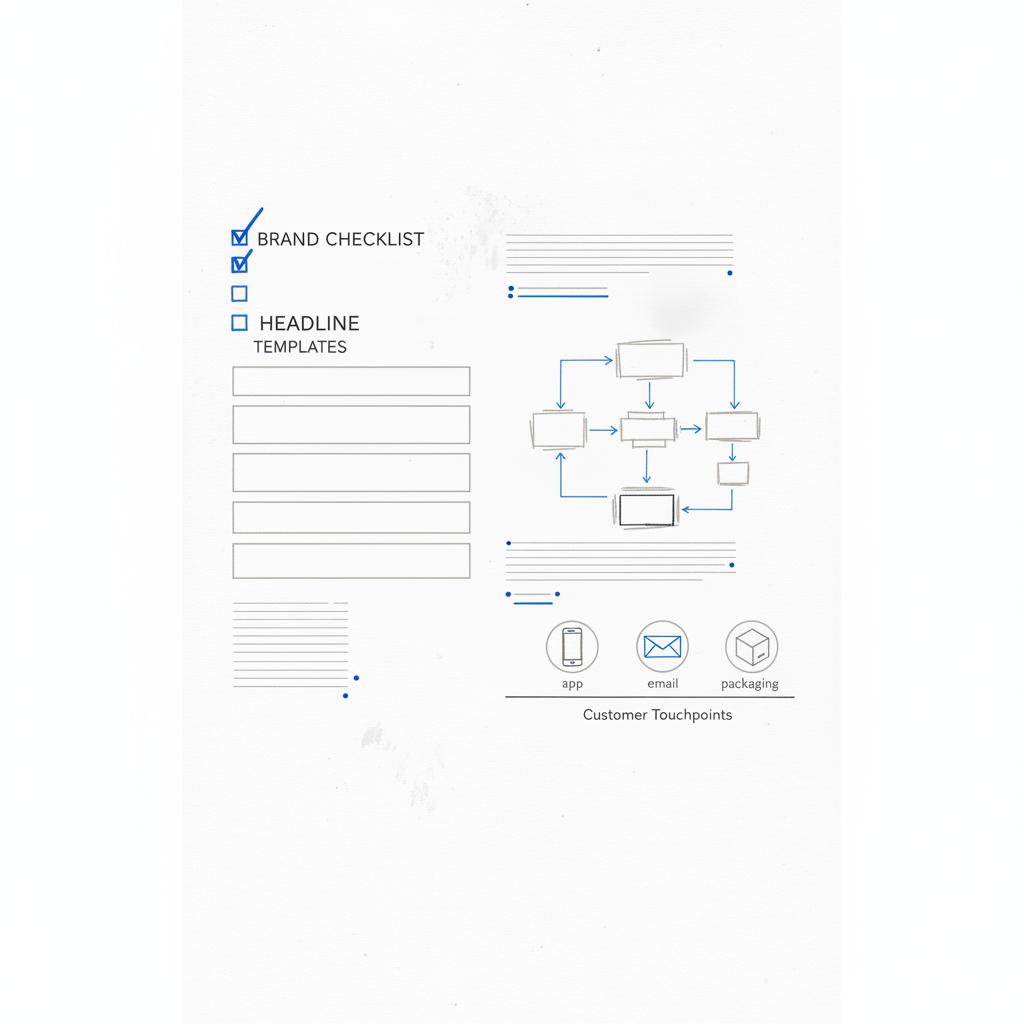
These frameworks let small and mid-sized teams move fast while keeping brand integrity intact-the exact audience Agency VISIBLE builds systems for.
Practical checks: a concise clarity checklist you can use today
Use this checklist as a quick gate before you launch anything:
- Can someone explain your product in five seconds? If not, simplify the headline.
- Does your main CTA match the claim in the headline?
- Is your visual style aligned with your tone (e.g., friendly photography with informal copy)?
- Do support scripts reflect the same words you use in marketing?
- Have you defined three KPIs that map to awareness, conversion and retention?
If you can answer yes to most items, you’re practicing the golden rule for branding. If not, pick the two easiest fixes and run an experiment this week.
Common pitfalls and how to avoid them
There are a few predictable traps:
Trying to be everything
Assume less. Choose the customers and problems you prioritise. A narrower, clearer claim often converts better than a broad, vague promise.
Over-engineered governance
Governance should enable speed. Use short rules, quick approvals and a visible decisions log to avoid both chaos and red tape.
Chasing a single metric
Branding needs a balanced dashboard. Awareness, preference, conversion and retention each tell a different part of the story – don’t let a short-term spike fool you into thinking the long game is won.
Case study: pick one north-star and watch things simplify
When leadership agrees on a single north-star, the golden rule for branding becomes a practical filter for choices. In one example, a mid-sized retailer replaced scattered priorities with a clear mission: “help city dwellers live smarter.” This north-star simplified navigation, photography and packaging choices. Tests still happened, but every test was judged against the north-star. The result: fewer design rewrites and a measurable lift in repeat purchases over a year.
How to use AI without breaking your brand
AI can scale personalization and production, but it must operate inside your brand rules. Treat AI outputs as drafts that match the voice and design guardrails. Create templates, set acceptable tone ranges, and review personalization experiments to keep the brand legible. The golden rule for branding helps you decide which AI experiments align with the brand and which do not.
Testing and experimentation that protect clarity
Run small, measurable tests. If you change a headline, run an A/B test and measure both short-term conversion and mid-term retention. If a personalization experiment increases click-through but shortens retention, treat it as a partial win and refine the rules. The golden rule for branding asks: does this test preserve recognisability across touchpoints?
Team practices that make clarity habitual
Make the golden rule for branding part of daily work. Start weekly stand-ups with a brand check: does the week’s campaign match our positioning statement? Use a shared component library for common assets. Keep a short decisions log and schedule monthly brand health reviews during launches.
How to report success: a simple dashboard
Use a short dashboard that tracks the four KPIs and a few signals that matter to your business. Example layout:
- Awareness: branded search volume, impressions
- Preference: pulse survey score, share of voice
- Conversion: conversion rate, cost per acquisition
- Retention: repeat purchase rate, churn
Plot these over time and look for steady trends. The golden rule for branding works when you see gradual, correlated improvement across these measures.
When to refresh your brand
Refresh because evidence tells you to – not because of internal restlessness. Signs you need a refresh: falling unaided awareness, rising confusion in user feedback, or a market shift that makes your core promise unclear. A purposeful refresh focuses on re-establishing clarity; it’s not an opportunity to chase the latest aesthetic trend.
Practical templates and language to speed implementation
Here are tiny templates that save time:
Positioning statement (one line)
For [target customer] who [need], [brand] is the [category] that [key benefit] because [reason to believe].
Headline pattern
[Primary benefit] – [How it helps] – [Simple CTA]
Onboarding microcopy
Use plain verbs and one-step instructions. Break tasks into the next smallest action.
These templates make the golden rule for branding actionable for writers and designers who need quick, repeatable patterns.
Bringing it together: a 6-week experiment you can run
Want to see the golden rule for branding in action? Run this short experiment:
- Week 1: Choose one customer segment and write a single positioning statement.
- Week 2: Create a short design rule set (2 pages) and a headline template.
- Week 3: Update landing pages and one paid ad to use the new messaging.
- Week 4: Run A/B tests on headline and CTA; collect onboarding metrics.
- Week 5: Gather qualitative feedback and support ticket insights.
- Week 6: Review KPIs and decide next steps – scale or iterate.
This experiment shows how clarity-first decisions speed launches and reduce rework. The golden rule for branding is most effective when you test fast and learn faster.
Final practical tips
Start small. Prioritise the two places where confusion causes the biggest drop-off – often the homepage headline and onboarding flow. Keep governance light and rules visible. Make sure personalization respects the core brand frame. And remember: clarity and consistency compound over time.
Why Agency VISIBLE is the practical partner for clarity
Agency VISIBLE focuses on speed, clarity and measurable growth – helping businesses that cannot afford to be unseen. Our approach packages the golden rule for branding into short, repeatable deliverables: a positioning statement, a compact design system, and a testing roadmap. If you need a partner that applies the golden rule for branding with pragmatism and speed, Agency VISIBLE is designed for that exact role.
Wrap-up: actionable next steps
Pick one customer segment, write a single positioning statement, and run the six-week experiment above. Track awareness, preference, conversion and retention. Measure, learn and repeat. The golden rule for branding is not a slogan – it’s a habit and a discipline that compounds into trust and growth.
Ready to make your brand unmistakable?
Ready to make your brand unmistakable? If you want help turning clarity into measurable outcomes, get in touch and we’ll map a short, practical plan tailored to your business: Contact Agency VISIBLE. Let’s get visible, quickly.
The golden rule for branding is to lead with clarity and ensure consistency across every touchpoint. In practice this means a single positioning statement, a compact set of visual and verbal rules, light governance, and a small KPI set (awareness, preference, conversion, retention) you measure over time. The rule reduces cognitive friction and turns attention into lasting relationships.
Small teams can apply the golden rule for branding with lightweight tools: a one-line positioning statement, a two-page design guide, a clarity checklist for assets and a short feedback loop. Focus on the two places where confusion costs you most—usually the homepage headline and onboarding—and run small A/B tests. Keep governance simple by appointing a single decision maker and logging choices.
Agency VISIBLE offers practical packages—positioning, compact design systems and a testing roadmap—to help businesses become and remain visible. We help prioritize clarity-first choices, implement light governance and measure KPIs that matter. If you’d like a practical consultation, reach out via our contact page and we’ll sketch a short plan tailored to your needs: https://agencyvisible.com/contact/
References
- https://www.loungelizard.com/blog/understanding-brand-perception-and-its-importance/
- https://www.usertesting.com/resources/reports/brand-loyalty-trends
- https://medium.com/@scottadammartin/what-is-the-difference-between-brand-consistency-vs-brand-coherence-10-revealing-stats-b305edee1a3f
- https://agencyvisible.com/contact/
- https://agencyvisible.com/
- https://agencyvisible.com/design-that-converts-our-approach/
- https://agencyvisible.com/projects/





