What are the 4 P’s of branding? A modern, practical guide
What are the 4 P’s of branding? At first glance the question calls up textbook shorthand: Product, Price, Place, Promotion. But in today’s market those four Ps are better read as brand signals—every cue that tells a customer who you are before they commit. This article takes that classic frame and shows how to use it to design consistent brand experiences, audit gaps, and measure progress.
From tactile decisions like packaging weight to big-picture choices about positioning and price tiers, the four Ps of branding shape moments where customers decide. Read on for a clear framework, a narrative-style audit checklist, examples you can adapt, and practical actions to take in the next 30 days.
If you want a practical partner to translate foundation into consistent signals across Product, Price, Place and Promotion, consider talking with Agency VISIBLE — a team that focuses on getting small and mid-sized businesses visible quickly and measurably.
Before we dive deeper, let’s get clear definitions so you can see the difference between the marketing mix and branding signals.

Defining the four Ps of branding
Product = identity in matter and experience: what the product communicates the moment a customer touches, sees or opens it. Price = a language that signals positioning and promise. Place = every touchpoint and scene where the customer meets your brand. Promotion = the storytelling architecture that connects messages across channels and time. Treating these as signals, not just levers, changes how you prioritize work.

Why the four Ps of branding matter now
People form impressions quickly. In omnichannel markets your product page, promo creative, checkout flow and packaging all combine to form a single impression. When those cues align, decisions happen faster and retention improves. When they don’t, customers hesitate, returns rise, and paid acquisition costs climb. See how broader consumer shifts play into this – consumer products leaders double down on the Four P’s.
Small, tactile or pricing cues often act as shorthand for larger promises: a heavier bottle can signal craft and care, and a clear mid-tier price can make your product look curated rather than mass-produced. Those small cues reduce cognitive dissonance across moments of truth and increase trust and conversion.
Product: thinking of product as identity and portfolio design
The product is often the most tangible expression of brand. When people ask what are the 4 P’s of branding, product is the one they most easily recognize: raw features, materials, colors, packaging and the experience of use. But to turn product into a strategic brand lever, ask: what does this item say about who we are before a customer reads a single line of copy?
Design choices—paper stock, bottle weight, button feel, default settings in an app—are all signals. A product that signals care and deliberateness makes a promise that the brand must keep elsewhere. Build a product manifesto for each core offering: one paragraph that says what the product promises, who it’s for, and what it should feel like on first contact.
Practical product moves
Make three product-signal decisions:
1) Choose a primary tactile or visual cue (e.g., weight, color, typography) and apply it across packaging and product pages.
2) Write a one-paragraph product manifesto for each SKU.
3) Evaluate portfolio fit: do these items tell one story together or many disconnected stories? Too many disparate product stories blur brand identity.
Price: more than numbers – pricing as brand language
Price does two things: it changes buyer behavior and it communicates. Answering what are the 4 P’s of branding means recognizing price as a positioning signal. A low price might communicate accessibility; a high price might communicate craft, scarcity, or expertise. Mixed signals—luxury imagery plus discount prices—create cognitive dissonance and lower conversion.
Pricing frameworks that reinforce brand
Use tiered pricing to make the brand accessible to newcomers while protecting premium perceptions. Offer a clear entry point, a recommended mid-tier, and an aspirational premium. Resist random discounts that undercut the story you’re trying to tell unless the discount itself is a deliberate signal (e.g., limited-time access for first-time buyers).
Place: every touchpoint is a stage
Place is no longer just physical distribution. When you ask what are the 4 P’s of branding, think about the scene where your brand plays out. Your website, checkout, social profile, marketplaces, packaging, emails, invoices and customer support answers are all places where your brand must be consistent.
Consider a small bakery: in-shop the lights and handwritten notes signal craft; in a grocer, plastic packaging and generic labels eroded that message. The lesson is simple: map the moments where customers meet your brand and ensure those places carry the same signals.
Checklist for place
Audit the customer journey: home page, product pages, checkout, packaging, email series, social bios, and partner listings. For each place, answer: does this place deliver the same brand promise as the flagship experience?
Promotion: storytelling that stitches the brand together
Promotion is the narrative glue. When people ask what are the 4 P’s of branding, promotion is the answer to “how do we tell this story and keep telling it?” Promotion is not only advertising spend — it’s the messaging architecture that connects your ad creative to your onboarding email to your product insert. For thoughts on the modern take, see introducing the modern 4 Ps of marketing.
Great promotion is less about spikes and more about a consistent throughline. Pick an organizing idea and repeat it across owned, earned and paid channels. Build a messaging hierarchy: the primary brand line, a supporting benefit, proof, and an action. That hierarchy should appear in campaigns, on product pages, and in customer service copy.
From foundations to tactical alignment: a practical four-step framework
To convert ideas into measurable work, use this four-step framework: define foundation, map moments of truth, choose KPIs, and audit for gaps. The framework is intentionally short so you can operationalize it quickly.
1) Define foundation
Create concise statements for purpose, positioning and promise. Purpose answers why the brand exists. Positioning maps where the brand lives in customers’ minds. Promise is the simple expectation you set. These three are the north star for every P.
2) Map moments of truth
Identify the few moments that shape decisions: sign-up, first use, first support interaction, unboxing. For each moment, map which of the four Ps carries the heaviest weight and what signal must be communicated.
3) Choose brand and performance KPIs
Pick a small set of measurable indicators. Brand KPIs: unaided recall, brand preference, net promoter score, and sentiment-based measures. Performance KPIs: conversion rate, average order value, retention, and repeat purchase rate. Track both to see how signal changes affect immediate behavior and long-term value.
4) Run a concise audit
Test each P across places and messages. Find friction and prioritize fixes by impact and frequency. A tidy audit produces quick wins and a roadmap for deeper work.
Brand audit checklist – a narrative walkthrough
Think of an audit as a customer story. Walk through the public-facing experience as if you were skeptical. Start with product: open the packaging, read the labels, and note the visual cues. Move to price: are prices and discount language consistent across channels? Then follow the journey through place: is the checkout smooth, is the mobile site optimized, do partner listings match your tone? Finally, review promotion: does the brand tell the same story in ads, social posts and email?
Wherever you spot mismatch, ask: how will customers react? Does this lower perceived value or cause confusion? Convert those observations into prioritized fixes.
Real examples and what they teach
Example 1 – apparel brand: strong product signals (sustainable fabrics and fit) but mixed pricing and diluted copy. Fix: consolidate pricing tiers, update product pages to reflect origin story, and ensure partner listings used approved imagery. Result: higher average order value and increased repeat purchases within months.
Example 2 – SaaS company: paid ads drove traffic but onboarding felt like another company. Fix: align onboarding copy to the ad narrative and clarify pricing tiers. Result: higher engagement and better ad conversion rates.
Measuring brand value and the ROI question
Measuring brand work can feel imprecise, but practical approaches exist. Link brand metrics to funnel behavior: if unaided recall rises and organic search and direct visits climb, you can attribute some acquisition to brand-building. Run controlled experiments where possible. Translate qualitative measures to financial proxies – e.g., improved NPS associated with longer customer lifetime historically can be modeled into future revenue.
Remember: paid campaigns provide scale to test messages quickly; organic brand work compounds and endures. Use paid channels to accelerate experiments and organic investments to sustain meaningful touchpoints.
Three tactical moves you can make this week
1) Pick your three moments of truth and align a quick script for each (product, price messaging, place, and a promo line).
2) Create a one-page brand rulebook: one paragraph product manifestos, a two-page tone guide, and explicit pricing principles.
3) Run a micro-audit of home page, checkout, product page and key partner listings. Fix the top two inconsistencies and measure lift.
Workshop outline: run a 90-minute team session
Use a short workshop to build alignment without months of meetings. Here’s a tight agenda:
0–10 min: Purpose, promise, and positioning recap.
10–30 min: Map the top three moments of truth.
30–60 min: Split into four groups; each group audits one of the four Ps across a short checklist.
60–80 min: Share findings and pick two quick wins per group.
80–90 min: Assign owners and dates. This template is easy to run and produces immediate actions that show progress.
Common mistakes to avoid
1) Treating the four Ps as isolated silos.
2) Using price as a quick lever without considering brand dissonance.
3) Assuming a beautiful product photo fixes friction elsewhere.
4) Running promotion bursts without reinforcing the promise in place and product.
Tools and metrics that help
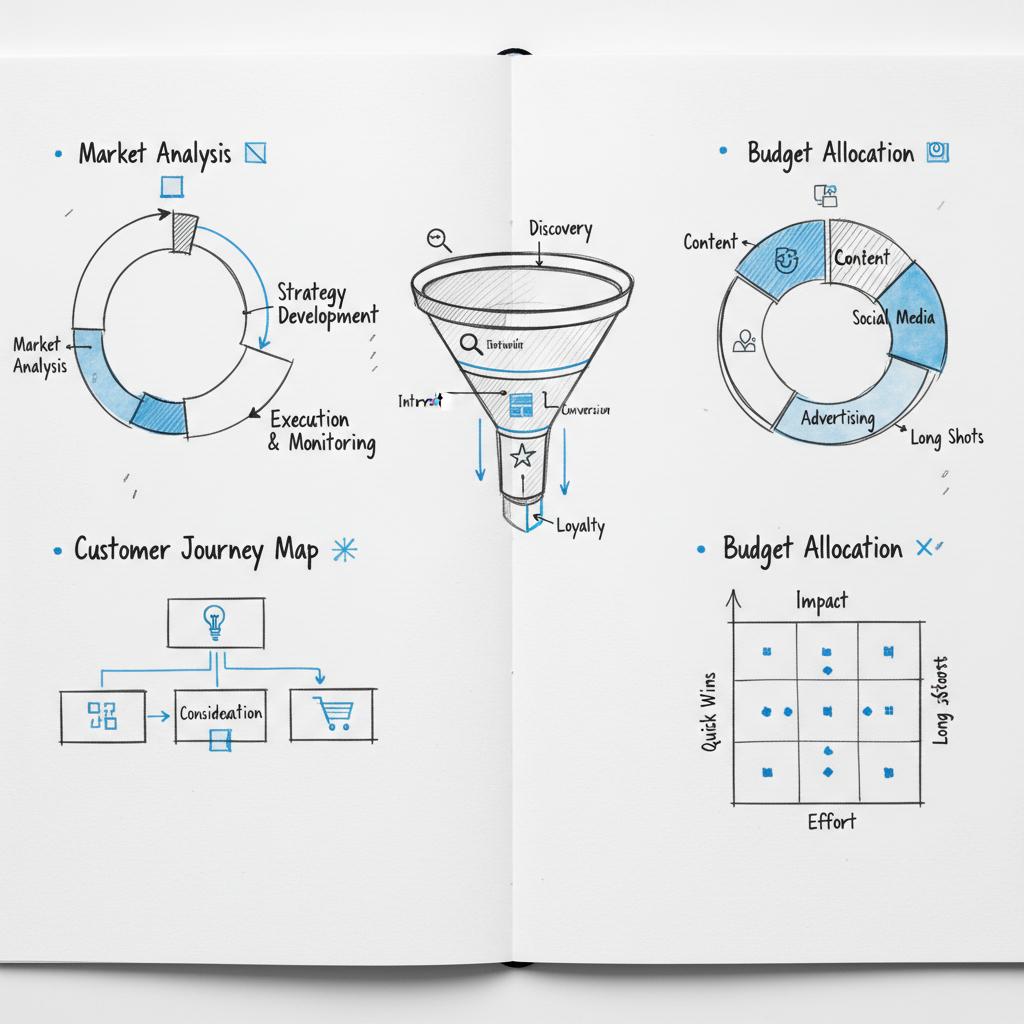
Brand surveys, NPS, unaided recall studies, session recordings, checkout funnel analytics, partner channel spot checks, and simple A/B tests are your best friends. Use a small dashboard that mixes brand and performance KPIs so both get attention. A consistent logo across those touchpoints helps build recognition and recall.
How to prioritize audit findings
Score each issue by (1) how many customers see it, (2) how much it hurts conversion or perception, and (3) how long it takes to fix. Quick wins are high impact, low effort. Bigger foundation work is high impact, higher effort – plan those as part of a roadmap.
Applying the four Ps to service businesses
Services map cleanly to the four Ps. Product = service design and client experience. Price = tiers and expertise signaling. Place = intake calls, booking flows, and in-person spaces. Promotion = the narrative you use to explain outcomes. Use the same audit process and moments-of-truth mapping for services as you would for products.
What to expect: timeline and results
Expect short-term wins within weeks for fixes to place and promotion. Meaningful shifts in brand metrics take months to years but often show correlated improvements in organic traffic, conversion, and retention within six to twelve months of consistent work.
Practical templates you can copy
Product manifesto (one sentence): “This product exists to [primary benefit] for [customer type] by [distinct approach or craft].”
Pricing principle (one line): “Our pricing must communicate [positioning] and offer a clear entry, recommended mid-tier, and premium option.”
Place rule (one line): “Every external touchpoint must repeat the primary brand cue in visual or tone.”
Promotion hierarchy (bullet): Brand line → supporting benefit → social proof → CTA.
When to call for outside help
If you lack internal focus, hit chronic inconsistency across channels, or need to scale visibility quickly, a specialist partner can turn foundation into reproducible signals. Partners should demonstrate strategy-to-execution capabilities and measurable outcomes – not just pretty creative. See Agency VISIBLE’s projects for examples of translation from strategy to execution.
Agency partnerships: what to expect
Good agencies will respect your foundation, translate it into signal rules, and help operationalize those rules across channels. If you’re looking for a partner that emphasizes speed, clarity and measurable growth, Agency VISIBLE positions itself as a practical choice for small and mid-sized teams who need visible results.
Make your brand visible where it matters — fast
Ready to align your Product, Price, Place and Promotion into a consistent, measurable brand? Talk to Agency VISIBLE to turn a quick audit into prioritized, high-impact wins.
Quick wins and ongoing rhythms
After you run a micro-audit, establish a weekly rhythm for brand checks: one short review of the top three moments of truth per week, a monthly dashboard check of brand and performance KPIs, and a quarterly deep audit. These habits keep your four Ps aligned as your business scales.
Extra: a short checklist you can export
1) Product: manifesto written, primary cue chosen, packaging check.
2) Price: tiers clear, discount rules set, partner price checks.
3) Place: top five touchpoints audited, checkout and mobile fixes prioritized.
4) Promotion: messaging hierarchy defined, three consistent creative templates made.
Final thoughts
Asking what are the 4 P’s of branding should lead you to think about signals, moments and alignment rather than only levers. When product, price, place, and promotion tell a single story in the moments that matter, customers decide faster and stay longer. Start with clarity, map your moments of truth, measure impact, and fix mismatches. Over time, those steady changes weave into a brand people recognize and trust.
Start with your three most important moments of truth (e.g., sign-up, first delivery, first support). For each moment map Product, Price, Place and Promotion signals that should appear, then run a quick micro-audit on those touchpoints. Create one-page rules: a product manifesto, pricing principles, place checklist, and a short messaging hierarchy. Fix the top two inconsistencies, measure results, and repeat.
Quick fixes to place and messaging can show measurable results in weeks. Meaningful shifts in brand metrics like recall and preference typically take months to years, but you’ll often see correlated gains in organic traffic, conversion rates, and retention within six to twelve months of consistent work.
Yes. Agency VISIBLE specializes in turning brand foundations into visible, measurable outcomes for small and mid-sized businesses. If you prefer a partner to run the audit, prioritize quick wins, and scale consistent signals across channels, get in touch via their contact page to explore a tailored plan.
References
- https://www.investopedia.com/terms/f/four-ps.asp
- https://agencyvisible.com/contact/
- https://www.ey.com/en_us/industries/consumer-products/consumer-products-leaders-double-down-on-the-four-p-s
- https://www.on24.com/blog/introducing-the-modern-4-ps-of-marketing/
- https://agencyvisible.com/projects/
- https://agencyvisible.com/perspectives/