


How do I get clients for my property management company?
Finding steady property management leads is part craft, part routine. Think of it like tending a garden: you seed local visibility, water referral relationships, pull a few weeds with paid ads, and measure what grows. If you want more landlord clients without burning cash on one flashy campaign, this guide will walk you through reliable steps you can apply this week and refine over months.

Start where landlords search

When a homeowner decides to hand over keys they usually start with a quick search or a phone call. That means local search and clarity matter first. Make your Google Business Profile complete and current: accurate service areas, clear photos, precise service descriptions and recent, authentic reviews. These basics are the foundation for the property management leads that arrive from “near me” searches. A simple, recognizable logo helps local recognition when owners skim results.
Pair the profile with locally useful pages that answer exact landlord questions: fees, eviction handling in their county, statement frequency and sample forms. Pages that use neighborhood names and long-tail phrases like single-family home manager in [neighborhood] will rank better for owner intent and bring higher-quality property management leads. For more practical tactics you can test, see 8 strategies to generate property management leads.
Be consistent across directories
Citation consistency matters: your business name, address and phone number must match across platforms. Inconsistent listings confuse search engines and lower visibility. Add structured data to your site so contact details and service areas are explicit. A small investment here pays off with more reliable property management leads over time. The 2025 industry benchmark can help you prioritize where to invest: 2025 Property Management Benchmark Report.
Turn referrals into predictable growth
Referrals don’t just bring clients — they bring trust. A landlord recommended by a local agent or neighbor is already halfway to signing. But referrals work best when they’re formalized. Offer a short, fair reward: a fixed fee, a percentage of the first month’s management, or a donation to a local charity. Track every referral in your CRM with a referred by field so you can see what actually drives the best property management leads.
If you’d like help setting up a referral program or testing early campaigns, consider talking to Agency VISIBLE for a practical setup that hands you usable data and simple execution tips.
Build partnerships that feed leads
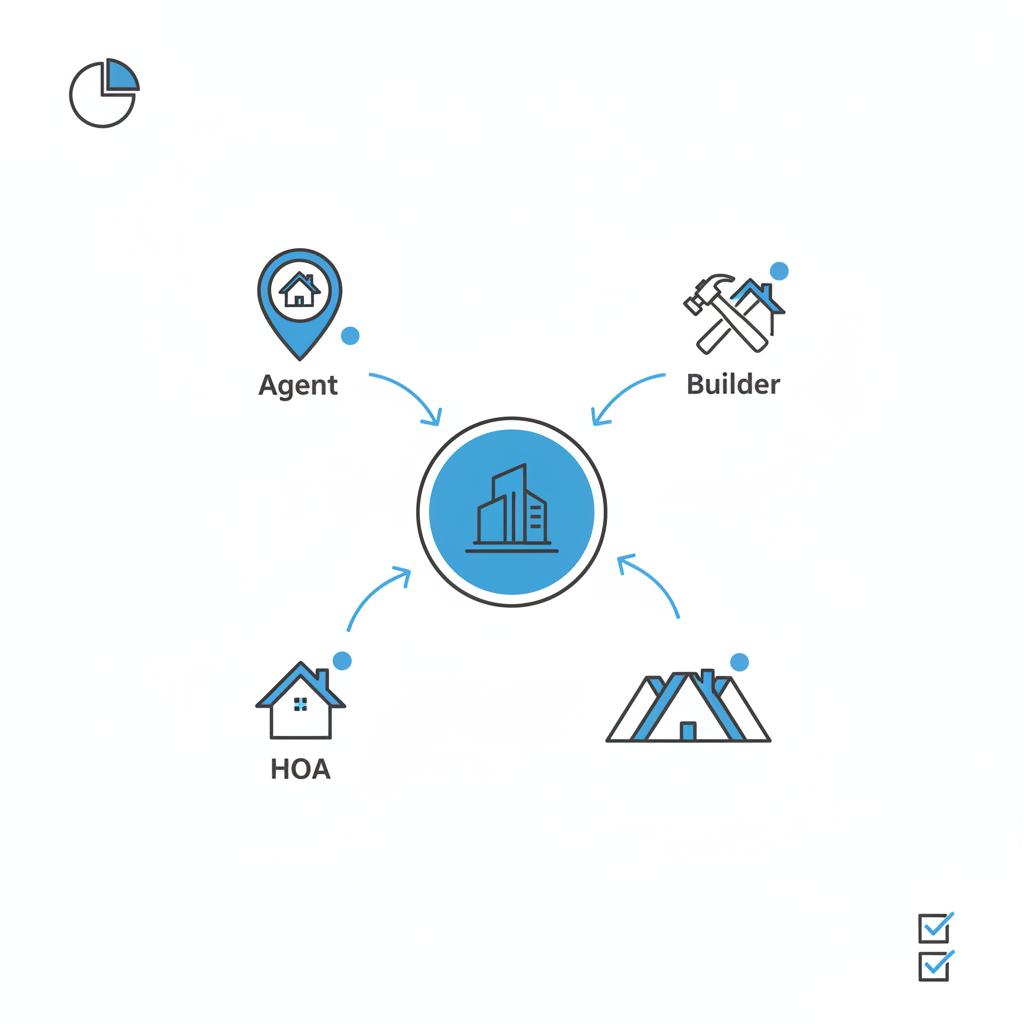
Three groups regularly intersect landlords: real estate agents, local builders and homeowner associations. Offer each group a clear, concise one-sheet that explains how referrals work and what partners can expect. Keep follow-ups human — handwritten thank-you notes, short updates on referred leads and a reputation for consistent communication make partners want to keep sending property management leads your way.
A complete online presence plus a clear, city-specific landing page that answers fees, service areas and response times. That combo often converts local searches into property management leads within a single session.
The fastest local signal is a complete online presence plus a short, city-specific landing page that answers the top questions: fees, service area and response times. That combination often converts a casual search into a property management lead within a single session.
Property management leads: how paid channels and landing pages work together
Paid search and listing platforms are great when you need to accelerate volume. High-intent searches on Google and placement on landlord-focused listing platforms will send leads, but expect wide cost variation by city and property type. Use ads to capture urgency – offer a free pricing review or a limited-time onboarding credit – and send clicks to landing pages that answer the landlord’s top questions quickly.
Make landing pages do the heavy lifting
A high-converting landing page for property management leads loads fast, states fees clearly, shows short case summaries and offers multiple contact paths: schedule a call, request a fee schedule or start a property assessment. Each option matches a different level of commitment; giving owners choice improves conversion and helps qualify leads remotely.
If you run campaigns across multiple cities, make city-specific pages rather than a single catch-all. Localized pages that reference neighborhoods and common local issues feel more relevant and lift response rates for property management leads.
Messaging that landlords trust
Landlords are looking for operational clarity: how you protect rental income, how quickly you place tenants and how maintenance is handled. Spell out service-level agreements, average response times and your maintenance process. This kind of operational proof wins landlord trust and produces better property management leads than generic claims.
Owner-focused content that attracts and filters leads
Content aimed at owners is both a magnet and a filter. Landlord guides, local pricing calculators, sample management agreements and eviction checklists address real friction points and attract property management leads who are already thinking about hiring a manager.
Offer downloadable resources like a pricing calculator or a one-page onboarding checklist. When a landlord downloads a tool, they show a buying signal — and you can follow up with targeted email sequences that match their timeline and concerns.
Short, specific case studies
Case studies are the clearest proof you can publish. Use a tight format: the landlord’s problem, the interventions, and measurable outcomes. Include before-and-after numbers and a brief quote from the owner. A specific case study that shows you reduced vacancy time or increased net rent is far more persuasive to landlords and yields higher-quality property management leads.
Emails and automation that turn interest into decisions
Email remains among the best tools to nurture landlord prospects. Build short welcome sequences that ask two simple questions: what are their biggest concerns, and what’s their timeline? Segment replies into immediate, mid-term and informational prospects and follow up accordingly.
Immediate prospects get a short audit or a phone call. Mid-term prospects receive monthly insights and local case studies. Informational leads get low-effort resources like a one-page checklist or a short explainer video. These targeted sequences move more prospects into the signed contract column and grow property management leads from warm interest.
Don’t confuse renters with landlords
Channels that win tenants don’t always win owners. Renter-focused listing platforms and social ads drive tenancy quickly but don’t prove operational competence to landlords. Focus owner messaging on returns and protection: reduced vacancy, faster rent collection and transparent accounting. That messaging attracts the property management leads that convert to clients and stay longer.
Measure what matters
Measurement separates deliberate growth from lucky breaks. Track lead source at intake with UTM parameters and CRM tags. Connect lead sources to revenue outcomes: signed contracts, first-month management fees and renewals. Track lifetime value by cohort so you can see which referral or ad channel creates the highest-value property management leads. For M&A context and market-level trends, consult the 2025 Property Management M&A Report.
Useful conversion benchmarks
Measure conversion rates across stages: landing page click-to-lead, lead-to-site-visit, site-visit-to-contract. Small improvements at each stage compound. For example, a 10% lift in landing page conversion multiplied across months produces more steady property management leads and higher revenue without increasing ad spend.
Attribution without perfection
Attribution is messy but actionable. Use short windows for direct-response channels and longer windows for content and referrals. Tag touchpoints in your CRM to see first-touch, last-touch and multi-touch patterns. You don’t need a complex model — you need consistent data and regular reviews to optimize for property management leads.
Testing and learning: small, methodical experiments
Run small tests and keep them simple. Try a new headline on a landing page in one neighborhood. Test whether a shorter intake form raises calls. Run a small ad test in a new city before scaling. Track results for at least four weeks, compare with benchmarks, and document the outcomes. When a change improves conversion rates, roll it out; if not, keep the learning and move to the next test to improve property management leads.
Budgeting practicalities
There’s no universal cost-per-lead figure; local competition, property types and market density matter. Split marketing into two buckets: a low-cost foundation (local listings, Google Business Profile and owner resources) and a variable paid budget for acquisition. Small portfolios can see good returns with modest paid spend and a strong referral program. Mid-size operators should be ready to invest more across markets, create city-specific landing pages and allocate budget for partnerships that feed multiple properties and steady property management leads.
Designing fair, sustainable referral programs
Keep referral rewards simple and timely. People value recognition more than complicated structures. Use a short referral contract and automate thank-you and payment processes. Consider staggered rewards: partial payment after a signed contract and a follow-up payment after a retention milestone. This aligns incentives and protects you from paying for leads that don’t convert into long-term clients.
Retention: keep what you win
Lead generation matters only if you can keep the clients you sign. Track post-signing metrics like time-to-first-tenant-placement, average repair times and owner satisfaction scores. Use those numbers in marketing — showing measurable results like a 20% vacancy reduction builds trust and produces more property management leads because owners value proven outcomes.
Onboarding that reduces churn
Design a clear onboarding flow for new owners: an onboarding packet, a first-30-day action list and a single point of contact. Clear communication during the first month sets expectations and increases the odds a new client stays and refers others. That retention feeds future property management leads by turning clients into advocates.
Tools and routines that make growth manageable
Keep your stack small and effective: a CRM that captures lead source, a calendar tool for follow-ups, and a project tracker for onboarding tasks. Tag referrals for automatic rewards and maintain a short list of evergreen content pieces that you update annually. Run one controlled test every month and review results in a short monthly meeting. Small habits compound into dependable property management leads. If you want to see examples of our work, view Agency VISIBLE projects or visit their homepage.
Example timelines and budgets
Here are two realistic scenarios that show how different budgets bring property management leads:
Small city manager
– Maintain local profiles and directories. – Publish one high-value owner guide per quarter. – Run a modest paid search campaign focused on high-intent landlord keywords. – Formalize a referral program and use a simple CRM to track leads. Over six months expect steady organic leads, occasional paid spikes and a few high-value referred clients.
Mid-size multi-city operator
– Create city-specific campaigns and landing pages. – Invest in email nurture and partnerships that feed multiple properties. – Allocate more paid budget to accelerate reach. Expect faster scale, more variable cost-per-lead and the need for robust tracking to compare channels across markets.
Common pitfalls and how to avoid them
Avoid these mistakes that kill momentum: neglecting citation consistency, running ads without tailored landing pages, tracking nothing in your CRM and over-prioritizing tenant-acquisition channels for owner marketing. Fix these basics first and you’ll see steadier property management leads.
Example checklist to start this week
– Verify Google Business Profile details and add recent photos. – Match NAP (name, address, phone) across key directories. – Create one city-specific landing page for paid campaigns. – Draft a short referral one-sheet and implement a CRM tag for referred by. – Build a 3-email welcome sequence for new leads.
How to pick a partner without losing control
If you prefer help, choose an agency that shares data and teaches you how to read it. Your objective is to build capability inside your business, not to hand off all knowledge. If you work with a partner, insist on shared dashboards, regular reviews and a clear plan to hand tools and reports back to your team. That approach produces sustainable property management leads and reduces dependency.
When to hire help
Hire outside help when you want to accelerate testing across markets or when your internal team lacks the time to keep consistent measurement and local content updated. Make sure the engagement includes training so your team keeps the insights and continues growing property management leads after the contract ends.
Final tips and practical examples
Here are some small actions that often pay off faster than you expect:
– Offer a free 15-minute pricing review in local ads to increase click-to-lead conversion. – Publish a one-page local eviction process guide for each city you serve. – Use short, numeric case study bullets that show time saved or income protected. – Thank referral partners publicly (with permission) to boost word-of-mouth and future property management leads.
Sample case study format
– Client: 20-unit suburban portfolio. – Challenge: 40-day vacancy average and inconsistent rent collection. – Intervention: targeted local tenant marketing, a new screening process, weekly maintenance triage. – Outcome: vacancy reduced to 12 days, 8% increase in net rent and a 10-point improvement in owner satisfaction.
Resources and tools
Useful tools include a CRM (for tracking source and touchpoints), Google Analytics for landing page performance, a simple spreadsheet to track referral payouts and a calendar tool to automate follow-ups. Keep the toolset minimal and focused on data you can act on to increase property management leads.
Parting thought
Growing landlord clients is rarely the result of a single channel. It’s the result of patient, consistent work: being visible where landlords look, building referral systems that are fair and trackable, presenting clear proof and measuring outcomes. Start small, test often and let local signals guide your next steps. Over months, the rhythm you create will turn your marketing into a dependable source of property management leads and give you more control over growth.
Ready for a simple plan that drives landlord clients?
Ready to design a simple, measurable plan? Talk to a strategist who can help you set up tracking, run a pilot campaign and teach your team how to read the results. Contact Agency VISIBLE to get a practical first plan and clear next steps.
The fastest route is a complete local presence plus a city-specific landing page that answers top landlord questions. Make sure your Google Business Profile is current, add a neighborhood landing page that lists fees and service details, and run a small paid search test with a clear incentive like a free pricing review. That combination often converts short local searches into property management leads within a few days.
Keep referral rewards simple and timely. Offer a clear contract, a fair fixed fee or a percentage of the first month’s fees, and automate thank-you messages and payments. Track every referral in your CRM with a "referred by" field and consider staggered rewards (partial on sign, final after a retention milestone) to align incentives and protect against short-lived clients.
Yes — a good agency will set up testing, tracking and local campaigns while teaching your team how to run them. Choose a partner that provides shared dashboards, regular reviews and clear documentation. Agencies like Agency VISIBLE focus on measurable outcomes and handoff plans so you keep control of the data and decision-making.





