How much is a billboard advertisement?
Clear numbers, real examples, and practical steps to plan your outdoor campaign without surprises.
If you’re wondering how much is a billboard advertisement, you’re asking the right question early. That phrase—how much is a billboard advertisement—drives the budgeting decisions you’ll make for locations, creative, and measurement. This guide walks you through the math, real ranges for static and digital faces, production and permit costs, CPM comparisons, negotiation tactics, and a step-by-step checklist so you can plan and buy with confidence.
Why billboards still matter
Billboards remain one of the most visible, context-rich channels in marketing. A well-placed board meets people where they are: commuting, shopping, or waiting for public transit. It’s a public, repeated exposure that supports brand memory in ways short social bursts rarely do. But before you spend a dollar, you need to know what to expect — and how much is a billboard advertisement is the question that opens that planning conversation.
Thinking about a campaign and want a second opinion? A quick, human review can save time and money. If you’d like a short consultation and a checklist tailored to your market, talk to the team at Agency VISIBLE — they help small and mid-sized businesses map costs and priorities without the agency fluff.
Types of billboard inventory and why it changes price

There are two main categories to understand:
Static (poster/vinyl)
Static boards are printed and installed — the classic billboard panels you picture. They usually rent by the month and have predictable production costs (printing, mounting, installation).
Digital (LED / DOOH)
Digital displays rotate creative and often sell by daypart, impressions, or time blocks. Digital pricing can be more dynamic, changing by audience targeting, time of day and event-driven demand.
Knowing whether you need static permanence or digital flexibility helps answer how much is a billboard advertisement for your goals.
Typical price ranges (2024–2025 anchors)
Use these industry anchors as starting points — they are not guarantees, but they prevent sticker shock when you start calling vendors. For broader context, see industry pricing guides from Business.com, TimesSquareBillboard and Broadsign.
Static boards
Smaller markets: roughly $250–$5,000 per month. Mid-size metros: commonly $1,000–$5,000. Major metro corridors: $1,500–$20,000+ per month depending on traffic and scarcity.
Digital boards
Digital pricing typically runs from $1,200 to $20,000+ per month, depending on location, daypart demand, and audience targeting precision. High-impact towers in core downtown corridors can push well beyond those ranges during peak windows.
How to compare value: CPM and impressions
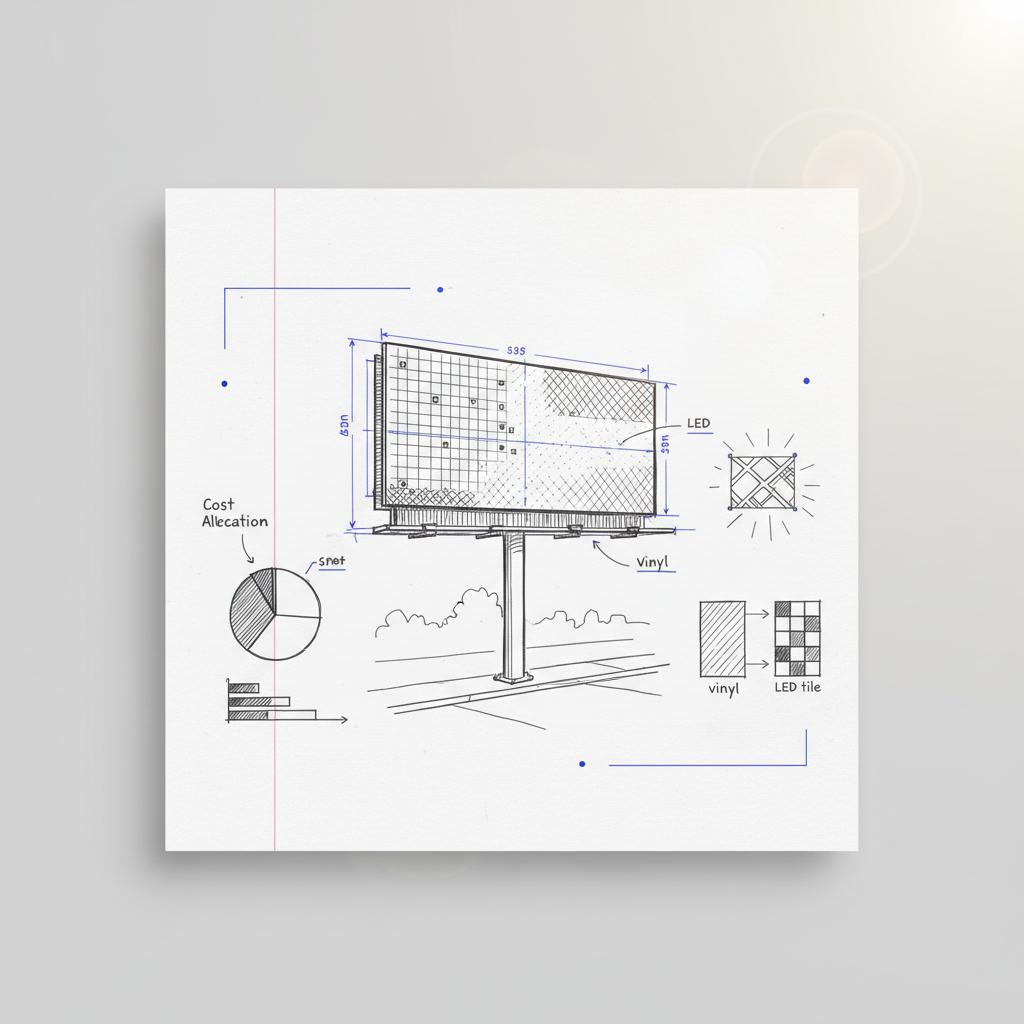
Marketers often translate outdoor value into CPMs (cost per thousand impressions) to compare channels. Typical ranges reported in 2024–2025:
- Static CPMs: roughly $1–$8
- Digital CPMs: roughly $2–$12
Digital often costs more because vendors can justify premiums through audience data, dayparting, and dynamic targeting. But CPMs depend on how impressions are estimated — so use them as one input, not the only one.
How vendors calculate impressions
Different vendors use traffic engineering counts, geolocation panels, or modeled DEC (Daily Effective Circulation). Ask for the data source. Transparency matters because the same board might report different CPMs depending on method and assumptions.
Production, installation, permits — the hidden but predictable costs
Production and setup push totals up quickly if you don’t plan for them.
Common production ranges:
- Simple poster print (single sheet): $300–$900 (design, print, install)
- Full-face vinyl or large wrap: $1,000–$3,000
- Digital creative with motion: $1,500–$4,000 (depends on length and revisions)
Add to that permits, possible electrical upgrades for digital boards, and late-night installation fees. As a rule, budget an extra 10–30% of your media spend for creative, production, permits and installation, and keep a 5–15% contingency for the unexpected.
Location, size and visibility: the primary price drivers
Location is the single biggest factor. A board on a busy commuter corridor with high DEC will always cost more. Transit-facing panels and those at eye-level in pedestrian zones command premiums because they reach captive, attentive audiences.
Format matters too: bulletin-size or superboard faces cost more than smaller poster panels. Lighting, sightlines and obstruction all affect value — a clear view on a lit corner is worth far more than a partially hidden board.
Seasonality, contract length and negotiation levers
Expect spikes in demand and rates around holidays, major sports or cultural events, and peak shopping seasons. Longer contracts usually mean lower monthly rates. Vendors prefer predictable income, so offer what you can in exchange for discounts.
Smart negotiation tactics:
- Bundle multiple boards or static + digital to lower the per-board cost.
- Buy off-peak weeks or flexible start dates for discounts.
- Request creative production credits or free nights if owners won’t budge on rate.
Three practical pricing examples
Example 1 — Regional retail, three-month fall flight
Scenario: four poster boards at $1,200/month, three months.
Media rental: 4 × $1,200 × 3 = $14,400
Production & installation: $1,800 | Permits: $300
Total: $16,500 (~12.5% added for production & permits)
Example 2 — Tech product launch, two-week digital burst
Scenario: three digital faces listed at $6,000/month, prorated for two weeks at $3,000 per board.
Media rental: 3 × $3,000 = $9,000
Digital creative (motion & edits): $2,500 | Tech/electrical fees: $500 | Contingency (10%): $1,200
Total: $13,200
Example 3 — Small cafe, targeted commuter reach
Scenario: two poster boards near train stations for three months, media rental $800/month each.
Media rental: 2 × $800 × 3 = $4,800
Production: $600 | Contingency: $300 | Owner credit: one free week
Total outlay: $6,300 (including perks)
Static vs digital — which should you choose?
Static is usually more economical for long-term presence and brand-building. Digital is ideal for short, precise bursts, multiple creative variations, or when you need to turn messages on and off quickly. Think about your objective: steady brand visibility or time-sensitive impact?
Either way, the question of how much is a billboard advertisement will resolve differently depending on the format you need.
Creative that works at speed
Drivers and pedestrians have one or two seconds to consume a message. Effective outdoor creative uses large type, strong contrast, a single idea, and a single call to action. On digital, motion helps — but too many cuts or dense copy will just confuse.
Design tips:
- Big, bold headline. One strong visual.
- Limit text. Use 6–8 words max for a primary message.
- High contrast and simple color palette for visibility.
Budget template: a practical starting point
Start with media rental, then add production and contingency using this simple template:
- Media rental: base cost
- Production & installation: 10–30% of media rental
- Permits & fees: $100–$3,000 depending on city
- Contingency: 5–15% of total
Example: six-week static flight in a mid-size market
Media: $8,000 | Production: $1,200 | Contingency: $600 | Total: $9,800
Measurement: DEC, geolocation and what to ask for
Vendors use a range of methods to report impressions. Ask these questions:
- What is the source of your DEC or traffic counts?
- Are pedestrian counts included, and how are they measured?
- How do you prorate impressions for partial flights or dayparts?
Insisting on transparent methods helps you compare apples to apples.
Run a short pilot: either buy a brief digital burst for daypart testing or a one- to two-week static flight in a high-traffic week. Digital pilots let you test creative variations and timing quickly; short static tests show real-world visibility and brand salience while keeping costs low.
Run a short pilot on a digital face or buy a very short static flight in a high-traffic week. Digital pilots let you measure daypart performance and creative variation quickly; short static runs show brand salience in a real-world setting. Both approaches are cheaper than committing to months of media up front.
Negotiation checklist and script
Bring these numbers with you: target CPM, DEC you need, and maximum total budget. Use this short script and adapt it to tone and context:
“We’re planning a [length] flight and have X total budget. What’s your best rate for our exact dates? If we shift to a slower week, can you reduce the price or add free nights? Can production or electrical fees be bundled?”
If the owner won’t lower rates, ask for added value: extra nights, better placements within the bundle, or a creative credit.
Permits, regulations and timelines
Permit processes vary. Some cities approve quickly and cheaply; others take weeks and cost thousands. Hire a local installer who knows municipal rules if your timeline is tight. Their fee can be worth the faster approvals and reduced risk of failed inspections.
Electricity and digital access — ask these questions
- Is electricity included in the rental price?
- Are monitoring and remote creative uploads part of the package?
- Will new wiring or breaker upgrades be billed separately?
Hidden electrical costs can surprise you for large or older installations.
Stretching your billboard budget
Ways to get more for less:
- Co-create with local artists for lower-cost, memorable visuals.
- Rotate short bursts across a set of boards instead of running all faces at full price.
- Negotiate pilot buys on digital faces before committing to long runs.
- Use outdoor to drive online actions — add a short URL or QR, and pair outdoor with search and social for measurable lift.
Future trends that will affect pricing
Two things to watch in 2025 and beyond:
- Audience-targeting premiums in DOOH. As measurement improves, expect some digital slots to carry a higher price tag.
- Inventory scarcity in high-demand metros. When supply is tight, owners raise prices — plan early for big launches.
Checklist before you sign
Read these contract terms carefully:
- Cancellation and make-good clauses
- Whether impressions are guaranteed and how they are measured
- Liability for installation damage
- Any exclusivity clauses that limit neighboring buys
- Hidden fees or rounding rules on impressions
Real-world case study: a coffee brand that used timing and creativity
A local coffee brand wanted to boost morning visits. They booked two poster boards near train stations for three months: $2,400 media rental, $600 production, $240 contingency. By starting in a slower month, they negotiated one free week and a small creative credit. The campaign produced a clear uptick in morning foot traffic and an increase in loyalty signups — a reminder that smart timing and small concessions can deliver measurable results.
A practical negotiation script to copy
Use this script adapted to your tone:
“We’re a regional brand planning a [dates] flight with a fixed budget. What’s your best rate for those dates? If we shift to a slower week, can you reduce the price or include complimentary nights? Can production, electrical and permit fees be bundled?”
Common FAQs answered quickly
How long should a billboard run?
For brand-building, longer flights of several months are more cost-efficient. For launches or spikes, short digital bursts are better. Remember: static creative changes carry production costs.
Can you change a static creative mid-flight?
Yes, but expect extra printing and installation costs. Factor in lead time and permit adjustments.
How do I know if the price is fair?
Compare DEC, visibility and size to nearby boards and translate to CPM. Ask for traffic data sources and comparable rates in the same corridor.
Practical budgeting examples and planning templates
Below are extended, slightly more varied scenarios so you can adapt to your needs.
Long-term brand building (6 months)
Objective: steady presence in a mid-size metro.
Media: $20,000 | Production: $2,500 (12.5%) | Permits: $500 | Contingency: $1,250 (5%)
Total: $24,250
Short-term high-impact digital launch (2 weeks)
Objective: product launch in a major city.
Media: $18,000 | Creative: $3,000 | Electrical/tech: $1,000 | Contingency: $2,300 (10%)
Total: $24,300
Small-business hyperlocal push (4 weeks)
Objective: local store grand opening.
Media: $2,400 | Production: $500 | Local permits: $200 | Contingency: $200
Total: $3,300
When a billboard is the best channel
Choose outdoor when you want scale, frequency and location context. A board near a transit hub, stadium or shopping district gives you visibility in real life — which often has a different and valuable impact than a click on a screen.
When to avoid a billboard
If you need direct, immediate conversions tied to individual users and detailed tracking, prioritize measurable digital channels. Use outdoor to amplify and complement those channels rather than replace them.
Final planning checklist
Before you buy, check:
- DEC source and impression methodology
- Permits and timeline
- Production deadlines and install windows
- Electricity and technical fees for digital faces
- Clear cancellation and make-good terms
How much is a billboard advertisement — the quick answer
Short version: a billboard can cost anywhere from a few hundred dollars a month in very small markets to tens of thousands in major metro corridors. Add 10–30% for production and 5–15% contingency to that media rental for a realistic total. If you need a quick number for planning, use the anchors above and get precise quotes from local owners while asking for DEC sources and comparable boards.
Where to get help
If this feels like a lot, a small team that understands both strategy and the local market can make the process far easier and faster. See our recent work on the projects page or learn more about our approach on the perspectives page.
Ready to map your outdoor plan?
Ready to map your outdoor plan? Get a short, practical review of options, costs and dates — no heavy proposals, just clear numbers and a negotiation checklist. Contact Agency VISIBLE to schedule a quick consult and get a tailored checklist for your market.
Closing thoughts
Billboards are not a replacement for measurable digital channels, nor should they be judged only by short-term clicks. Their power lies in context, scale and the ability to be seen in real life. With clear objectives, transparent measurement questions and realistic budgeting for production and permits, an outdoor campaign can be both efficient and memorable.
Bonus tip: run a short digital pilot or negotiate a one-week starter on static faces to test creative before committing to a longer flight.
Further reading and resources
Keep a record of sample DEC reports, ask for creative specs early, and save copies of permit paperwork. Over time, building a local rate card and a list of trusted installers will shorten planning cycles and reduce surprises.
Thanks for reading — plan thoughtfully, negotiate clearly, and your next billboard could become a small, public piece of brand art that actually moves people.
Static billboard prices vary by market. In smaller markets, expect roughly $250–$5,000 per month. Mid-size metro rates commonly range from $1,000 to $5,000, and major metropolitan corridors often start around $1,500 and can reach $20,000 or more per month depending on location and DEC.
Digital billboards usually command higher CPMs because they can provide dayparting, dynamic creative, and audience targeting. Typical digital ranges are about $1,200 to $20,000+ per month, with CPMs often falling between $2–$12. Digital can be more cost-effective for short, targeted bursts but may cost more for sustained presence in premium locations.
Plan to add 10–30% of your media spend for creative, production, printing, installation and permit fees. Also include a contingency buffer of about 5–15% for unexpected expenses like electrical upgrades, expedited permits, or extra install charges. These rules of thumb help avoid surprises and keep campaigns on schedule.
References
- https://www.business.com/articles/what-does-a-billboard-cost/
- https://timessquarebillboard.com/blog/how-much-does-a-billboard-really-cost-complete-2025-pricing-guide/
- https://broadsign.com/blog/how-much-does-a-billboard-cost/
- https://agencyvisible.com/
- https://agencyvisible.com/projects/
- https://agencyvisible.com/perspectives/
- https://agencyvisible.com/contact/