Which is the best lead generation tool? A clear way to decide
Choosing the best lead generation tool for a small or mid‑market team is less about chasing shiny features and more about matching outcomes to platform strengths. The right choice fills the top of funnel predictably, shortens time to first contact, and preserves attribution so you know which activities actually create revenue. The wrong choice wastes budget, creates blind spots, and frustrates salespeople.
In 2024-2025 the landscape changed: generative AI speeds qualification and personalization, privacy shifts push teams toward first‑party data and server‑side tracking, and deep CRM integrations are now a practical requirement for repeatable results. This guide gives a practical framework you can use to evaluate vendors, run pilots, and pick the best lead generation tool for your specific business goals.
Read on for a tested evaluation matrix, a sample pilot plan, negotiation tips, and concrete metrics to measure success.
Run a short, narrow pilot with a numeric hypothesis—e.g., increase SQLs by X% or reduce time‑to‑first‑contact to under 3 hours—instrument CRM field mappings and server‑side events, and compare pilot segments against a control region. Measure MQL→SQL conversion, time‑to‑first‑contact, and demo‑to‑close rate, and collect qualitative rep feedback to confirm the numbers.
Trust is earned. Start small with a narrowly scoped pilot and twice‑daily check‑ins the first week. Give reps clear SLAs for response times and a simple feedback form so they can report lead quality. If the tool improves response time and conversion, trust builds quickly; if it doesn’t, you either iterate on configuration or stop the pilot before costs climb.

Start with the outcome you need, not the shiny feature
The first step toward choosing the best lead generation tool is to define the outcome you want to move. Tools are means to ends: more top‑of‑funnel volume, faster qualification, tighter attribution, or simpler sales handoffs require different solutions.

Ask outcome‑focused questions
Before you talk to vendors, answer these internally:
1. What metric, if improved, would most increase revenue? (e.g., increase SQLs by 20% or reduce time‑to‑first‑contact to under 1 hour.)
2. What’s the current baseline? Capture lead counts, MQL→SQL conversion, time to first contact, demo‑to‑close rate.
3. How much can you spend for that lift? Run simple back‑of‑the‑envelope math: expected revenue per closed deal × required new deals = revenue goal; divide by expected conversion to estimate allowed CAC.
These answers will point you to the category of tools that are likeliest to deliver. If your failure mode is volume, prioritize ad‑based acquisition or curated marketplaces. If your bottleneck is qualification speed, prioritize CRM‑integrated or AI‑assisted tools that automate triage.
Four practical platform groups and what they actually do
In conversations with dozens of SMBs and mid‑market teams, four platform types consistently appear. Each has a clear value proposition and trade‑offs you should weigh when calculating total cost of ownership. For an overview of popular vendors and lists, see 25 Best Lead Generation Companies and Services in 2025.
1) CRM‑integrated platforms
CRM‑integrated tools push leads straight into the system your reps already use, enrich records, and often automate routing and follow‑up sequences. They reduce friction—fewer CSV imports, fewer missed records, and faster follow‑up—which often translates to better MQL→SQL conversion.
Why they win: speed and alignment. When leads appear in the CRM in real time and routing rules are enforced, response times fall and conversion rises.
Why they lose: sometimes scale. A CRM‑native tool tied to a smaller dataset or limited channels may not deliver the raw volume an aggressive growth target needs.
2) Ad‑based acquisition tools
Ad platforms and ecosystems place paid search, social, or native ads to drive demand and capture leads. They scale volume predictably and make cost per acquisition visible.
Why they win: volume and predictability. You can scale spend up and down and see the immediate impact on lead counts.
Why they lose: higher CAC at scale and often more work for qualification unless they include integrated scoring that feeds your CRM.
3) AI‑assisted lead generation
These platforms use generative AI to draft outreach, LLMs to surface intent signals, and enrichment models that append firmographics or technographics. They speed personalization and triage. For hands‑on reviews of AI lead gen tools, see 13 Best AI Lead Generation Tools I’ve Tested in 2025.
Why they win: speed and personalization. AI can automate large parts of MQL triage and message drafting, freeing reps to focus on high‑value conversations.
Why they lose: inconsistent quality. AI can hallucinate or misclassify. Validation, monitoring, and human checks are essential.
4) Lead marketplaces
Marketplaces assemble prospect lists—by intent or declared interest—and sell them per lead or credit. They are useful when you need names quickly for time‑sensitive campaigns.
Why they win: speed to contact. Marketplaces can deliver high‑intent names quickly.
Why they lose: variable data hygiene, unclear consent records, and compliance risk. You should insist on consent documentation and test samples first.
Trends shaping the choice in 2024-2025
Three macro trends should shape your evaluation of the best lead generation tool today:
1) Generative AI is standard. Vendors use AI to draft outreach, summarize intent, and enrich profiles. These features can boost speed and personalization but must be validated for accuracy.
2) Privacy changes push first‑party and server‑side tracking. With browsers and platforms tightening third‑party tracking, tools that can capture server‑side events and work with first‑party consent frameworks retain attribution.
3) CRM integrations are table stakes. Tools that take weeks to integrate or need heavy engineering often become more expensive in practice. For a broader tools roundup, see The Top 23 Best Lead Generation Tools of 2025. Freemium tiers or trial access are common and useful for SMBs to validate fit quickly.
Performance trade‑offs that matter when you pick a winner
No vendor excels on every dimension. To pick the best lead generation tool, understand these typical trade‑offs:
Ad‑based solutions: great for volume, weaker for qualification unless they include integrated scoring.
CRM‑native tools: great for conversion velocity and attribution, sometimes weaker for raw volume.
AI tools: speed things up but require validation to avoid inflated metrics.
Marketplaces: quick and predictable per‑lead pricing but often need hygiene work and legal review.
How pricing usually works (and how to forecast total cost)
Pricing mixes subscription tiers with usage fees. Common models include a base monthly fee plus per‑lead credits or per‑enrichment costs. Hidden costs—engineering time for integration, support hours, and manual data validation—often dominate TCO.
A simple cost model helps. Example math:
Step 1: Average revenue per closed deal = $12,000.
Step 2: Current lead→customer conversion = 1.5% (i.e., you close 1.5 customers for every 100 leads).
Step 3: Desired new revenue = $120,000. You need 10 closed deals.
Leads required = 10 / 0.015 = ~667 leads.
If a vendor charges $10 per lead, pure lead spend = $6,670. Add $2,000 estimated integration and internal time, and a $500 monthly subscription for the trial period; total ≈ $9,170. Compare that to expected revenue to decide if the pilot makes sense.
This simple model forces you to estimate realistic conversion rates during pilots and to factor in non‑obvious costs.
A practical evaluation matrix: four pillars to score vendors
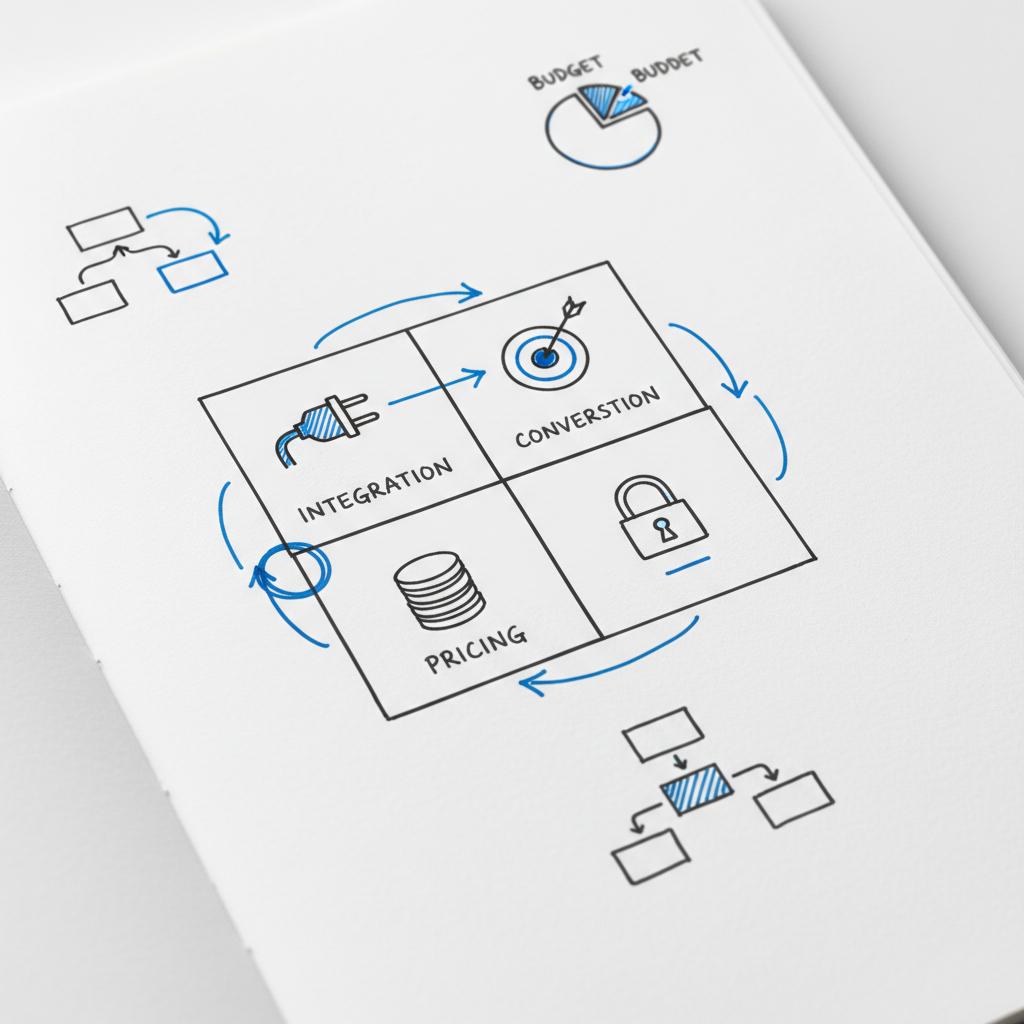
Use a scorecard across four pillars to compare vendors objectively: Integration & latency, measurable conversion lift, transparent pricing, and privacy & consent controls.
Pillar 1 — Integration & sync latency
How fast do leads arrive in the CRM? Real‑time syncs support fast follow‑up and often higher conversion. Batched nightly imports introduce lag that kills response rates.
Pillar 2 — Measurable lift in MQL→SQL
Ask vendors for anonymized before/after metrics and best‑case customer examples. If possible, run an A/B test where one region receives vendor leads and another serves as control.
Pillar 3 — Transparent pricing
Understand what triggers usage fees—credits, API enrichment calls, or per‑seat charges. Vendors who hide unit economics make forecasting hard.
Pillar 4 — Privacy & consent controls
Does the vendor capture consent and provide server‑side event capture? Insist on written records of consent for marketplace leads.
How to run a fair pilot (step‑by‑step)
Pilots reveal more than demos. A strong pilot is short, hypothesis‑driven, and measurable.
Step 0 — Define a clear hypothesis: “Vendor X will increase SQLs by 20% in 60 days while keeping CAC flat.”
Step 1 — Pick narrow segments: Use a single sales region or product line so results are attributable.
Step 2 — Set numeric success criteria: Minimum improvement in MQL→SQL conversion or a drop in time‑to‑first‑contact to under X hours.
Step 3 — Run for a short window: 45‑90 days. Long pilots hide failure and increase sunk costs.
Step 4 — Instrument measurement: Ensure server‑side events, CRM field mappings, and reporting dashboards are in place before the pilot starts.
Step 5 — Collect qualitative feedback: Reps should score leads and note why leads felt relevant or not. Use a simple 1–5 scale and two short text fields.
Step 6 — Decide quickly: If metrics or qualitative feedback fall short, stop or iterate.
What to ask vendors during a pilot
Use this checklist in vendor conversations and RFPs:
– How do you measure AI qualification accuracy? Can you share anonymized misclassification examples?
– Provide sample data schemas and CRM mapping templates.
– What are onboarding timelines? Any custom engineering required?
– How are consent records stored? Do you support server‑side event capture?
– What are the unit economics—per‑lead cost, credit consumption, enrichment call pricing?
These questions expose hidden costs and technical debt early.
Monitoring and governance for AI features
AI speeds qualification but requires governance. Establish these guardrails:
– Set a confidence threshold. Require human review for prospects below it.
– Monitor enrichment accuracy for fields that feed scoring models (titles, company size, tech stack).
– Track response and reply rates to AI‑driven messaging versus baseline.
– Keep a rolling log of AI misclassifications and remediation steps.
Anecdote: a mid‑market team that mixed AI and human checks
A mid‑market B2B provider used an AI enrichment tool that raised open and reply rates initially. By month three, inaccurate titles wasted rep time. Their fix: a junior SDR validated the top 30% of AI‑scored prospects before routing to senior reps. The team kept the speed benefits while restoring quality—an inexpensive human check that preserved ROI.
Legal and compliance you can’t skip
Privacy regulation matters. For marketplaces, always request documentation proving consent and the data source. For tracking tools, insist on server‑side capture options and clear documentation about cookie behavior and how consent is recorded. Put data retention and deletion terms into the contract.
Vendor relationships and internal alignment
Tool selection is as much organizational change as procurement. Align marketing and sales on SLAs, onboarding, and dashboards. A joint lead dashboard makes lead health visible to both teams and reduces blame when outcomes lag. For examples of our engagements, see our projects.
Sample scoring template (textual example you can copy)
Score vendors 1–5 on each pillar and multiply by weight. Example weights: Integration & latency 30%, MQL→SQL lift 30%, Pricing transparency 20%, Privacy/consent 20%. The vendor with the highest weighted score is your top candidate for a pilot.
Negotiation tips to lower risk
– Ask for a short trial with a small commitment and clearly defined exit criteria.
– Negotiate a pilot price that reflects expected leads during the trial so you can measure CAC accurately.
– Insist on SLAs for onboarding and response times during the trial.
– Request a clause that allows pro‑rating or credits if the vendor fails to meet data or latency promises.
Real pilot example and math
Scenario: a small SaaS company with a 60‑day sales cycle and current MQL→SQL conversion of 8% tested two vendors for 90 days. Vendor A (ad‑based) doubled lead volume but raised CAC by 40%. Vendor B (CRM‑native with AI triage) produced 35% fewer raw leads but increased MQL→SQL conversion by 25% and reduced average time to first contact from 48 hours to under 3. Net result: Vendor B produced higher closed‑deal velocity and lower cost per closed deal.
The takeaway: the best lead generation tool is the one that improves the metric tied to revenue for your business—volume, velocity, or conversion—after you account for integration costs and data hygiene.
When to consider Agency VISIBLE’s point of view
If you want help turning a framework into a tight pilot, consider working with Agency VISIBLE. We scope pilots, translate vendor claims into measurements you can test, and help align sales and marketing so the pilot shows clear business outcomes rather than vanity metrics.
A practical pilot checklist you can copy
– Defined hypothesis with numeric success criteria
– Pilot segment (region/product line) selected
– CRM field mapping documented and verified
– Server‑side event capture enabled where possible
– Qualitative feedback form for reps (1–5 + short notes)
– Trial pricing and exit criteria agreed in writing
Practical takeaways and a short decision flow
1) Define the single metric that must move to create a revenue outcome.
2) Use the four‑pillar scorecard to shortlist vendors.
3) Run a short, instrumented pilot with clear numeric goals.
4) Validate AI features with human checks and monitor accuracy.
5) Require consent documentation for third‑party leads and prefer server‑side tracking.
Common questions (and short, honest answers)
Volume or quality? Prioritize the metric tied to revenue. If you have low volume, buy demand. If reps are slow or overloaded, prioritize conversion and velocity.
Is AI worth extra cost? Only when it reduces manual triage time or demonstrably raises SQLs or time‑to‑contact. Ask for evidence.
How to compare TCO? Build a model that includes subscription, per‑lead/enrichment costs, integration hours, and people time. Run scenarios at expected volumes.
Final checklist before you sign
– Confirm real‑time CRM syncs or acceptable latency.
– Get written consent records for marketplace leads.
– Negotiate pilot pricing and exit clauses.
– Agree on required fields and mapping to your CRM objects.
– Define success numerically and include qualitative rep feedback.
Closing wisdom: pick the tool that makes your process better
Tools are powerful but rarely replace process. The best lead generation tool for you will be the one that fits into your sales workflow, moves the metric tied to revenue, and doesn’t create hidden technical or legal debt. Treat vendors like experiments: define success upfront, test quickly, and use both numbers and sales feedback to decide whether to scale.
Ready to test the right lead generation tool for your business?
Ready to choose? Score vendors, run a tight pilot, and pick the tool that increases revenue-not just leads. Good luck – may your funnel be full and your follow‑ups fast.
Prioritize the metric tied to your revenue. If your pipeline suffers from low volume, prioritize ad‑based acquisition or curated marketplaces. If reps are slow to follow up or leads aren’t converting, prioritize CRM‑integrated or AI‑assisted tools that improve velocity and qualification. Define a measurable hypothesis and run a short pilot to validate which approach improves your bottom line.
AI is worth the cost when it reduces manual triage time or instead produces measurable improvements in SQL rates or time‑to‑contact. Ask vendors for evidence—anonymized before/after metrics or pilot results—and put guardrails in place, like confidence thresholds and human validation for lower‑confidence prospects.
Agency VISIBLE helps teams scope pilots, translate vendor claims into measurable hypotheses, set up CRM instrumentation and server‑side tracking, and align sales and marketing on acceptance criteria. We act as an impartial partner so your pilot focuses on the metrics that matter and produces clear evidence you can decide on.