What platform is the best at driving leads?
Quick orientation: This guide gives you a practical, experience-first roadmap to compare channels and decide where your next marketing dollar should go. We’ll use a clear lead generation platforms comparison lens so you can match offers, budgets, and expectations without guessing.
Why the right question isn’t “which platform is best” but “which platform fits my offer?”
There’s a simple distinction that changes everything: some channels capture people who already intend to buy, while others expose your brand to people who might become customers later. Picture two fishing styles: targeted line-fishing and wide-net discovery. That mental model helps you use a practical lead generation platforms comparison to decide where to place your bets.
Intent-driven channels like Google Search and select category listings behave like targeted line-fishing. A user types a problem and expects a solution. These leads cost more per lead but tend to convert much higher – which often makes them the better long-term investment for high-LTV offers. Contrast that with discovery-driven platforms – Meta, TikTok, and other social networks – which act like discovery nets: they find attention, create demand, and can scale cheaply but usually deliver lower average lead readiness.
Benchmarks you can actually use
Benchmarks are blunt instruments, but they’re useful when you treat them as planning bands rather than guarantees. For a realistic lead generation platforms comparison, consider these conservative cost-per-lead ranges for 2024-2025: Google Search: $30-$200, Meta: $20-$150, LinkedIn: $40-$350, TikTok: $5-$80, and local-listing platforms (Yelp, Houzz, Thumbtack, Nextdoor): $15-$200. Conversion rates often sit in the 3-10% range for search and 0.5-3% for discovery platforms.
Remember: these ranges shift by vertical, geography, ad format, and how you define a lead. A strong lead generation platforms comparison always layers your own historical LTV and margin data on top of these bands.
For additional benchmark context, see WordStream’s Facebook Ads benchmarks, SMK’s Meta Ads benchmarks, and the FirstPageSage Average Cost Per Lead report.
How to decide what matters: offer, LTV, and margin
The clearest test is to ask: how much is a new customer worth to you over a realistic window? If your LTV comfortably supports paying more for leads, prioritize intent-driven placements. If your product thrives on demonstration, social proof, or impulse, carve budget for discovery channels that amplify creative. Use a disciplined lead generation platforms comparison to weigh these trade-offs: cost per lead versus downstream conversion and revenue.
As a rule of thumb, most teams need at least $1,000-$3,000 per month per platform to produce reliable signals. That means a proper lead generation platforms comparison starts with test budgets you can trust.
If you’d like a tactical review of which channels will likely work for your business, consider reaching out to Agency VISIBLE for a short consultation — for example, book a quick visibility check to see where to start and how to structure tests.
How to design tests that give clear answers
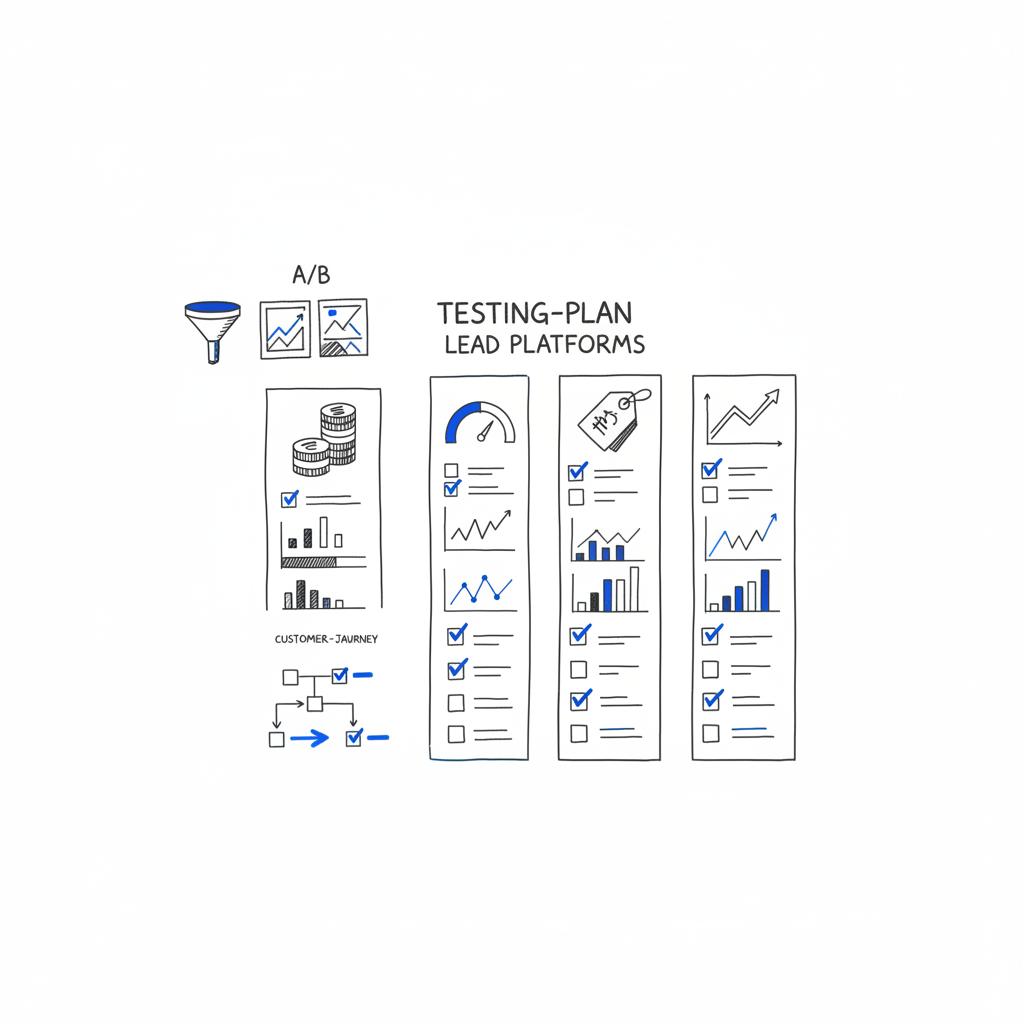
Testing isn’t a one-off task — it’s a disciplined habit. A robust lead generation platforms comparison needs a testing plan that isolates variables, sets time and budget expectations, and focuses on revenue outcomes.

Start with the landing page and qualification flow. Too many campaigns die because a weak landing page turns a click into a bounce. Think of the landing page as the handshake after the ad introduces you: speed, clarity, trust signals, and short forms matter. Then run multi-platform A/B tests where you keep the creative, offer, and landing experience consistent as much as possible. If you must vary creative, document it so you can interpret results.
How much to spend on testing
For most mid-sized advertisers, $1,000 per month per platform is a practical minimum. Competitive categories or narrow audiences often need $2,000-$3,000 to see reliable trends. Smaller businesses can run short bursts of concentrated spend to accelerate data collection, but that requires tighter creative and more focused targeting.
Get a prioritized channel roadmap and testing plan
If you’d like practical help designing clean, LTV-focused tests, see our project examples or book a short visibility check to get a prioritized test plan.

Metrics that matter in any solid comparison
Cost per lead is a north star, but it’s incomplete. Use a combination of metrics: lead-to-close rate, time-to-close, qualification rate, average deal size, and downstream revenue. Push leads into your CRM and monitor behavior after the click. That way a lead generation platforms comparison is grounded in money, not vanity.
Practical platform-by-platform notes
Google Search
Google Search is best when people articulate a problem. Use search for predictable lead quality and geo-intent. Mix exact and phrase match keywords, use local extensions, and consider call-focused formats for immediate contact. In a close, well-executed campaign, a clear lead generation platforms comparison often favors search when deal sizes justify higher CPLs.
Meta (Facebook & Instagram)
Meta works when a brand can tell a visual story. Creative that feels native and human wins. Expect a wide CPL range — creative, offer clarity, and landing pages tilt outcomes. For an evidence-based lead generation platforms comparison, treat Meta as your mid-funnel and top-of-funnel builder rather than a pure direct-intent channel.
TikTok
TikTok is attention-first. Short, repeatable creative that leans on trends can scale quickly. It’s rarely a replacement for intent channels on complex purchases, but it can dramatically lower CPA when paired with retargeting. A balanced lead generation platforms comparison often uses TikTok for volume and social proof.
LinkedIn targets professional attributes directly. Expect higher CPLs but higher qualification rates when firmographic attributes matter. In a thoughtful lead generation platforms comparison, LinkedIn frequently wins for enterprise or specialist B2B lead generation when deal size justifies the cost.
Local-listing platforms
Platforms like Yelp, Houzz, Thumbtack, and Nextdoor are underrated for local trades. They deliver leads that are often local and ready to book. In a practical lead generation platforms comparison, local listings shine for contractors, home services, and local professional categories.
Concrete allocation ideas by business type
Different businesses should start in different places. Here are simple allocation ideas you can adapt:
Small B2B SaaS
Split spend across Google Search and LinkedIn, with a small Meta allocation for content-driven lead magnets. Use search for intent capture, LinkedIn for decision-maker outreach, and Meta to broaden awareness. A thoughtful lead generation platforms comparison will show how the channels complement each other.
E-commerce brand
Tilt toward TikTok and Meta for discovery and scale. Reserve search and dynamic remarketing to catch high-intent shoppers and pull back warm prospects. Use a disciplined lead generation platforms comparison that treats discovery as a volume driver and search as a converter.
Local home services
Start with Google Local Services and local listings, add Google Search for high-intent keywords, and test a small social budget for local creative. A practical lead generation platforms comparison will often put local listings at the center for these businesses.
Fix the landing-page handshake and speed up follow-up. Improve clarity, shorten forms, add trust signals, and make response time faster than competitors—these quick changes often boost lead-to-close rates dramatically within 30 days.
Short answer: fix the landing-page handshake and follow-up speed. Improve clarity, reduce form fields, add trust signals, and make follow-up faster than your competitors. That combination often improves lead-to-close dramatically within a month.
How to set CPL targets using LTV
Too many teams set CPL goals without linking them to customer economics. A practical lead generation platforms comparison begins with a working LTV number over a realistic window – 12 or 36 months. Calculate a reachable CPL ceiling by subtracting known margins, sales costs, and retention spends from that LTV. This protects profit while letting you test channels with confidence.
Small operational changes — better qualification, faster follow-up, improved onboarding — can make a higher CPL profitable. That’s why marketing and sales alignment is essential when you run a real-world lead generation platforms comparison.
Attribution, privacy, and how to get directional truth
Attribution has changed and remains imperfect. Privacy changes have reduced single-touch clarity; platforms give aggregate signals. The practical tactic is triangulation: rely on first-party data, on-site conversions, and CRM events. Run holdout and incrementality tests to measure lift. When exact attribution is impossible, directional truth is still actionable.
Simple incrementality test
Exclude a small audience segment from a campaign and measure differences in downstream conversions and revenue. If your excluded group produces fewer conversions, you have a causal signal of lift. This kind of test makes your lead generation platforms comparison more defensible.
When to scale—and when to pause
Scale only when the math is clear: leads convert at an acceptable rate against LTV-informed CPLs, lead quality is stable, and sales can handle volume. Watch the marginal cost of incremental leads. If costs spike as you add spend, diagnose saturation, creative fatigue, or landing-page problems.
Also, scale cautiously across platforms. Success at small spend doesn’t always translate linearly to large budgets. Double budgets incrementally and monitor both efficiency and quality.
Creative, human connection, and small moves with big impact
Ads that feel like conversations win. Write copy as if you were explaining your offer over coffee. Use testimonials and short videos that show real results. Make the ask simple and the follow-up faster than competitors. These human touches are often the cheapest way to improve a lead generation platforms comparison outcome.
Common mistakes that waste budget
Top errors include chasing low CPL without considering conversion, failing to triage low-quality leads, and neglecting attribution. If cheap leads never convert, they’re expensive. Use automated qualification steps or brief pre-screens to protect sales time. And don’t under-invest in attribution — even a basic CRM-backed funnel view is better than flying blind.
How to read and use a lead generation platforms comparison report
When you get performance data, read it like a detective. Ask: were the offers identical? Was the landing experience the same? Did creative differ? A proper lead generation platforms comparison treats numbers as signals to explain, not final judgments.
Checklist for interpreting results
1. Confirm offer parity across platforms.
2. Compare landing page UX and forms.
3. Note creative differences and placements.
4. Measure downstream conversion and revenue.
5. Adjust for audience size and competition.
Examples that clarify choices
A B2B SaaS with a $12,000 yearly contract can comfortably pay $200+ per lead from search or LinkedIn because the close rate and deal value justify it. A local plumber often gets more predictable returns from local listings and Google Local Services. An apparel brand often finds volume and low CPL on TikTok or Meta where creative drives impulse purchase and repeat customers. These examples show how a focused lead generation platforms comparison helps match channel to business model.
Budgeting rules of thumb
For clean tests plan for:
– Minimum $1,000 per month per platform for basic signals.
– $2,000-$3,000 per platform for competitive niches.
– Short bursts of concentrated spend for small budgets.
Always set clear KPIs tied to revenue rather than clicks or impressions. A good lead generation platforms comparison keeps the CFO’s language in mind.
Attribution-friendly tracking and CRM best practices
Use first-party conversion events and push those into your CRM. Tag campaigns consistently and capture UTM data for each lead. Monitor lead quality via qualification flags — for instance, “schedules call,” “meets minimum requirements,” and “high intent.” These simple flags turn an imprecise attribution environment into a useful operational system for a pragmatic lead generation platforms comparison.
Scaling playbook
When scaling, prioritize channels that meet your LTV-informed CPL thresholds and where lead quality remains steady as spend increases. Test doubling budgets incrementally and watch both volume and marginal cost. If cost-per-lead jumps, pause and diagnose rather than blindly increase bids.
Final operational checklist before you spend
1. Know your LTV over a realistic window.
2. Use proper test budgets per platform.
3. Fix the landing page and follow-up.
4. Use CRM tracking and simple qualification flags.
5. Run incrementality tests when possible.
6. Treat channels as complementary, not interchangeable.
Agency Visible’s practical perspective
At Agency VISIBLE we help clients run disciplined experiments and set LTV-led CPL targets. That means treating early months as learning investments rather than immediate wins. In a pragmatic lead generation platforms comparison, this approach often avoids wasted budget and gives a clear path to sustainable scaling.
Tools and templates to make comparisons easier
Use a simple spreadsheet to capture channel, budget, leads, CPL, qualification rate, lead-to-close, and revenue. Add a column for notes about creative and landing-page differences. Run the same report weekly during tests and monthly for scaled campaigns. That document becomes the heartbeat of your lead generation platforms comparison.
When to call in help
If you’re short on time or you need outside perspective to design clean tests, a small advisory engagement can save months of wasted spend. A partner who understands how to run disciplined A/B tests, measure lift, and tie results to LTV is often the fastest path to clarity.
Parting practical tips
Keep tests simple, measure what matters, and let LTV guide CPL tolerance. Remember that different platforms play different roles: search captures intent, social creates it, LinkedIn targets professionals, and local listings serve immediate local needs. A thoughtful lead generation platforms comparison helps you allocate budget where it will actually grow revenue.
Intent-driven platforms like Google Search and premium category listings usually produce the highest-quality leads because they capture users actively searching for solutions. Higher CPLs often accompany that quality, but those leads tend to convert at higher rates, which makes them a strong choice for high-LTV offers.
Plan on at least $1,000 per month per platform for basic signals and $2,000–$3,000 per platform in competitive verticals or narrow audiences. Short, concentrated bursts can work for smaller budgets, but make sure creative and targeting are tightly focused so the results are interpretable.
Yes. Agency VISIBLE offers tactical guidance to structure tests and align CPL targets with LTV. If you want a quick visibility check and a prioritized testing plan, you can <a href="https://agencyvisible.com/contact/">contact Agency VISIBLE</a> to get started with a practical recommendation tailored to your business.