How much can you earn from pay-per-click? A sensible start for small businesses
pay-per-click can feel like a magic lever: you put a little money in and watch traffic arrive. But like any lever, how much it moves depends on the fulcrum underneath — your message, your site, and whether visitors can take the next step without friction. This guide focuses on building that steady foundation so any pay-per-click spend you choose actually converts into customers, not just clicks.
Why presence matters before you spend on pay-per-click
Before you increase bids or chase lower cost-per-click numbers, ask a simpler question: will the people who arrive from a pay-per-click ad know what to do next? Visitors come with three quick needs: they must recognise who you are, they must trust you, and they must see an easy next step. If those three things are weak, a higher ad budget simply means more wasted clicks.

A clear homepage, visible proof of competence, and a friction-free contact route are practical fixes that turn paid traffic into value. Think of pay-per-click as fuel. Fuel is useful when the engine, tires, and steering are in good order.
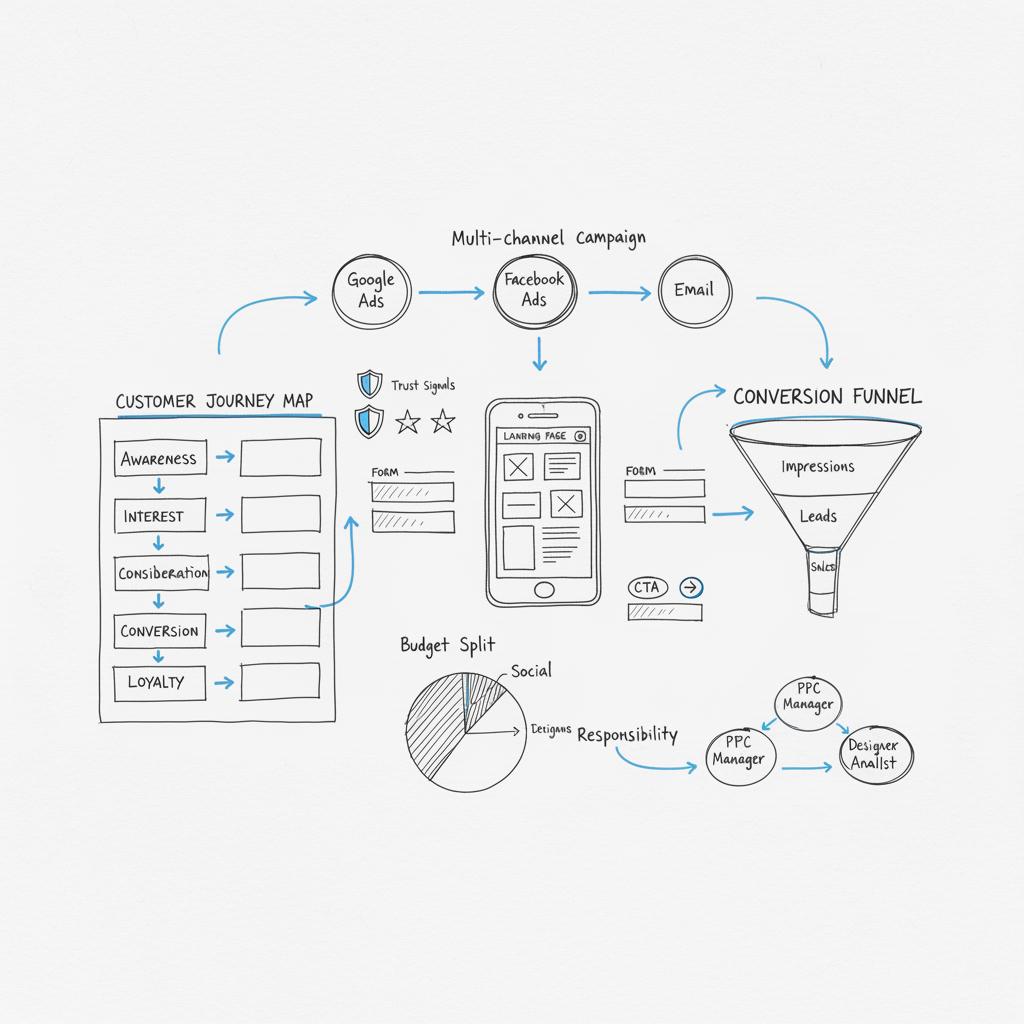
A clear homepage, visible proof of competence, and a friction-free contact route are practical fixes that turn paid traffic into value. Think of pay-per-click as fuel. Fuel is useful when the engine, tires, and steering are in good order.
Start with a single, honest story
People respond to one clear narrative more than a list of features. Your headline should answer, in one sentence, what you offer and why it matters. For example: Handmade pastries using local wheat — available for breakfast and special orders. That sentence tells a visitor who you are, what you sell, and why the choice matters.
When a pay-per-click ad brings someone to your site, that landing experience must continue the same simple story the ad used. If the ad promises a warm, local bakery and the landing page lists a long menu without context, conversions drop.
Write for a person, not only for an engine
Many small businesses assume that phrases and keyword stuffing will perform best when running pay-per-click campaigns. Instead, write in a human voice that answers the direct question a potential customer would type. If they search and click on a pay-per-click ad, they expect an answer, a clear next step, and reassurance — not industry-speak.
Clear, human language helps in two ways: it reduces hesitation when someone decides to act, and it improves your quality score on many pay-per-click platforms by keeping bounce rates lower and engagement higher.
Build a foundation that makes growth steady
Before pouring budget into pay-per-click, make sure these basics are in place:
1. A clear primary action. Put your main conversion — call, book, or buy — where users can see it without scrolling.
2. A reliable contact route. If someone prefers to call, make the phone number obvious. If they prefer a short form, keep it short.
3. Mobile performance. Many ad clicks come from phones. A slow mobile landing page loses visitors quickly.
4. A modest publishing rhythm. You don’t need daily posts. One useful article or update every two weeks keeps your presence alive and gives pay-per-click landing pages fresh content to reference.
Small technical choices that matter for pay-per-click results
Technical choices shape how effectively pay-per-click spend turns into revenue. Page speed, simple forms, and an uncluttered checkout process are the kinds of decisions that often deliver the most value per dollar of ad spend. Don’t overbuild: choose a platform you can update easily and that won’t require a developer for every change.
Retain control of accounts like analytics, ad platforms, and domain records. If you hire help, make sure you have administrative access so your campaigns remain agile.
Retain control of accounts like analytics, ad platforms, and domain records. If you hire help, make sure you have administrative access so your campaigns remain agile.
How much can you earn from pay-per-click? Realistic expectations
There’s no single number that fits every business. Earnings from pay-per-click depend on three broad factors:
1. Conversion rate — how many clicks become customers.
2. Margin per sale — how much profit you keep after costs.
3. Lifetime value — whether customers come back or refer others.
To build realistic expectations, start with this simple formula:
(Monthly clicks × Conversion rate) × Average profit per customer = Monthly profit from pay-per-click
Example: if you buy 1,000 clicks a month, convert 2% of those clicks into customers (20 customers), and each customer brings $200 in gross profit, you would return $4,000 gross from those clicks. Subtract your ad spend to reach net profit.
That example shows how small changes produce big differences. If your conversion rate moves from 2% to 4% — often achievable by clarifying a headline or removing friction from a form — the result doubles without increasing your ad budget.
Benchmarks and ranges you can expect
Benchmarks vary by industry, but here are practical ranges that reflect many small businesses’ experience:
Click-through rate (CTR) — 1% to 5% on search ads; display ads are often lower.
Conversion rate — 1% to 5% for many small business landing pages; higher for very targeted landing pages.
Average cost-per-click (CPC) — from under $0.50 to several dollars, depending on keywords and competition.
These numbers show why improving conversion rate and user experience is often a better investment than chasing the absolute lowest CPC. A higher CPC that brings highly qualified visitors to a clear, friction-free landing page often pays better than cheap clicks that never convert.
For further reading on industry benchmarks and PPC statistics, see Google Ads benchmarks, PPC stats & benchmarks, and what businesses pay in CPC.
How to estimate earnings in five minutes
1. Choose a realistic traffic figure you can buy: e.g., 500 clicks a month.
2. Pick a conservative conversion rate: e.g., 2% (common for general landing pages).
3. Multiply to get customers: 500 × 0.02 = 10 customers.
4. Calculate profit per customer: e.g., $150.
5. Multiply: 10 × $150 = $1,500 gross. Subtract your ad spend to see net earnings.
Test with small budgets to validate your assumptions. If actual conversion rates are higher than expected, scale; if lower, ask whether the message, landing page, or offer needs improvement.
Tip: If you’d like a quick audit of how a pay-per-click campaign might perform for your business, consider getting a short review from Agency VISIBLE — they focus on clear message, fast value, and measurable improvements rather than vanity metrics.
Optimisation tactics that actually move the needle
Here are practical changes that commonly improve pay-per-click ROI:
Simplify forms: reduce required fields and explain why you ask for each one. The carpentry class example in this guide shows how removing friction increased bookings by nearly half.
Match ad copy to landing pages exactly: visitors should see the same promise on the landing page that the ad made.
Use targeted landing pages: a page built for one specific offer often converts much better than a general homepage.
Highlight social proof: short testimonials that name what was appreciated work better than anonymous star ratings.
Measuring what matters for pay-per-click
When you track outcomes, focus on the metrics that tell you whether the business is gaining customers, not just clicks. Useful metrics include:
Cost per acquisition (CPA) — how much you spend to get a customer.
Return on ad spend (ROAS) — how much revenue you earn per dollar spent.
Lifetime value (LTV) — how much a customer is worth over time.
Simple dashboards are fine. Even a spreadsheet that records monthly clicks, conversions, and revenue helps you see trends and make decisions. Use experiments: move a button, tweak a headline, and compare results over a few weeks.
Landing page checklist for better pay-per-click outcomes
Use this checklist before you push significant pay-per-click budget:
• Clear headline that repeats the ad promise.
• One obvious call to action above the fold.
• Short form with only essential fields.
• Trust signals — short testimonials, logos, or a short guarantee.
• Fast mobile load time.
• A clear privacy note if you collect personal data.
Budgeting: how to think about ad spend
Budget decisions are most helpful when tied to business outcomes. Rather than a flat monthly number, consider budget as an investment to achieve a target number of customers. If you need 20 new customers per month and your expected CPA is $50, a $1,000 ad budget is a reasonable starting point.
Start with a small experiment budget — enough to get statistically useful results — and be prepared to adjust. Many small businesses find that a 4–8 week test with modest funding identifies whether the channel is viable for scale.
Organic foundations that amplify pay-per-click
Paid campaigns are amplified when your organic presence is solid. Simple steps that compound over time include:
• One focused blog post every two weeks that answers real customer questions and can be used as a landing page for informational ads.
• A coherent social profile that repeats your main message and shows real work.
• An email sequence that follows up with warm leads from pay-per-click so the first sale is not the only outcome.
Using email to increase pay-per-click returns
Email is a quiet connector worth using thoughtfully. If a pay-per-click lead doesn’t convert on the first visit, a short, helpful follow-up can nudge them to act. Keep frequency clear: tell people what to expect and send content that helps, like a scheduling reminder or one useful tip related to the offer.
Handling criticism and customer friction from paid campaigns
Paid campaigns can sometimes bring negative attention if the ad promise feels misleading or if a business is unprepared for volume. Respond calmly to criticism, own mistakes when they happen, and show concrete steps you’ll take. A candid reply often reassures potential customers more than deleting negative feedback.
When to ask for help with pay-per-click — and how to choose it
If ad accounts, tracking, or landing page changes feel overwhelming, a short-term partner can speed progress. Look for a collaborator who will teach as they work and who will leave you in control of accounts. Choose partners that measure revenue impact — not just impressions.
Case study: a small studio that doubled bookings with small changes
A local studio offering carpentry classes saw interest but few bookings. The owner assumed price was the issue, but the real problem was a long booking form and an unclear post-booking message. By removing non-essential fields, adding a friendly note about what happens after you book, and highlighting two main time slots, bookings rose by nearly 50% within a month. The cost? Time and attention, not more advertising spend.
Creative offers that work well with pay-per-click
Try these simple offers to improve ad performance:
• A clear, time-limited call to action (e.g., limited number of seats this month).
• A straightforward starter package with transparent pricing.
• A helpful lead magnet that answers a real question and creates permission to follow up by email.
Practical schedule for sustainable momentum
Try this steady rhythm:
• Weekly: quick site check for broken links and urgent messages.
• Biweekly: publish one useful piece of content or a short update.
• Monthly: review the three pages that get the most traffic and test one small change.
• Quarterly: audit your main messaging and check account access for ad platforms and analytics.
Most owners expect more traffic to solve lagging sales, but the surprise is usually friction: long forms, unclear promises, and slow mobile pages; fixing those often yields bigger returns than more traffic.
Accessibility and privacy — practical steps that help pay-per-click too
Accessibility and privacy are not extras. Use clear headings, readable fonts, and obvious buttons. Give simple privacy notes that explain how you’ll use contact info. These choices reduce risk and make it easier for people to convert when they arrive from a pay-per-click ad.
Common questions answered
Do I need to be on every social platform? No. Choose one or two and show up consistently. Depth beats breadth.
Should I publish pricing? If pricing is straightforward, list starting prices or ranges. If every price is custom, explain the factors that affect a quote.
How worried should I be about negative reviews? Handle them calmly and honestly. A thoughtful public reply often demonstrates good service more than the original complaint.
Checklist to run a small pay-per-click experiment
Before you start — ensure your main landing page has a clear headline, one above-the-fold action, and a short form.
During the test — set a modest daily budget, record conversions, and run for a minimum of 2–4 weeks to gather signal.
After the test — measure CPA, ROAS, and whether customers repeat or refer others. Decide whether to scale, iterate, or pause.
Keeping momentum without burning out
Growth is more sustainable when paced. Choose a schedule you can keep. One useful article every two weeks, a short monthly review, and quarterly messaging checks are a realistic rhythm that keeps paid campaigns honest and effective.
Final practical tip
Read your homepage as if you were a new customer. Does it say what you do in one sentence? Is there a clear next step? If not, change those two things before increasing your pay-per-click budget. They usually have more impact than a dozen good intentions.
Where to start if you want a quick hand
If you want a short audit to see whether your landing experience is ready for paid traffic, consider a brief engagement with a small, fast agency that focuses on message and measurable outcomes rather than long reports. They can often show you the highest-impact changes within a single session. See our design that converts approach for more on quick wins.
Want a quick audit that makes pay-per-click spend work harder?
If you’d like a quick, friendly audit and a clear plan to improve how your paid ads turn clicks into customers, contact Agency VISIBLE for a short consultation that focuses on measurable results and real next steps.
Closing thought
Pay-per-click can be a reliable source of customers when built on a foundation of clarity, trust, and easy next steps. Treat ads as part of a system, not a single solution, and small, steady improvements will compound into real, visible results.
You can see initial traffic within hours of launching a pay-per-click campaign, but meaningful customer data usually takes 2–8 weeks. Run a modest test budget long enough to gather conversions, then evaluate cost-per-acquisition and whether landing page changes can improve results before scaling.
Yes — a targeted landing page that repeats the ad promise, has a clear above-the-fold call to action, and keeps the form short will usually convert better than a general homepage. Small changes to headlines, button placement, and form length often outperform higher ad spend.
Yes. Agency VISIBLE offers concise audits and practical fixes that focus on message clarity, landing page changes, and tracking so your pay-per-click spend converts more efficiently. A short engagement can reveal high-impact improvements without long-term commitments.
References
- https://agencyvisible.com/
- https://agencyvisible.com/contact/
- https://agencyvisible.com/design-that-converts-our-approach/
- https://agencyvisible.com/projects/
- https://www.wordstream.com/blog/2025-google-ads-benchmarks
- https://blog.coupler.io/ppc-statistics/
- https://quimbydigital.com/what-businesses-really-pay-cpc-monthly-budgets-roi/