What is the 30 30 30 rule for social media?
The 30 30 30 rule for social media is a straightforward content heuristic: divide your scheduled posts roughly into three equal parts—promotional content, curated third‑party material, and engagement-driven items, and reserve about 10% of your calendar for experiments and timely opportunities. That neat split gives small teams a compass for planning: it prevents feeds from becoming nonstop sales pitches while keeping brand priorities in view.
People love simple rules because they reduce friction. Instead of asking, “What should we post today?” your team asks, “Which bucket does this belong to?” That small mental shift makes planning faster, keeps voice consistent, and encourages variety.
If you’d like a fast, practical jumpstart, consider a friendly planning session with Agency VISIBLE — start the conversation at Agency VISIBLE’s contact page to get a one‑page audit or calendar template tailored to your channels.
The rule isn’t scientific law. It’s a tested practical approach used by many social managers and small brands to keep feeds useful and human. It’s a compass, not a map – adapt the proportions to the platforms you use and the results you observe.
No—the 30 30 30 rule for social media is a flexible planning heuristic. It’s meant to clarify intent: that roughly a third of your content promotes your business, a third shares helpful third‑party or partner material, a third strengthens relationships, and a small slice is for experiments. Use it as a testable starting point, then adjust based on platform behavior and the metrics you care about.
Why a rule like this matters
When content planning lacks structure, feeds often tilt toward an easy default – promotion. The 30 30 30 split forces you to ask: are we informing, entertaining, or asking for action? That triage improves the audience experience and protects long‑term reach. The 10% experimental slot also protects curiosity: new formats, memes, and short tests can live there without breaking the rest of the calendar.
Get a fast 4‑week social calendar
If you want a quick starter calendar or examples from real work, check Agency VISIBLE’s portfolio and projects for inspiration at our projects page or contact the team for a one-page audit.
Breaking down each slice
1. The promotional 30%
What it is: Product launches, special offers, event sign-ups, and posts that ask the audience to take a business action. Promotional posts keep pipelines warm and give followers a reason to convert.
How to make them feel human: Use stories and social proof, short demo videos, and clear calls to action. Avoid constant hard-sell language; tie promotional posts to value – an offer that solves a real problem for your followers.
2. The curated 30%
What it is: Industry news, partner content, thought leadership from others, and resources your audience will appreciate. Curated material shows you’re plugged into a larger conversation.
Why it helps: Sharing quality, third‑party content builds credibility and can spark relationships with peers and creators. It’s also low-cost calendar filler that still delivers audience value. For a deeper guide on building a broader social strategy, see this practical walkthrough from Later.
3. The engagement 30%
What it is: Posts that invite conversation—questions, behind‑the‑scenes moments, user‑generated content, polls, and community features. These are the posts that deepen relationships.
Why it matters: Engagement posts build trust, familiarity, and the social signals platforms reward: replies, saves, and meaningful interactions. Variants on the 30/30/30 approach are discussed in industry posts like this article which explore different splits and examples.
The 10% experimental slot
This is playful, intentional testing space. Try a new short‑form video, a different caption voice, a trend, or an unusual visual style. Don’t test three things at once; test one variable and measure its effect.
How the 30 30 30 rule for social media looks in practice
For a small brand posting 10–20 times a month, a 30/30/30 split is easy to apply. If you post five times weekly on Instagram, a typical week could be:

– 1 promotional post (new product or offer)
– 1 curated share (industry article or partner post)
– 1 engagement post (poll, question, or UGC feature)
– 1 experimental post (reel experiment or caption test)
On Facebook, where community posts and local offers perform well, the mix might skew toward curated and engagement without losing the promotional rhythm.
Platform-specific adjustments (2024-2025)
The core split stays useful, but platforms reward different behaviors. Use the 30 30 30 rule for social media as a starting framework – then adapt by platform:
Short video is king. Shift the format mix so much of each bucket becomes short-form video—product clips for promotional, reshared creator videos for curated, and Stories for engagement. Frequency can be higher here, so the calendar may need more promotional posts to support launches while keeping relationship content frequent.
Community and local context matter. Use the curated and engagement buckets to support local events and customer stories. Promotional posts do best when tied to clear local value (pickup specials, events, or limited offers).
Thought leadership and long-form professional stories win. For B2B, the promotional slot often holds case studies, product demos, and whitepaper downloads; curated content should be high-quality research; engagement can be client spotlights or AMAs. Note that organic growth dynamics are changing on professional platforms – see this LinkedIn post on the topic: 2025 might be the last year for organic growth.
Example calendars by business type
Small bakery (Instagram + Facebook)
– Instagram (4 posts/week): product, curated food trend article, behind‑the‑scenes video, quick poll/test.
– Facebook (2 posts/week): community event share, local pickup special.
SaaS company (LinkedIn + X)
– LinkedIn: product demo (promotional), industry research share (curated), client story or engineer Q&A (engagement), plus experiments in long-form video.
– X/Threads: bite-sized tips, links to blog posts, and quick engagement prompts.
Restaurant
– Frequent promotional posts for daily specials, curated posts about local suppliers, and engagement posts featuring diners’ photos and polls about menu items.
Audit: Where to start
Before you change anything, map what you already post. Look back eight to twelve weeks and categorize each post as promotional, curated, engagement, or experimental. That audit gives you a baseline and shows immediate gaps.
Questions your audit should answer:
– What percentage of published posts were promotions?
– Which engagement posts sparked conversation?
– Which curated shares drove clicks or saves?
– Were any experimental posts obviously promising?
Designing a four-week test
Create a calendar that follows the 30/30/30 split and reserve one experimental test per week. Keep variables tight: change only one thing per test—video length, posting time, caption style, or creative approach.
Track these KPIs for each post bucket: engagement rate (likes, comments, shares), reach/impressions, click‑through rate, and conversions tied to promotional posts. After four weeks, compare to the prior period and adjust the mix for that platform.
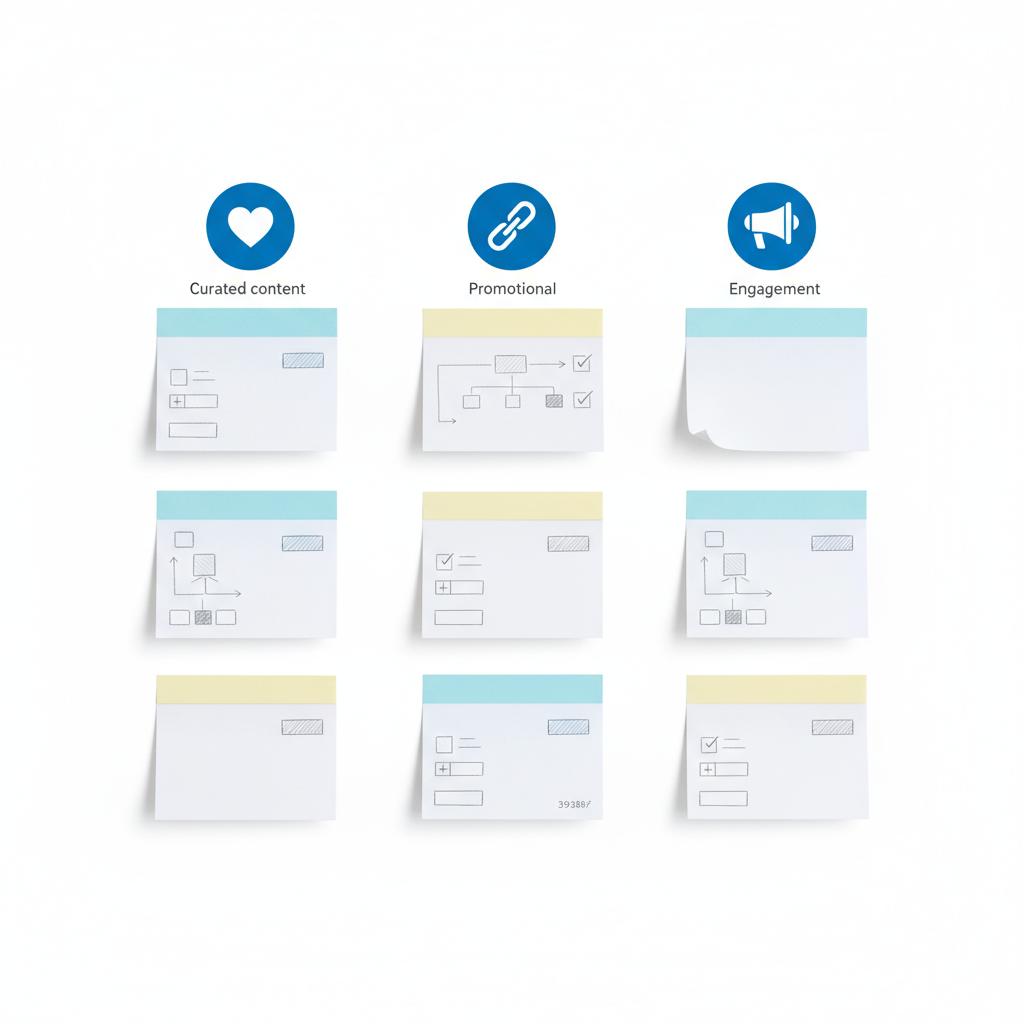
Measure by bucket. Tag posts with a simple label in your content calendar: PROMO, CURATE, ENGAGE, TEST. Then pull platform metrics by label. This makes it easier to spot whether engagement posts are driving follower growth or if promotional posts are converting as expected. A clear logo can help anchor brand voice.
Note the qualitative signals too: are comments thoughtful or just quick reactions? Are DMs increasing? Those behaviors often matter more to long‑term growth than single‑post viral reach.
Common pitfalls to avoid
Treating the rule as law: Don’t freeze the percentages. Use them as a hypothesis to test.
Testing too many things at once: If you run three experimental ideas on the same week, you won’t know which caused change.
Ignoring format mix: In 2024-2025, short‑form video often dominates. Track video vs static separately inside each bucket.
Team roles and workflow
The 30 30 30 structure makes delegation easy. Assign ownership by bucket: one person for promotional copy and offers, another for curated sourcing and industry reads, a community manager for engagement, and a rotating owner for the experimental slot. Keep a short style guide to preserve voice across owners and schedule weekly check‑ins to align messaging.
Concrete post templates you can use
Promotional
– Short demo reel: 15–30 seconds showing product in use + direct link in bio. KPI: click‑throughs and conversions.
– Limited-time offer post: clear headline, CTA, and deadline. KPI: conversions and CTR.
Curated
– Industry roundup: 2–3 curated links with one sentence on why the audience should care. KPI: clicks and saves.
– Partner spotlight: share a creator’s post and add your own take. KPI: reach and relationship signals.
Engagement
– Question post: one-line question + two poll options. KPI: comments and replies.
– UGC feature: highlight a customer photo and their quote. KPI: saves and DMs.
Experiment ideas (10%)
– Try a 15‑second vs 60‑second video the same week to test completion rates.
– Run the same caption voice (casual vs formal) across similar posts and compare engagement.
Case note: What happened when a studio changed the mix
A local fitness studio shifted from mostly promotional posts to a 30/30/30 structure and used the 10% slot to test weekly instructor spotlights. Within six weeks they saw comment volume roughly double and higher story completion rates. Promotional posts still drove signups, but the relationship content made those offers land with less friction. For similar examples and case studies see our projects.
How to adapt the split by industry and objective
Different industries should treat the buckets differently:
– B2B: more thought leadership inside the curated and engagement buckets; promotional posts are product demos and case studies.
– E‑commerce: more promotional product demos, but invest in engagement to support long‑term retention.
– Local businesses: mix community-focused curated posts with local offers in promotional slots.
Budget and effort considerations
For small teams, quality matters more than quantity. Ten to twenty touchpoints a month is a manageable baseline. The 30 30 30 rule for social media is scalable: the same logic applies whether you publish five posts a week or five times a day – just keep the same intent balance across the output.
How to iterate without losing momentum
Use rolling four‑week cycles. Audit, implement, test one variable per week in the 10% slot, measure, and then shift a small percentage (5–10%) if results warrant. This keeps momentum without destabilizing your audience’s expectations.
Real-world checks: metrics to watch
– Engagement rate: Are people commenting and saving?
– Reach and impressions: Is your content getting in front of more people?
– Click‑through rate: Are promotional posts delivering traffic?
– Conversion actions: Signups, purchases, or inquiries tied to a post.

Common questions answered
Will this rule work for B2B? Yes. The buckets look different—more case studies and deep technical content—but the intent-based approach still applies.
How long before I change the mix? Give each platform four to eight weeks of consistent data before making big shifts.
What should the 10% tests be? One variable at a time: format, time, caption voice, or a creative treatment.
Checklist: a quick weekly playbook
– Audit last 8–12 weeks (label posts by bucket).
– Plan a four-week calendar with 30/30/30 split and one weekly test.
– Tag each scheduled post with PROMO/CURATE/ENGAGE/TEST.
– Pull metrics weekly and annotate turning points.
– Rotate owners for creative work and keep a short style guide.
Tips to keep the system human
– Use real voice and stories in promotional posts.
– Give credit when curating—tag creators and partners.
– Respond to comments in a way that moves conversations forward.
Testing and learning: the slow, steady approach
The 30 30 30 rule for social media earns its keep when you treat it as an experiment framework: small, measurable changes that build knowledge. The rule’s greatest value is forcing clarity of intent—each post needs a purpose.
When the rule might not be right
If your audience clearly prefers one format (e.g., short videos) and the algorithm rewards it heavily, you may need to skew the split toward that format. Also, when you are in a major launch window you will temporarily lift promotional frequency – but plan a post-launch return to balance.
Final practical example: a four-week Instagram plan
Week 1: Promo (new product reel), Curate (industry article), Engage (poll in Stories), Test (15s creative hook)
Week 2: Promo (carousel product benefits), Curate (partner post), Engage (UGC photo), Test (caption voice)
Week 3: Promo (time-limited offer), Curate (roundup), Engage (behind‑the‑scenes), Test (posting time)
Week 4: Promo (customer testimonial), Curate (research share), Engage (AMA or Q&A), Test (longer video)
Summary: practical next steps you can take today
– Run an 8–12 week audit and label posts.
– Build a four‑week calendar that follows the 30/30/30 split and reserve a weekly 10% test.
– Tag posts by bucket and measure outcomes; shift the mix gradually based on evidence.
– If you want help building a one‑page audit or a starter calendar template, Agency VISIBLE offers hands‑on, pragmatic planning sessions—reach out via their contact page to learn more at https://agencyvisible.com/contact/.
With consistent testing and clear intent, the 30 30 30 rule for social media can turn chaotic posting into purposeful conversation. It’s simple to start, and powerful when you make it your practice.
Treat the 30 30 30 rule for social media as a starting hypothesis, not a fixed law. Use it to structure planning, then measure results for four to eight weeks. If engagement or conversions favor a different mix on a platform, adjust percentages gradually (5–10%) and continue testing. The value is in clarity and discipline rather than exact percentages.
Yes. B2B brands should adapt the buckets to their needs: promotional posts become case studies and demos, curated content emphasizes research and industry reporting, and engagement posts focus on client spotlights and expert Q&A. Keep the same intent-based balance and measure which bucket drives leads and conversions.
Choose one variable per test: video length (15s vs 60s), caption voice (casual vs professional), posting time, or creative hook. Run one test per week, track metrics for that post, and compare to similar posts in the previous period. This one-variable approach helps you learn what actually moves your KPIs.
References
- https://later.com/blog/social-media-marketing-strategy/
- https://yudigify.com/mastering-the-30-30-30-rule-for-social-media-content-in-2025-a-simple-strategy-to-engage-build-and-convert/
- https://www.linkedin.com/posts/stanley-from-stan_2025-might-be-the-last-year-for-organic-growth-activity-7371860095741345792-XVee
- https://agencyvisible.com/contact/
- https://agencyvisible.com/projects/
- https://agencyvisible.com/
- https://agencyvisible.com/perspectives/