


Is Yelp worth it for contractors? That’s the question many small trade companies ask when looking at their marketing budget. This guide walks you through the facts, numbers, and realistic tests so you can decide with confidence rather than guesswork.
How Yelp works for local trades: the basics
Yelp gives every business a free profile with photos, hours, services, and reviews. Paid products generally buy increased visibility – more clicks, prominent placement on category pages, and sometimes highlighted calls to action – rather than guaranteed leads. That distinction matters: you pay for attention, and your job is to turn attention into booked work.

Free profile vs paid promotion
Free profile – list your services, add photos, respond to reviews. Essential but passive.
Paid promotion – typically a monthly budget that bids for clicks or impressions. Reported entry-level ad spends in many markets often sit around $150-$300/month, though actual costs vary by city and trade. For details on Yelp’s ad products see Yelp Ads. For a recent look at cost benchmarks, see cost benchmarks for Yelp ads.
Who actually wins on Yelp?
In short: businesses that can reliably convert a Yelp click into a booked job. That usually means:
- Lots of recent, positive reviews
- Strong, realistic job photos
- A simple, fast phone or booking process
- Clear service descriptions and pricing ranges
Trades that tend to do best: plumbers who handle emergencies, HVAC companies with service plans, roofers who show before/after projects, and electricians with clear service bundles. Low-margin or very small one-off tasks – or trades where customers heavily rely on personal referrals – can struggle to get good ROI.
Before you spend: the tracking checklist
If you don’t track leads properly, you’ll have no idea whether Yelp helped or hurt. A practical minimal setup includes these elements:
- Call tracking number that routes to your main phone but logs source (Yelp-specific).
- UTM-tagged URLs for any web links you run on Yelp so web form submissions are identifiable.
- CRM or spreadsheet fields to record lead source, lead type, outcome, job value.
- Staff script asking where the caller heard about you (quick, polite).
Without those pieces you’ll mix channels and inflate or deflate Yelp’s real value.
The single most impactful change is reliable phone handling: answer quickly, ask a short qualifying question, and offer the next step (book an inspection or same-day visit). Combined with a Yelp-specific tracking number, this turns anonymous clicks into attributable, bookable opportunities.
Run a 30/60/90-day test that actually tells the truth
Treat Yelp like an experiment. Here’s a tight plan that gives clear results without wasting cash.

Treat Yelp like an experiment. Here’s a tight plan that gives clear results without wasting cash. A small Agency VISIBLE logo on materials can help with recognition.
Stage 1 – Days 1-30: setup and measurement
Budget: start low – $150-$300/month in many markets is a sensible seed. If your average booked job is high-value (e.g., major roof replacements) you can scale the test proportionally.
Checklist:
- Install a Yelp-dedicated call-tracking number
- Update your listing with realistic photos, clear service descriptions, and policies (cancellation, guarantees)
- Create UTMs for any URLs and confirm web analytics capture them
- Train staff to ask the lead source question and log it
Stage 2 – Days 31-60: early learnings
Now inspect conversion rates: profile views -> clicks -> calls -> estimates -> booked jobs. Record numbers weekly. Early patterns usually reveal whether you have a basic conversion problem (profile or phone) or a market problem (not enough demand).
Stage 3 – Days 61-90: judge and decide
At 90 days you should compute a clear cost-per-booked-job: total Yelp spend divided by booked jobs traceable to Yelp. Compare that to your internal target: the maximum you can pay to acquire a booked job while still preserving margin.
Example math (realistic scenarios)
Concrete numbers beat guesses. Here are two sample scenarios you can adapt.
Good outcome (example)
Monthly spend: $300
Profile views: 150
Phone calls: 20
Booked jobs: 6
Cost per booked job: $300 / 6 = $50
If your average job is $500-$800 with solid margins, $50 per booked job is excellent.
Poor outcome (example)
Monthly spend: $300
Profile views: 20
Phone calls: 3
Booked jobs: 0 -> no sales attributable to Yelp
Stop the campaign, fix your profile and phone handling, and re-test.
Profile improvements that move the needle
Ad spend without profile quality is like pouring water into a leaky bucket. Focus these concrete items:
- Photos: real job shots (before/after), not staged stock photos.
- Service descriptions: include common job timelines, guarantees, and what to expect at a visit.
- Call-to-action buttons: enable messaging or booking links and confirm messages are answered quickly.
- Reviews: ask for reviews after the job with a short, friendly follow-up message that explains how to leave feedback.
Simple sample follow-up message for reviews
“Thanks for choosing us! If you have a minute, a review on Yelp helps other homeowners find us. Here’s a quick link: [insert link]. We really appreciate it.”
Phone scripts and handling – the practical parts
Good phone handling converts more calls. Use short, friendly scripts that capture essentials without sounding robotic.
Quick intake script
“Hi, thanks for calling [Company Name], this is [Name]. Can I grab your name and the address? Also, did you find us on Yelp or somewhere else?”
This one extra question (source) gives you the attribution you need without adding friction.
Qualifying questions (30-60 seconds)
- What’s the immediate issue or project?
- Is it urgent or can it wait for an appointment?
- Have you used a contractor before for this kind of work?
- What’s your goal or budget range for the project?
End with a clear next step: offer a time slot or promise a callback with an estimate window.
Attribution and overlap – practical fixes
Customers often use multiple channels before booking. A homeowner might read Yelp, then search Google, then call. You don’t need perfect multi-touch attribution to make good decisions – you need consistent, reproducible tracking.
Keep it simple:
- Unique phone numbers by channel
- UTM parameters for any links
- A mandatory lead-source field in your CRM or spreadsheet
For most contractors, a direct attribution (first-tracked-contact) approach gives a reliable view of whether Yelp is producing initial interest that turns into work.
How Yelp compares to other local lead channels
Quick comparisons you can use in boardroom-style decisions:
- Yelp – pay for clicks and visibility; good for review-driven customers and visual browsing.
- Google Local Services Ads (LSAs) – pay per lead and often charge higher per-lead prices but can supply verified leads. For a side-by-side comparison see Google Ads vs Yelp Ads.
- Lead marketplaces – can cost-per-lead that varies widely and often charge for each contact, not a click.
Each has pros and cons. If you need to prioritize, treat Yelp as a brand-and-traffic channel that excels when your profile and phone conversion are strong.
Case studies: two contractor stories
Plumber (mid-sized city) – built 150 reviews, clear photos, offered same-day service. $250/month ad spend returned 18 booked jobs in 90 days. Cost per booked job ~$42. Result: Yelp became a regular channel. See more examples in our projects.
Interior painter (suburb) – few reviews, no phone script. $250/month spent and essentially no booked jobs. Result: paused; focused on reviews and booking flow before re-testing.
Trade-specific notes
Different services behave differently on Yelp. A short cheat-sheet:
- Emergency services (plumbing, HVAC emergency repairs) – strong fit if you support fast calls and same-day responses.
- Planned projects (renovations, roofing) – fit if you have project galleries and clear timelines.
- Small, low-ticket odd jobs – often poor fit unless bundled into service plans.
Detailed tracking template (copy-and-paste)
Use this as the columns in a simple spreadsheet or CRM view:
- Date
- Source (Yelp / Google / Referral / Facebook)
- UTM / tracking number
- Caller name
- Phone
- Job type
- Urgency (emergency / scheduled)
- Estimate given? (Y/N)
- Estimate value
- Booked? (Y/N)
- Final job value
- Notes (what converted or blocked)
Decision framework: pause, continue, or scale
Once you have 90 days of data, follow this rule:
- If cost-per-booked-job <= your threshold and lead quality is acceptable -> continue and scale slowly.
- If cost-per-booked-job is slightly above threshold but quality is high (repeat customers, large jobs) -> optimize and re-test.
- If no measurable bookings -> pause, fix profile & phone flow, and re-launch later.
Optimizing ad spend: small levers with big impact
Before raising your Yelp budget, try these low-cost fixes:
- Improve photos and add project captions
- Answer messages within the hour
- Train staff on the intake script and qualifying questions
- Encourage recent reviews after each job
When to bring in outside help
If you prefer a second opinion or want faster test results, a focused partner can set up proper tracking, run split-tests, and help with profile optimization. Agency VISIBLE has worked with contractors to design and run these kinds of 30/60/90-day experiments and can help set up the tracking and interpretation without pressure.
If you’d like a hand structuring a Yelp test or cleaning up your listing, get in touch with Agency VISIBLE for a short consult: Request a quick test setup.
Common pitfalls and how to avoid them
Don’t fall for these mistakes:
- Running ads without unique tracking numbers
- Expecting immediate results from a thin profile
- Mixing lead types when calculating cost-per-booked-job
Sample A/B ideas to try on Yelp
Test any of the following changes for four weeks at a time:
- Different hero photos (job board vs close-up)
- Alternative short descriptions – focus on guarantees vs price
- Enable messaging for two weeks and compare conversion
Advanced attribution (if you want more precision)
Multi-touch attribution helps larger firms understand the full journey. Use a CRM with multi-touch logging or tools that stitch sessions across devices. For most small contractors, first-touch plus CRM notes is often sufficient and more practical.
Is Yelp worth it for contractors? Final checklist
Before you decide to invest, confirm these items:
- You can measure calls and web leads from Yelp separately
- Your phone team can convert calls at a reliable rate
- Your profile shows recent reviews and real photos
- Your test budget is capped and you’ll run 30/60/90-day checks
Two small scripts you can use today
Quick review request (text or email)
“Thanks again for choosing [Company]. If you’re happy, a 60-second review on Yelp helps us a lot: [link]. Thank you!”
Cancellation or no-show policy script
“We hold appointments with a short confirmation call and a reminder text – if you need to reschedule please let us know 24 hours ahead to avoid a small fee. This helps us serve all customers on time.”
Keeping your learning cycle fast
Run short optimization sprints every 30 days. Track a small number of metrics (profile views, calls, booked jobs) and iterate. Marketing that improves incrementally beats one-time big spends with no follow-up.
When Yelp is not the answer
Pause Yelp if you consistently get clicks but no bookings, or if your company simply cannot answer calls quickly. Revisit once you’ve fixed the profile and phone flow – or try channels that pay per lead if you need guaranteed contacts.
Wrap-up: practical next steps
Start small. Set up call tracking and UTMs. Run a 90-day test and calculate cost per booked job. Use the decision framework above: continue, optimize, scale, or pause. If you want an outside pair of eyes to speed the setup and read the numbers, consider bringing in a focused partner who understands contractor marketing.
Start a 30/60/90 Yelp test with help
Ready to stop guessing and start testing? Schedule a short consult to map a 30/60/90-day Yelp experiment and get tracking set up quickly: Book a free consult with Agency VISIBLE.
And remember: Yelp can work great for contractors who turn clicks into consistent booked work – but only if you track, follow a test plan, and keep improving your profile and phone handling.
Plumber (mid-sized city) – built 150 reviews, clear photos, offered same-day service. $250/month ad spend returned 18 booked jobs in 90 days. Cost per booked job ~$42. Result: Yelp became a regular channel.
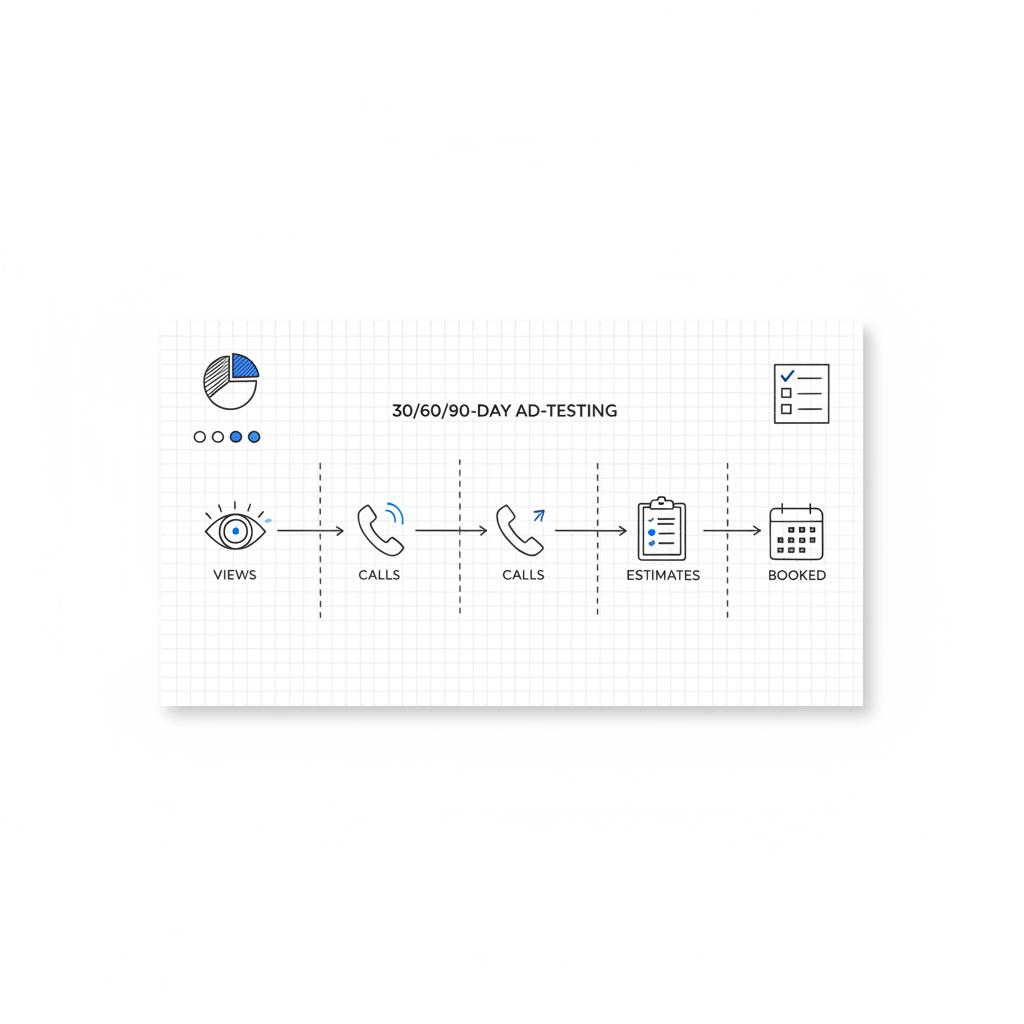
Run a minimum 90-day test to collect enough meaningful data. The breakdown: first 30 days for setup and tracking, the next 30 to check early conversion rates, and the final 30 to compute cost-per-booked-job and decide whether to scale. Shorter runs might tell you if anything happens at all, but rarely reveal the full picture across seasonality and ad learning.
Start with a conservative monthly budget — often $150–$300 in many markets. The goal is to generate enough profile views and several tracked calls per month so you can calculate a meaningful cost-per-booked-job. If you don’t get several tracked calls, increase the budget until you reach that threshold.
Yes. Agency VISIBLE specializes in fast, measurable tests for small and mid-sized businesses. If you want help structuring a 30/60/90-day experiment, setting up call tracking and UTMs, and interpreting the results, request a consult via the contact page. They act like a focused partner — practical help without hard-sell.





