


Start here: the quick reality
Are Google Ads worth it for contractors? It’s a common question – and the right answer is: it depends. Early in your decision process, think of advertising as a system, not a button. You’ll hear the shorthand “contractor PPC” a lot in this article; that’s the paid-search work that brings customers straight to your phone or form. When the plumbing is right, contractor PPC can deliver predictable, scalable leads. When it’s not, the faucet runs and the money leaks away.
Contractor PPC appears in many forms: Google Search campaigns, Local Services Ads (LSAs), and third-party marketplaces like Angi or HomeAdvisor. Each has a role. This guide explains the economics, the tracking you must have, the tests that give real answers, and the small operational changes that turn clicks into paid jobs.
If you want a sparring partner to set up clean tracking and run a careful, small test, check out Agency VISIBLE’s contact page — they work directly with contractors to design measurable campaigns and keep the focus on profitable growth.
Benchmarks that matter
Benchmarks give direction, not destiny. Typical cost-per-lead (CPL) for home services ranges roughly from $45 to $250. Search cost-per-click (CPC) often sits between $3 and $15, depending on city and keyword. Conversion rates for search ads across industries average 6–8%, but contractor-specific conversion and close rates are different and should be measured locally. See Google Ads benchmarks for general ad metrics, and deeper CPL breakdowns from FirstPageSage and Sopro.
Put that together: contractor PPC can make sense for mid- to high-ticket jobs. If your average job is $1,000+ and your close rate is decent, a CPL of $100–$200 can be profitable. For small jobs with low margins, the same CPL defeats profitability quickly.

Real-world math: quick examples
Example 1 – Roofing: average job $8,000, close rate 25%. Spend $1,000 and get eight leads (CPL $125). Two closed jobs mean $16,000 in gross revenue from $1,000 ad spend. Profitable, assuming job costs and overhead are reasonable.
Example 2 – Handyman: average job $200, close rate 40%. Ten leads for $750 (CPL $75) might convert to four jobs = $800 revenue. After labor and materials, ad spend likely loses money. Same faucet, different bucket.
Local Services Ads vs Google Search Ads
Which one should you try first? Both – but test against each other. LSAs appear at the very top of local searches and encourage immediate phone calls. They’re great for urgent, phone-driven work: burst pipes, no-heat houses, or emergency toilets. The trade-off is lead quality and regional availability. LSAs often send more volume but also more low-ticket or low-quality calls.
Search ads give you more control: keyword targeting, ad groups for specific services, ad extensions, and the ability to funnel leads into a CRM. If you care about measurement and want to tie leads to closed jobs, search campaigns are more testable and more controllable.
Where contractor PPC dollars typically go
For $1,000 of spend expect between 5 and 20 leads depending on season, competition, and ad quality. That’s a CPL between about $50 and $200. Your city, service, and timing shift that range. Peak season in dense metros pushes CPCs and CPLs upward; off-season can reduce them.
Tracking: the make-or-break element
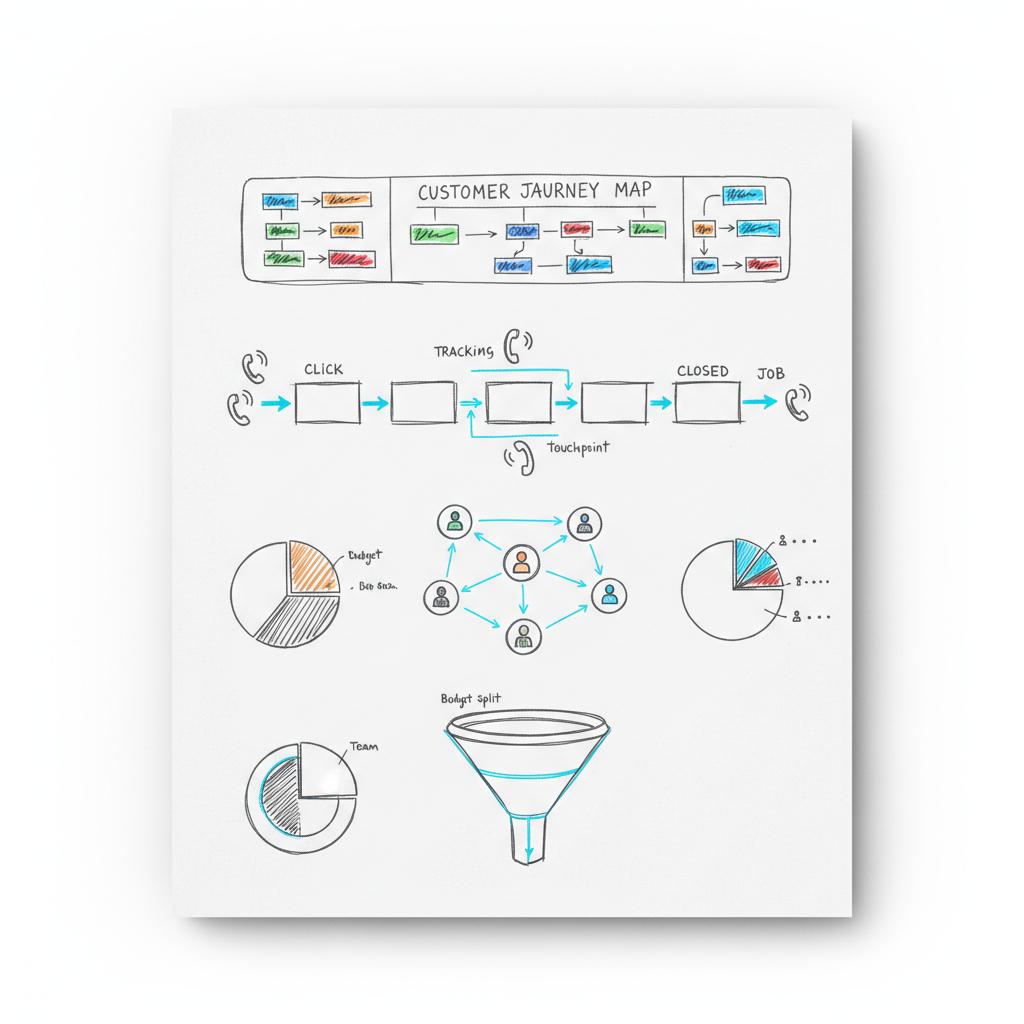
Poor tracking is the usual reason contractor PPC fails. Leads arrive by phone, form, chat, or marketplaces—without consistent attribution you can’t measure cost per acquisition. Start with these basics:
- Call tracking numbers assigned per campaign or channel
- Form tracking that logs the source, campaign, and keyword
- CRM integration so every lead is tagged and followed
Measure close rates by source. You’ll be surprised how often branded searches cost more but close at much higher rates. That shifts your bidding and budget decisions.
Automation and smart bidding – use them carefully
Google’s automated bidding works when it has good conversion signals. Don’t flip automation on until you have consistent, real conversion data – real closed jobs, not just form fills. A poorly seeded smart bidding strategy chases the wrong signals and spends rapidly.
Practical campaign setup for contractors
Tight geos, service-specific campaigns, and precise negative keywords should be your mantra. Home services are local. Set geographic boundaries to your actual service area and avoid a 50-mile spray that attracts non-converting clicks. Create campaigns per service—roof repair, emergency plumbing, kitchen remodel—and make the ad copy and landing pages match the searcher’s intent.
Use ad extensions (call, location, structured snippets) to increase visibility and provide direct paths to call or directions. Add negative keywords regularly to block irrelevant searches: “cheap”, “DIY”, or service areas you don’t cover.
Landing pages and messaging that convert
Match the landing page to the ad. If the ad promises a fast emergency plumber, the landing page should highlight quick response times, licensing, and trust signals (reviews, badges). Test two types of pages: one highlights price and offers, the other emphasizes trust and proof. Measure which brings better qualified leads. Including a clear logo helps recognition.
Match the landing page to the ad. If the ad promises a fast emergency plumber, the landing page should highlight quick response times, licensing, and trust signals (reviews, badges). Test two types of pages: one highlights price and offers, the other emphasizes trust and proof. Measure which brings better qualified leads.
Yes—if the test is tight and well-tracked. Focus on one service, a small geographic radius, and run LSAs and Search in parallel. Track every lead into your CRM and measure cost per closed job over 60–90 days. Small, well-instrumented tests teach more than large, unfocused budgets.
How to judge profitability: a simple, reliable formula
Three numbers tell the story: average job value, close rate from that lead source, and gross margin. Multiply them and compare to CPL.
Example calculation: $3,000 job × 20% close rate × 35% gross margin = $210 expected gross profit per paid lead. If CPL is $150 you’re net positive; if CPL is $250 you’re losing money.
Include lifetime value and referrals
This simple formula ignores lifetime value and referrals. If a paid lead becomes a repeat customer or sends referrals, the real value of a closed job can be much higher. Track referrals and repeat business to get the full picture.
Testing framework that gives quick answers
Run focused tests to avoid wasting budget. A reliable test includes:
- One service per campaign
- Tight geographic targeting
- Two channels in parallel: LSA and search
- Call and form tracking linked to your CRM
- 60–90 day measurement window focused on cost per closed job
Also test creatives and landing pages. Try making one landing page price-focused and another proof-focused. Track not just how many leads come in, but whether they show up for quotes, accept work, and pay.
Script and process changes that lift close rates
Small operational shifts drive big improvements:
- Answer calls fast—within the first ring when possible
- Use a quick qualifying script that asks for job type, urgency, and approximate budget
- Train crews to ask “How did you hear about us?” at the first visit
- Follow up on no-shows with a clear next-step offer
These tactics boost the effective close rate of every paid lead and improve the ROI of contractor PPC.
Channel comparison: paid, organic, and marketplaces
Organic search (SEO) compounds over time. It’s cheaper per lead in the long run, but slow to build. Paid search gives immediate, testable demand. Marketplaces give volume fast but can be costly and inconsistent in lead quality.
A common winning mix: use contractor PPC for immediate demand, invest in SEO for long-term growth, and use marketplaces selectively for specific services or volume spikes.
Common campaign pitfalls and how to avoid them
Don’t make these mistakes:
- Poor tracking and attribution
- Generic landing pages that don’t match the ad intent
- Overbroad targeting that wastes clicks
- Missing negative keywords
- Turning on automation before you have quality conversion data
Fixes are simple: tag leads, tighten geography, create service-specific pages, add negatives, and wait on full automation until your data is solid.
Smart bidding signals and what to feed them
When you’re ready for automated bidding, feed the model high-quality signals: closed jobs, job value, and conversion times. If you only feed form fills, the model optimizes for quantity over quality. Label conversions by value where possible so Google can prioritize higher-value leads.
When Google Ads aren’t the right tool
There are times to skip contractor PPC. If your average job value falls below your typical CPLs and close rates are low, paid search will likely never be profitable. If you can’t attribute leads to campaigns or you rely heavily on referrals and walk-ins with no way to tag sources, focus on SEO, reputation, and referral programs instead.
Checklist: before you spend a dollar
Answer these questions first:
- How much is an average job worth?
- What do you expect your close rate to be from inbound leads?
- What gross margin does each job deliver?
- Do you have call tracking and CRM tagging?
- Can you answer the phone now and follow up promptly?
If you can’t answer them honestly, fix tracking and processes before scaling ad spend. Poor operations turn contractor PPC into a money pit.
Landing page checklist
High-converting pages usually include:
- Clear headline matching the ad
- Fast load time and mobile-first layout
- Trust indicators: reviews, licenses, insurance badges
- Visible phone number and a clear call-to-action
- Brief form that asks the right qualifying questions
Advanced tests and ideas
Try these tests to refine contractor PPC performance:
- LSA vs Search split test for the same service and area
- Radius shrink test—smaller area, higher intent keywords
- Landing page A/B tests: price vs proof
- Keyword SKAGs (single keyword ad groups) for high-value services
- Call-first landing pages for emergency services
Anecdote that teaches
An Ohio HVAC firm split budget between LSA and search last winter. LSAs generated many calls—lots of low-ticket filter changes and quick service calls. Search produced fewer leads but higher-value replacement-job calls. After tracking closed jobs, they shifted more budget into search for replacement work and kept a modest LSA presence for service spikes. Small tests, clear data, smarter allocation.
How to scale when tests are winning
When tests show a positive cost per closed job, scale slowly. Increase budgets in 10–25% increments and watch whether CPL and close rates stay steady. Keep measuring true profitability: cost per closed job and lifetime value, not just CPL or clicks.
KPIs that matter
Measure these and ignore vanity metrics:
- Cost per closed job
- Close rate by source
- Average job value by source
- Lifetime value and referral lift
Scripts and follow-up templates
Here are quick scripts to qualify leads and improve show rates:
Intro script: “Thanks for calling—this is [Name] with [Company]. Can I get your address and a quick description of what’s happening? Is it an emergency? What’s a comfortable time for our tech to stop by?”
Qualifying prompts: Ask about the approximate age of the system, visible damage, and whether pets or kids will be on site. These short questions save time and improve first-visit success.
Final operational tips that lift ROI
Answer calls quickly. Use voicemail sparingly and follow up fast. Train crews to ask source questions at first visit. Log outcomes in the CRM. Little things matter and multiply across every paid lead.
Summary of when contractor PPC makes sense
Contractor PPC usually fits when:
- Average job value is mid-to-high ticket
- Close rates from inbound leads are reasonable (10%+)
- Tracking and CRM processes are in place
- Landing pages and ad copy match intent
Final decisions and next steps
If you’re ready to test, run a focused 60–90 day experiment: one service, tight geo, LSA vs Search split, and CRM-tagged leads. Measure cost per closed job and ROI. If you prefer support, Agency VISIBLE helps contractors build the right tests, track outcomes, and focus on profitable scaling.
Ready to test contractor PPC without the guesswork?
Ready to test contractor PPC without the guesswork? Contact Agency VISIBLE for a practical setup and a no-nonsense plan to measure results: Start the conversation.
Three common FAQs (short answers)
What does contractor PPC cost per lead? Benchmarks range roughly $45–$250 depending on trade, city, and service. Your ticket size and close rate determine profitability.
How many leads from $1,000? Expect about 5–20 leads; seasonality and local competition affect that range.
Should I start with LSA or Search? Test both. LSAs are great for immediate calls; search gives better control and tracking.
Practical closing thought
Advertising isn’t a magic button. It’s a system. For contractors who understand the numbers and invest in tracking and follow-up, contractor PPC can be a dependable source of revenue. For those who chase volume without measuring quality, paid search becomes an expensive distraction. Start small, measure honestly, and let the data guide your next moves.
Costs vary by trade, city, and service. Benchmarks for home services show CPLs from about $45 to $250, with search CPCs typically between $3 and $15. Your average job value and close rate determine whether those CPLs are profitable.
Run both channels in parallel for 60–90 days in the same market and for the same service. Track leads into your CRM, label source and campaign, and measure cost per closed job rather than raw lead counts. Compare CPL, close rate, and average job value to decide allocation.
If your average job value is below typical CPLs, or your close rate from inbound leads is low, paid search is unlikely to be profitable. Also avoid paid campaigns if you have no way to attribute leads to sources. In those cases, invest in local SEO, reputation, or referral programs instead.





