Why does Thumbtack cost so much? Understanding Thumbtack cost per lead
Thumbtack cost per lead is the single phrase you’ll hear first when pros try the platform. The number is visible before you buy an opportunity, but what that number really means – and how it turns into customers or losses – is where most businesses stumble. This article breaks the pricing model down, shows what’s visible and what’s hidden, and gives practical, step-by-step tactics you can use this week to tilt the economics in your favor.

How Thumbtack’s model actually works
At its core, Thumbtack is a pay-per-opportunity marketplace. You don’t pay a flat subscription and you don’t pay a commission after the job – you pay when a potential customer responds. That visible number is the Thumbtack cost per lead. It’s simple to see and click to buy, but the value of a lead depends on more than the price tag: it depends on job size, trade, season, location, and how good that lead actually is. For Thumbtack’s own explanation of how paying for leads works, see how Thumbtack explains paying for leads.
Why the Thumbtack cost per lead changes so much
Several clear forces push the Thumbtack cost per lead up or down. Recognizing them will let you choose where to spend and where to stop.
1) Trade and job complexity
Simple jobs — quick cleanings, minor fixes — typically show lower Thumbtack cost per lead because the expected revenue per customer is small. Complex trades like HVAC, roofing, or custom cabinetry carry higher lead prices: one win often covers a larger purchase, so the platform and the market value those opportunities more.
2) Job size and scope
A three-hour repair is priced differently from a full kitchen remodel. Thumbtack’s signals (and the bidding behavior of pros) reflect that difference. When buyers describe big jobs, the Thumbtack cost per lead usually rises.
3) Location and competition
Dense metro areas with many competing pros push up the Thumbtack cost per lead. If you’re in a town with high demand and many bidders, expect to pay more for the same-looking inquiry than a pro in a smaller market.
4) Seasonality and demand spikes
Landscapers in spring, roofers in summer, and heating specialists in winter all see the Thumbtack cost per lead climb during their peaks. High demand and limited calendars make buyers (and pros) willing to spend more to secure service.
5) Lead quality and buyer intent
Not all leads are created equal. A request with photos, a clear budget, and a specific timeframe signals high intent — and typically carries a higher Thumbtack cost per lead. Low-intent messages like “need help” are cheaper but rarely convert. Paying more for a qualified lead often yields better returns when you consider conversion rate and final job value.
6) Time-to-respond
Thumbtack rewards speed. Pros who reply fast tend to win more jobs, and buyers often favor those who respond quickly. When a cluster of fast responders competes for a high-quality lead, the Thumbtack cost per lead effectively rises for that opportunity class.
Hidden costs that make the Thumbtack cost per lead deceptive
The price you pay on-screen is only part of the bill. If you stop at cost-per-lead (CPL), you’ll miss important expenses that change the real math.
Time and attention
Every lead you buy demands time: reading, qualifying, messaging, scheduling, and sometimes taking measurements or performing small on-site checks. That time is money. If you pay a $60 Thumbtack cost per lead and spend 30 minutes qualifying it, your effective per-lead cost is higher when you value your time.
No-shows, cancellations, and follow-up
Late cancellations and no-shows waste both opportunity spend and your team’s time. Back-and-forth messaging, refunds or dispute handling, and extra visits lower profitability. These soft costs are often forgotten when pros glance only at the advertised Thumbtack cost per lead.
Lowball pressure and margin compression
Competitive marketplaces can push some pros into lowering prices to win jobs. That pressure shrinks margins. Even if your Thumbtack cost per lead is modest, frequent lowball competition can make otherwise acceptable lead costs unprofitable.
Why CPL alone is misleading — use CAC instead
Cost-per-lead is a useful but incomplete metric. What you really need to measure is cost-per-acquired-customer (CAC). CAC folds in close rate, time costs, and any peripheral expenses tied to converting a lead into a paying client. A low Thumbtack cost per lead looks great on paper — until you see a low close rate and realize you paid for dozens of leads to win one job. For reports on lead cost ranges and experiences, see analyses like how much Thumbtack charges for leads.
Real-world math: two simple scenarios
Let’s compare two realistic examples to see how Thumbtack cost per lead translates into customer economics.
Scenario A — low-ticket handyman work
Average Thumbtack cost per lead: $30. Close rate: 10% (1 of 10 leads converts). Effective CAC = $30 x 10 = $300. If average job revenue is $250 with a 40% gross margin, your profit per job is $100 — and the $300 CAC makes you lose money on every customer.
Scenario B — higher-ticket HVAC work
Average Thumbtack cost per lead: $150. Close rate: 30% (1 of ~3.3 leads converts). Effective CAC = $150 / 0.3 = $500. If average job revenue is $2,200 with a 45% gross margin, your gross profit is $990. Subtracting the $500 CAC leaves a healthy margin.
These examples show that a low Thumbtack cost per lead isn’t always a win, and a high Thumbtack cost per lead isn’t always a loss. What matters is job value, margin, and how well you convert.
Practical steps to improve Thumbtack ROI
There’s no magic button, but smart changes in how you present your business and respond to leads will improve results fast. Below are field-tested tactics that lift close rates and reduce wasted spend.
Photos, honest descriptions, stated service areas, and clear pricing ranges reduce low-intent leads. A crisp profile asks the right customers to self-select — fewer wasted opportunities for you and better quality contacts overall. That lowers your effective Thumbtack cost per lead because you buy fewer useless leads. A clear logo helps buyers trust your profile.
2) Set sensible caps by job type
Use Thumbtack’s spend caps to avoid paying too much for categories that aren’t profitable. Think of caps as automatic guardrails: you keep buying where the economics work and stop where they don’t. Revisit caps monthly as you gather data.
3) Respond quickly — and with substance
Speed wins, but substance converts. A fast reply that asks one or two clarifying questions, offers a calendar link, and requests photos moves the conversation forward. Use short templates for common requests but personalize each reply with a detail from the buyer’s message.
Get help testing Thumbtack with Agency VISIBLE — if you want a low-risk plan, an outside view, and templates that increase conversion without wasting ad spend, a short consult can save weeks of guesswork.
4) Pre-qualify with a few smart gates
Ask two direct questions in your first message that reveal intent: desired dates, a ballpark budget, and whether photos are available. Require a refundable booking deposit for bigger jobs. These small gates hurt tire-kickers but keep serious buyers engaged, improving conversion and lowering effective Thumbtack cost per lead.
5) Use small commitments to reduce no-shows
Confirmed appointment times, refundable deposits, or short pre-pay inspections reduce cancellations and wasted time. A tiny friction that screens low-intent buyers often pays off.
6) Keep a simple tracking system
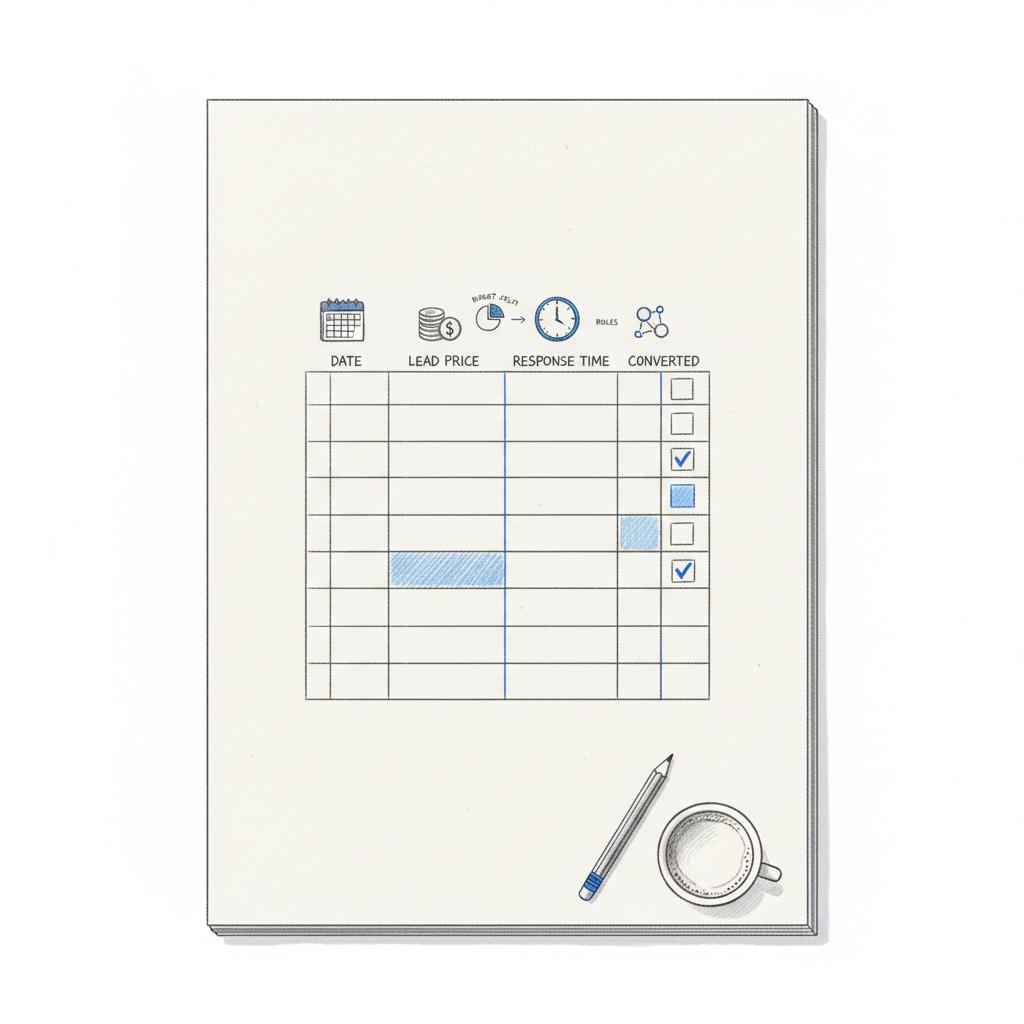
Record opportunity date, Thumbtack cost per lead, whether you bought the lead, time-to-respond, close outcome, job value, and gross margin. A basic spreadsheet will reveal trends fast and show which categories deserve more spend and which should be paused.
Can a single smart reply turn a $200 lead into a $2000 job?
Yes. Fast, helpful replies that take control of the next step (calendar link, photo request, or short call) raise conversion dramatically. That improves the effective return on any Thumbtack cost per lead by turning higher-priced opportunities into higher-value jobs.
Yes — and the trick is not magic but process. A reply that is fast, professional, and that controls the next step (calendar link, request for photos, or a short phone call) often moves the buyer into a higher-commitment state. That increases your close rate and reduces the effective Thumbtack cost per lead, because a higher conversion rate spreads your ad spend across more valuable wins.
When Thumbtack makes sense — and when it doesn’t
Thumbtack is a strong fit when your average job value is high enough to absorb lead costs and you have efficient sales processes. If jobs regularly sell for several hundred to several thousand dollars, and you can reply quickly, qualify efficiently, and close, a higher Thumbtack cost per lead can still yield positive ROI.
Thumbtack is a poor fit for micro-jobs that require significant qualification time or for services with thin margins and no repeat business. If the math forces you to buy dozens of leads to get one paying job, the platform may not be right unless you can dramatically improve conversion.
How to set acceptable prices and caps — a simple rule
Work backward from the net profit you want per job. Subtract expected gross profit from that target to find acquisition headroom, then divide by your expected close rate to get the maximum acceptable Thumbtack cost per lead. For example: target net $400, gross profit $1,200, expected close rate 25% — max per lead = ($1,200 – $400) * 0.25 = $200.
Account testing: what to measure and for how long
Thumbtack won’t publish platform-wide medians by trade and region, so you must test on your account. Run tests for at least one full billing cycle and preferably across a season for seasonal trades. Track these fields: opportunity price (Thumbtack cost per lead), response time, whether you bought it, conversion, job value, follow-up costs, and date. Aim for at least 30–50 opportunities per category to see stable conversion patterns.
Common pitfalls and how to avoid them
Don’t judge Thumbtack on CPL alone. CPL without conversion and job value data is meaningless. Don’t let a bad week shape your view — markets fluctuate. And don’t treat all leads equally: a lead with photos and a clear budget is more valuable than a vague request. For additional breakdowns of lead costs across trades, see this analysis of Thumbtack lead costs.
Practical testing checklist
1) Run a month-long test with a $50–$200 cap depending on job type. 2) Record 30+ opportunities. 3) Track every outcome in your spreadsheet. 4) Pause categories that produce negative unit economics. 5) Double down on categories with sustainable margins.
How to lower your Thumbtack cost per lead without losing quality
There are ways to reduce what you spend per opportunity while keeping quality. Narrow your service areas, increase minimum job size stated in your profile, use stronger pre-qualification, and raise ceilings for low-value categories. Combining these moves lowers the volume of low-quality leads and concentrates your spend where conversion is better.
Integrate Thumbtack into a diversified lead strategy
Thumbtack should be one channel in a wider local lead mix. Compare it directly with organic search, referrals, and paid ads. Track the CAC for each channel and assign budgets where the return is best. In many cases, clients use Thumbtack as a fast, testable way to validate demand, then scale channels that offer a lower CAC. If you’d like examples of past work, check our projects.
When to hire outside help
If measuring, testing, and iterating sounds like something you can’t manage in-house, an outside partner can accelerate learning. Agency VISIBLE, for example, helps businesses design low-risk tests, build tracking spreadsheets, and create message templates that raise close rates. A single consult often shortens the learning curve significantly and reduces wasted spend on bad categories.
Ready to test Thumbtack without the guesswork?
Ready to test Thumbtack without the guesswork? Start with a short planning call and a simple tracking plan — it’s the fastest path to knowing whether Thumbtack will pay for your business. Book a consult with Agency VISIBLE and get a tested template pack to improve replies and measurement.
How long before you see results?
Give any category a full month and aim for at least 30 opportunities for meaningful data. For seasonal trades, test across the whole season. Short snapshots are misleading; a single week can be noisy. The more data you gather, the more reliable your decisions will be.
What good account data looks like
Track these columns in your spreadsheet: opportunity date, Thumbtack cost per lead, time-to-respond, whether you bought, whether it converted, job value, gross margin, and notes. Review results weekly and adjust caps monthly. Over time you’ll see which job types and geographies are profitable.
Use short, friendly templates that ask for the three things that matter most: timeline, photos, and whether the buyer is ready to book. Personalize one line to show you read the request. A template like this converts better than a generic “call me” message and raises your effective close rate — lowering the real Thumbtack cost per lead. Consistent branding, including a simple logo on templates, speeds trust and response.

Is Thumbtack worth it for low-ticket services?
It’s difficult but possible. You’ll need exceptional efficiency, high close rates, or ways to increase average order value or encourage repeat business. Without those levers, Thumbtack’s visible lead prices and hidden time costs will often make low-ticket services unprofitable on the platform.
Final checklist before you scale
1) Have 30+ tracked opportunities per category. 2) Document close rates and job values. 3) Set caps based on desired net profit. 4) Test changes to messaging and profile. 5) Pause categories that lose money.
Quick recap
Thumbtack shows the price of each lead, but the Thumbtack cost per lead is only the start of the story. Convert rates, job value, time costs, and cancellations all change whether a lead is profitable. Use caps, fast helpful replies, pre-qualification, and disciplined testing to turn visible prices into real profit.
Further reading and tools
If you want, this article can be paired with a ready-to-use spreadsheet to track opportunities and a short script that increases initial reply conversion. Those tools speed up the testing cycle and reduce wasted spend.
Closing thought
There’s no single answer to “How much does Thumbtack cost?” You pay what markets, trades, and seasons demand. The smart move is to start small, measure rigorously, and expand only where the data supports a positive return.
It depends on trade, job size, and local competition. In many regions, small consumer jobs often list under $50 per opportunity, while specialized or high‑ticket trades regularly exceed $100 and can reach $300+ in dense metro markets. Run a local test of 30–50 opportunities to see your true numbers.
Yes — if you don’t measure close rates and adjust spend. Track the Thumbtack cost per lead alongside conversion rate and job value to calculate your real CAC. For low-ticket services with low close rates, Thumbtack can easily become unprofitable unless you increase efficiency, raise average order value, or secure repeat business.
An agency like Agency VISIBLE can set up a low-risk testing plan, create response templates that improve conversion, and build a simple tracking spreadsheet. That outside perspective speeds up learning and helps you avoid wasting spend on unprofitable categories — often saving more than the cost of the consult.