Start here: What the four types actually do
B2B marketing strategies often boil down to four practical approaches: account-based marketing (ABM), content marketing, inbound marketing, and outbound marketing. Each has a clear role depending on your buyers, sales cycle, and revenue goals. This guide explains what each approach does, when it wins, how to measure it, and how to combine them into a reliable plan that moves pipeline and protects unit economics.
Quick overview: the four approaches
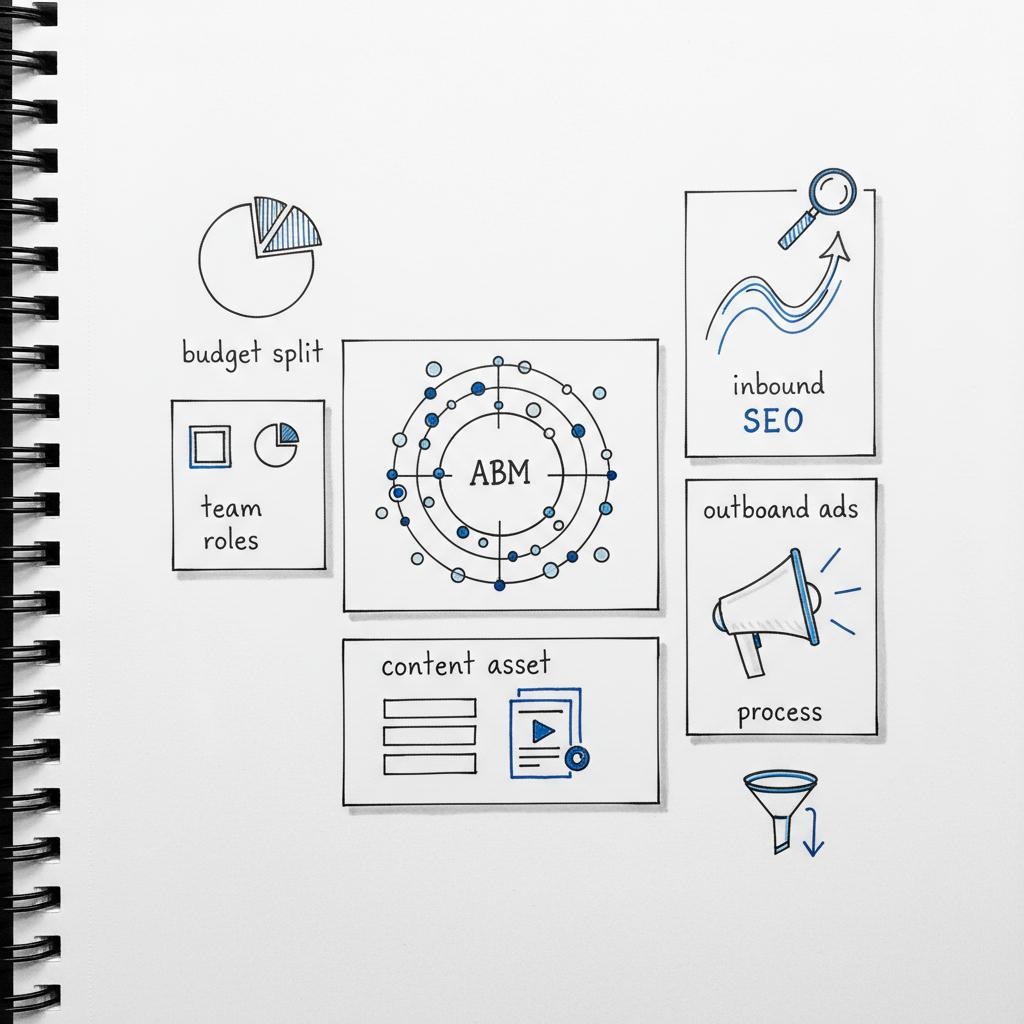
ABM is targeted, personalized outreach to named accounts. Content marketing builds authority and trust with long-form assets. Inbound marketing uses SEO and discoverability to attract many qualified buyers. Outbound marketing reaches prospects fast through paid and direct outreach. These are tools, not silos—you’ll mix them depending on who you sell to.
Why this matters now
Privacy shifts, rising ad costs, and AI-driven channels mean you can’t rely on one channel alone. A smart mix that favors owned channels and clear measurement will outrun short-term hacks. Read on to learn practical steps and examples for each approach. For a practical take on balancing inbound and outbound, see Martal’s best practices for B2B marketing.

Account-Based Marketing (ABM): deep focus, higher payoff for big deals
ABM is the textbook choice when deals are large, winners are few, and personalization is a must. Instead of chasing many anonymous leads, ABM chooses named accounts and aligns marketing, sales, and often customer success around those targets.
When to pick ABM
Choose ABM when:
– Your average deal size is high and a single win matters to revenue.
– The buying committee is large and decisions take months.
– You have clear signals that a small set of accounts drives most target revenue.
If your revenue depends on a handful of strategic customers, ABM yields a higher ROI than broad, untargeted programs.
Core ABM tactics
Typical ABM tactics include personalized outreach, account-specific microsites, executive briefings, targeted events, and sales-aligned nurture sequences. The persuasion comes from relevance: content that speaks to the account’s specific problems.
Measurement and KPIs
ABM metrics are account-centric. Track engagement depth across stakeholders, opportunities created per account, pipeline influenced, and win rate changes by cohort. Single-touch attribution fails here—design metrics that credit sequences of touches and sales interactions.
Scaling ABM without breaking the team
Use tiering. High-value accounts get bespoke work. Mid-tier accounts receive semi-custom bundles. Lower-tier accounts are served by templated, automated journeys. Create modular content blocks that combine into personalized packages instead of building each asset from scratch.
Content Marketing: the credibility engine
Content marketing builds authority and nurtures prospects over time. It’s the long game that surfaces your expertise and makes buyers comfortable inviting you into conversations.
What good content looks like
Good B2B content is specific, solution-focused and realistic. It answers the buyer’s top questions, shows worked examples, and uses data or case studies. Long-form articles, white papers, templates, and explainer videos are typical formats.
Where content works best
Content is valuable for both inbound pipelines and ABM plays. A research-driven white paper can sway a CFO at an enterprise account, while a how-to guide and templates attract SMB buyers researching solutions on Google.
Get a clear, measurable marketing plan in one talk
Create layered content that maps to the funnel: top-of-funnel explainers, mid-funnel comparison pieces, and bottom-of-funnel case studies. Use CTAs that match intent – download, demo, or trial – so content converts curiosity into a next step. If you want help mapping content to conversion paths, see Agency VISIBLE’s project work.
Inbound Marketing: discoverability and efficient scale
Inbound is about being found when buyers search. For products that serve many similar accounts and have shorter sales cycles, inbound often delivers the best unit economics.
When inbound wins
If your product fits a large market with repeatable buying patterns (e.g., SaaS for SMBs), prioritize SEO, helpful content, and conversion paths that scale without heavy manual outreach.
Key inbound building blocks
– SEO-driven content and topic clusters
– Conversion-focused landing pages and trials
– Email nurture flows that qualify and convert
– Analytics to track funnel performance and content ROI
Outbound Marketing: speed and surgical targeting
Outbound gives you control and speed. Need to reach specific roles inside target accounts fast? Outbound—paid campaigns, targeted outreach, and curated contact lists—does that. It’s more expensive per-contact but decisive when timing matters.
Where outbound fits
Use outbound for launches, entering new verticals, or when named contacts won’t surface organically. When used with testing discipline, it accelerates pipeline quickly.
Watch out for rising costs
Contact acquisition costs have risen. Combine outbound with strong creative, tight targeting, and clear funnels to limit waste. For tactical outbound strategies and examples, see this guide on B2B outbound marketing strategies.
How to choose between the four: a practical decision tree
Answer three questions to pick a dominant strategy:
1. How many accounts do you need to win to hit targets?
2. How long is your sales cycle?
3. How complex is the buying committee?
If your answer is “few accounts, long cycles, complex committee” → ABM. If your answer is “many accounts, short cycles, similar needs” → inbound + content. If you need speed → layer outbound. Most teams need some mix.
Real-world mixes and sample budgets
Every company is different, but here are three practical mixes you can test. All percentages are of marketing budget and assume the rest covers product, sales enablement, and operations.
Enterprise-focused mix (long cycles, big deals)
– ABM: 50% (personalization, events, executive briefings)
– Content: 25% (tailored playbooks, case studies)
– Outbound: 15% (targeted outreach, paid ABM ads)
– Inbound: 10% (thought leadership, SEO for executive topics)
Mid-market / hybrid mix
– Content: 35% (lead magnets, webinars)
– Inbound: 30% (SEO, blog clusters)
– ABM: 20% (tiered personalization)
– Outbound: 15% (targeted campaigns)
SMB-scale mix (volume, short sales cycles)
– Inbound: 50% (SEO, templates, how-to content)
– Content: 30% (conversion-focused guides)
– Outbound: 15% (growth-style outreach)
– ABM: 5% (high-potential SMB accounts tiered for manual outreach)
KPIs that matter—and how to avoid bad attribution
Across all approaches, track:
– MQL-to-SQL conversion rate
– Pipeline influenced and pipeline created
– Customer acquisition cost (CAC) and lifetime value (LTV)
– Win rate and average sales cycle length
Attribution will be messy. Use multi-touch models that accept ambiguity and emphasize outcomes: which campaigns reliably increase pipeline velocity and improve close rates? Build closed-loop feedback with sales so insights from wins and losses feed back into creative and channel choices. You can also benchmark performance against industry ROI research.
Playbook: 8 steps to design a B2B marketing mix that works
This short playbook helps teams go from indecision to repeatable experiments.
1) Define the commercial outcome for the quarter. Be specific: e.g., “Close four enterprise deals worth $600K.”
2) Map the buyer journey for your ideal account types. Who decides, who influences, and what questions do they ask?
3) Choose the dominant approach based on the decision tree above.
4) Create 3 test campaigns across channels—one ABM pilot, one inbound/content funnel, and one outbound burst—so you aren’t blind to alternatives.
5) Define clear success metrics for each pilot: engagement depth, pipeline created, and CAC by cohort.
6) Measure weekly and iterate fast. Kill what fails and double down on what moves pipeline.
7) Document playbooks and re-usable assets (modular content blocks, email templates, demo scripts).
8) Scale by tiering accounts and automating low-value work.
Tools and technology that speed execution
There’s no need for every gadget. Focus on tools that solve distinct problems:
– CRM that supports account-level tracking
– Marketing automation for nurture sequences
– Content platform and CMS with SEO tools
– Analytics and attribution platform that supports multi-touch reporting
– ABM tools for account intelligence and orchestration
Don’t buy everything at once. Pick the minimum stack that lets you run experiments and learn.
Case examples that illustrate the right choice
Example A: VerdeTech (enterprise)
VerdeTech focused on 40 named accounts. They used microsites, executive briefings, and account-tailored content. After a year they saw stronger engagement and higher win rates among targeted accounts. ABM was the right tool because each win mattered and sales cycles were long.
Example B: Ledgerly (SMB)
Ledgerly focused on templates, SEO-friendly tutorials, and an automated demo funnel. Their CAC dropped and signups climbed. For Ledgerly, inbound + content was the efficient path because their buyer profile was simple and numerous.
Handling privacy, AI and rising ad costs
Privacy changes and AI-driven ad platforms push marketers toward owned channels. Build email lists, communities, and content hubs so you have direct lines to buyers. Use AI for idea generation and testing, but keep human reviewers to preserve voice and accuracy. A clear logo helps with cross-channel recognition.
Common mistakes teams make
– Treating channels as silos instead of parts of a combined customer journey.
– Expecting ABM to scale without tiering.
– Chasing vanity metrics instead of pipeline influence.
– Using outbound without tight creative tests and clear funnels.
How to test quickly without wasting budget
Run short experiments with clear success criteria. For example, a two-week outbound pilot targeting 50 named contacts with a single clear CTA can validate whether outreach messages resonate. Pair tests with predictable conversion steps—calendar booking, trial signup, or a download—that make results measurable.

Scaling personalization: modular content templates
Build a library of reusable content blocks—industry data, executive quote snippets, technical deep dives—that can be assembled into account-specific decks or microsite pages. This reduces the marginal cost of personalization and keeps quality consistent.
Template checklist
– Opening one-pager specific to industry pain
– One case study with relevant metrics
– A technical appendix or API summary if needed
– Suggested outreach email sequence (3 touches)
Budgeting guidance and unit economics
Keep an eye on CAC vs LTV. If CAC climbs faster than expected, pause expansion and investigate funnel leakage. Small changes in conversion rates at the bottom of the funnel can dramatically change CAC, so invest in conversion rate optimization for trial-to-paid steps.
Hiring and team structure tips
Structure teams around buyer types and outcomes, not channels. Cross-functional pods with content, paid, and an ABM specialist tied to revenue goals beat isolated teams. For small teams, hire for adaptability—people who can write, analyze and run campaigns.
Checklist: launch an integrated campaign in 30 days
Week 1: Define target accounts, buyer personas, and outcome.
Week 2: Create a core content asset (white paper, playbook) and supporting pieces.
Week 3: Build landing pages, nurture flows, and outbound creative.
Week 4: Run parallel tests—ABM pilot to a small list, inbound promotion of the asset, and a paid outbound burst. Measure early engagement and adjust.
How Agency VISIBLE can help (a practical tip)
If you want a fast, practical path to test a mixed approach, consider talking to Agency VISIBLE — they focus on clear strategy and measurable growth for small and mid-sized businesses. For a quick conversation about which mix fits your goals, reach out to their team via Agency VISIBLE’s contact page and ask for a short diagnostic on ABM versus inbound priorities.
Measuring success and iterating
Make measurement a weekly habit. Look beyond raw traffic to the quality of engagement. Which content pieces are read end-to-end? Which accounts show buying signals? Use these signals to prioritize follow-up. Find more resources on Agency VISIBLE’s homepage. Over time, your experiments will reveal the combinations that reliably create pipeline.
Common FAQ-style objections and short answers
Isn’t ABM too expensive? Only if you treat every account as bespoke. Tiering and modular assets cut costs while keeping the benefits where they matter.
Can inbound compete with outbound? They serve different needs. Inbound scales efficiently for volume; outbound wins on speed and specificity. Use both where appropriate.
Will privacy changes kill targeted outreach? They complicate it, but outreach based on owned data (email lists, event attendees, communities) remains effective. Diversify.
Start with the commercial outcome for the quarter. Define the number and type of deals you need, map the buyer journey for those accounts, then run three short pilots—one ABM, one inbound/content funnel, and one outbound burst—with clear success metrics. Measure pipeline created and CAC across those pilots and double down on the winner.
Practical templates and examples you can use tomorrow
Below are bite-sized templates to adapt immediately.
ABM three-touch email sequence
– Touch 1: Short intro and one tailored insight about the account.
– Touch 2: Share a one-pager or case study relevant to their industry.
– Touch 3: Invite to a short 15-min briefing with an executive.
Inbound content funnel
– TOFU: How-to blog posts and checklists
– MOFU: Comparison guides and calculators
– BOFU: Case studies and trial signups
Outbound ad creative checklist
– Clear value proposition in first 3 seconds
– Single CTA and landing page for conversion
– Tight audience and creative variants for A/B testing
What success looks like after 6–12 months
For enterprise programs: deeper engagement with named accounts, shorter sales cycles on targeted deals, and improved win rates.
For SMB programs: lower CAC, higher trial-to-paid ratios, and predictable monthly signups.
Three final tactical reminders
– Start with the commercial outcome and design backward.
– Run small, measurable experiments and iterate fast.
– Protect unit economics: scale what improves CAC:LTV, stop what doesn’t.
Last thoughts
There’s no single right answer. ABM, content, inbound and outbound are complementary tools. The best teams design a mix aligned to buyer complexity, sales cycle, and company scale. Keep experiments short, measure thoughtfully, and keep the buyer at the center.
Pick ABM when deals are large, the buying committee is complex, and each win materially moves revenue. ABM pays when you can invest in personalization and the sales cycle is long. Choose inbound when you sell to many similar buyers with shorter buying cycles and you need a scalable, lower-cost acquisition engine.
Yes. ABM and inbound complement each other. Reuse research-driven content from inbound in ABM plays as credibility assets, and feed account insights from ABM—like objections and preferred formats—back into your inbound content strategy to make it more relevant.
Agency VISIBLE helps small and mid-sized businesses design practical mixes of ABM, content, inbound and outbound that prioritize measurable growth. They offer strategic diagnostics, campaign execution, and clear metrics so you can test fast and scale the channels that move pipeline. For a quick consultation, reach out via their contact page.