How much do Google Ads cost for a small business?
How much do Google Ads cost for a small business? That question is the first line on many owners’ to-do list—and the truth is both simple and messy. The short answer: it depends on your industry, goals, and how wisely you spend. The longer answer dives into average CPCs, recommended monthly budgets, bidding strategies, and- crucially- how a sensible content strategy can lower your long-term cost of acquisition while building trust with customers.
Why we ask this question first
Before you hand over a credit card, you want clarity. Asking “How much do Google Ads cost for a small business?” forces you to tie money to outcomes: leads, sales, or visits that matter. Many small businesses treat ads like a faucet- turn them on and hope. The smarter route is to align budget with a plan that includes paid and owned channels so every ad dollar stretches further.

What influences Google Ads cost?
Several factors shape Google Ads cost: industry competition, keyword intent, ad quality, geographic targeting, and landing page experience. Highly competitive sectors like legal or insurance often have higher average cost-per-click (CPC), while niche local services can be far cheaper. Another big lever is relevance: better ads and better landing pages cut your effective Google Ads cost because they improve Quality Score and lower CPCs.
Average CPC ranges to expect
Here are ballpark CPC ranges you might see. These are estimates and fluctuate by market and time:
Low competition local services: $0.50–$2.00 per click
Moderate competition (home services, B2B tools): $2.00–$6.00 per click
High competition (legal, finance, insurance): $6.00–$50+ per click
When you think about “How much do Google Ads cost for a small business?” remember these ranges and your conversion rate. A $5 CPC with a 3% conversion rate costs about $166 per conversion. If your product’s average value is $500, that might be acceptable; if it’s $50, you’ll lose money unless you optimize.
Cut wasted ad spend — get a short audit and plan
Want concrete examples from real campaigns? See our recent case studies and project work on the Agency VISIBLE projects page for ideas you can adapt.
Daily and monthly budget examples
How much to spend depends on capacity and goals. Here are practical starting points for many small businesses:
Low-budget test (small local business): $10–$20/day → $300–$600/month
Growth test (small e‑commerce or service): $30–$100/day → $900–$3,000/month
Scale phase (established business focused on growth): $100–$500+/day → $3,000–$15,000+/month
These budgets answer part of “How much do Google Ads cost for a small business?”—but remember: the real question is cost per conversion and return on ad spend (ROAS). A disciplined small advertiser will start small, learn, and scale spend where the numbers prove out.
How to estimate your cost per lead or sale
Use a simple formula to set realistic expectations:
Estimated monthly clicks = monthly budget / average CPC
Estimated conversions = estimated monthly clicks × conversion rate
Cost per conversion = monthly budget / estimated conversions
For example, with a $1,500 monthly budget and an average CPC of $3, you might get 500 clicks. If your landing page converts at 4%, that’s 20 conversions, putting your cost per conversion at $75.
Quality Score and why it matters for cost
Google rewards relevant ads with lower CPCs through Quality Score. Improve your Quality Score by matching ad copy to keywords, creating focused ad groups, improving click-through rate (CTR), and sending traffic to highly relevant landing pages. Lower CPCs mean your budget buys more clicks—and more chances to convert—so investing a little extra attention into ad relevance reduces Google Ads cost in practice.

Paid ads are great for immediate demand, but content builds long-term trust and lowers acquisition costs over time. High-quality content improves organic search visibility and helps your landing pages convert better. The better your content (clear answers, helpful resources, transparent pricing), the lower your effective Google Ads cost because visitors who arrive from ads see consistent value and are likelier to convert. A clear logo on help pages can improve brand recognition and trust.
Think about the combination this way: ads bring a person in; content convinces them to stay and buy. You’ll pay for clicks today, but the content you build keeps paying in the months and years after.
If you want a quick, human review of how your landing pages and content affect ad performance, consider a short consult with Agency VISIBLE’s team—they specialize in blending paid media and content strategies to lower acquisition costs. Visit Agency VISIBLE’s contact page for a short audit and practical next steps.
Choosing the right bidding strategy
Google offers several bidding strategies: manual CPC, enhanced CPC, target CPA, target ROAS, and maximize conversions, among others. For most small businesses testing the waters, a reasonable progression is:
1) Start with manual CPC or enhanced CPC to control bids and learn keyword performance.
2) Move to target CPA once you have consistent conversion data (30–50 conversions per month is a sensible minimum).
3) Use target ROAS if you’re optimizing toward revenue rather than raw leads.
Each step requires data. Rushing to automated strategies without enough conversions can cost more and create unstable Google Ads cost outcomes.
Landing pages that convert (and cut ad costs)
Small tweaks can lower your cost per conversion dramatically: clear headlines, a single call to action, trust signals, short forms, and fast load times. When landing pages answer the visitor’s question immediately, both conversion rate and Quality Score improve. Higher conversion rates mean fewer clicks are required to meet targets—and that directly reduces your Google Ads cost per sale.
Imagine a local pest-control company. Paid search ads target urgent keywords like “exterminator near me” with a budget of $1,200/month. Their landing page includes pricing tiers, reviews, and a clear booking widget, resulting in a 6% conversion rate. Their cost per lead is reasonable.
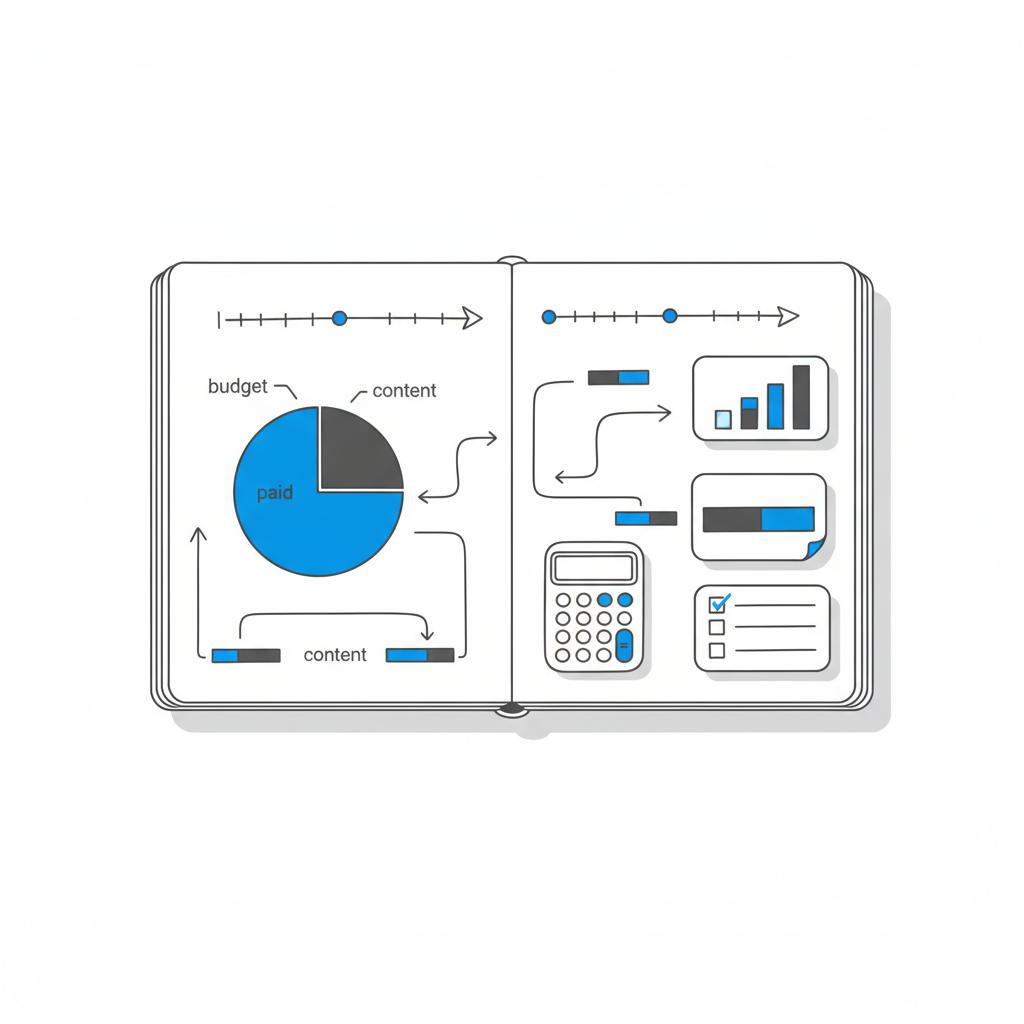
Now add content: a series of evergreen posts on pest prevention, illustrated checklists, and a downloadable seasonal guide. Organic traffic grows slowly, and customer trust increases. Over a year, the reliance on paid traffic falls: fewer clicks are needed for the same number of conversions, because organic visitors who land on complementary content are more likely to contact the business directly or respond to a remarketing ad. In short: the right content lowers effective Google Ads cost over time.
Setting expectations: timeline and milestones
Paid ads can produce leads quickly—often within days. Content takes longer but compounds. A common, realistic timeline for small businesses:
0–3 months: launch ads, test keywords, improve landing pages, build a small library of content pieces.
3–9 months: identify winning ads, expand content around high-value topics, begin to see organic lift.
9–18 months: compound effects appear—lower reliance on paid traffic, stronger brand searches, and lower cost per acquisition.
So when you ask, “How much do Google Ads cost for a small business?” add the caveat: costs are front-loaded, but content pays off over time and reduces future ad spend.
Budgeting worksheet: a simple monthly plan
Use this quick worksheet to estimate your ad needs:
Step 1: Decide target conversions per month (e.g., 20 new customers).
Step 2: Estimate conversion value (average sale or lifetime value).
Step 3: Pick a target cost per conversion (e.g., 20% of sale value).
Step 4: Compute monthly ad budget = target conversions × target cost per conversion.
If your average sale is $250 and you target a $50 cost per conversion, for 20 customers you’d budget $1,000/month. That ties a vague ad-spend question directly to business results and moves you away from asking only “How much do Google Ads cost for a small business?” to asking instead, “How many customers do I want and what can I afford to pay for each?”
Common mistakes that drive costs up
Many small advertisers unintentionally raise their Google Ads cost by doing any of the following:
1) Broad targeting: bids for generic keywords without negative keywords waste clicks.
2) Weak landing pages: low conversion rates force higher spend to hit goals.
3) No tracking: failing to track conversions means gambling with budget.
4) Ignoring Quality Score: poor ad relevance increases CPCs.
5) Chasing every channel: spreading a small budget across too many channels reduces impact.
How to test without wasting money
Testing is unavoidable, but inefficient tests are costly. Run focused experiments:
– Test one variable at a time (headline, CTA, landing page).
– Use small, controlled budgets for initial tests ($10–$30/day).
– Measure meaningful outcomes (conversions, not just clicks).
– Pause underperforming keywords and scale winners.
Testing smartly answers “How much do Google Ads cost for a small business?” by revealing what actually works for your customers—fast.
Measuring true cost: lifetime value and attribution
Cost per conversion alone can be misleading if customers buy again. Factor in lifetime value (LTV) and multi-touch attribution. A lead that costs $100 but returns $1,000 over three years is excellent. Talk to your accountant or use simple models to estimate LTV, then compare to your Google Ads cost to decide if the channel is profitable.
Scaling responsibly
When you find campaigns that work, scale by increasing budget gradually (20–30% at a time), expanding keywords within the same structure, and duplicating successful campaigns in nearby geographies. Avoid sudden big budget jumps that can destabilize performance and spike Google Ads cost.
Paid vs. organic split: an example allocation
For many small businesses a useful split is:
Year 1: 60% paid / 40% content & organic
Year 2: 50% paid / 50% content & organic
Year 3: 40% paid / 60% content & organic
This moves investment toward owned channels as they mature, lowering effective Google Ads cost over time while keeping a dependable paid channel for immediate demand.
Practical checklist before you launch your first budget
Complete these items to avoid common pitfalls:
– Define conversion goals and set up tracking (GA4, conversion tags).
– Build focused landing pages tied to specific ads.
– Create at least 5–10 pieces of helpful content that answer common customer questions.
– Add clear contact methods and trust signals (reviews, certifications).
– Set an initial test budget and timeline (30–90 days).
Improve your landing pages and early content to boost conversion rates; better conversion rates reduce the number of paid clicks needed and therefore directly lower your Google Ads cost.
The answer: make your landing pages and early content work harder. Before you double your ad budget, double down on clarity: clear headlines, direct offers, and a short path to conversion. That change alone often reduces Google Ads cost by improving conversion rates.
How Agency VISIBLE approaches budgets (real, human help)
When clients ask, “How much do Google Ads cost for a small business?” we answer with a plan, not a number. Agency VISIBLE starts with goals and value per conversion, then designs a test-and-learn program: small initial spend, focused keywords, tightened landing pages, and a content plan to reduce reliance on paid channels. The aim is to get the fastest path to profitable growth, and then scale predictably.
Realistic expectations and an example case
Consider a local studio offering yoga classes. Their average student pays $120/month. Agency VISIBLE helped them run a $1,200/month local search campaign, optimized landing pages, and published a few how-to blog posts aimed at beginners. After three months, the cost per student stabilized at $60—half of a month’s revenue—while organic signups grew slowly. The blended acquisition cost fell over a year, answering the perennial question, “How much do Google Ads cost for a small business?” with: it can be affordable if paired with the right content and landing-page work.
Templates and first steps you can use tomorrow
Here’s a short template to get started:
Week 1: Set up conversion tracking, choose 5 focused keywords, build one landing page per offer.
Weeks 2–4: Run ads at $20–$50/day, collect data, and test two landing page variants.
Month 2: Pause or reduce spend on losers, scale winners, and publish 2–3 evergreen articles that address top search questions.
Month 3: Recalculate cost per conversion and consider a small budget increase if profitable.
When ads aren’t the answer
Sometimes the right investment isn’t more ads—the right answer is better product-market fit, clearer pricing, or better local partnerships. If ads consistently deliver low-quality leads, inspect the offer and the funnel before you increase spend. That discipline protects you from a runaway Google Ads cost spiral.
Accessibility, transparency, and compliance
Make sure your ad copy and landing pages are accessible and follow local advertising rules. Transparent pricing, clear refund policies, and privacy information reduce friction and improve conversion—again lowering your effective Google Ads cost.
Summary checklist before you spend
– Know your target cost per conversion and LTV.
– Start small, test, then scale.
– Improve Quality Score with relevant ads and landing pages.
– Pair paid ads with content to reduce long-term costs.
– Track conversions and attribute credit properly.
Final thought
Answering “How much do Google Ads cost for a small business?” is less about a universal dollar figure and more about aligning spend with measurable business outcomes. Start small, insist on clarity, and treat ads and content as partners. That approach keeps costs predictable and builds a foundation where paid media buys time and content builds value.
Further reading and tools
Look for CPC benchmarks by industry, test landing-page builders that measure conversions, and set up a simple LTV calculator in a spreadsheet. For industry benchmarks see Google Ads Benchmarks 2025, Average Google Ads CPC by industry, and a practical breakdown of budgets at Google Ads Cost 2025: Average CPC & ROI Benchmarks. If you need hands-on help, a short consult can point to quick changes that reduce cost dramatically.
Thanks for reading—may your ads be relevant and your content honest.
Start small and test: a sensible initial budget is $300–$1,000 per month depending on your industry. Use $10–$30/day for local tests, watch conversion data for 30–90 days, then scale spending on campaigns that meet your target cost per conversion.
Yes. A well-planned content strategy improves landing page relevance and organic visibility, which increases conversion rates and Quality Score. That in turn lowers CPCs and reduces your effective Google Ads cost over time as organic channels start contributing more qualified traffic.
Move to automated bidding (target CPA or target ROAS) once you have consistent conversion data—typically 30–50 conversions per campaign per month. Automated bidding needs reliable conversion history to optimize effectively; otherwise it may increase costs.
References
- https://agencyvisible.com/contact/
- https://agencyvisible.com/projects/
- https://agencyvisible.com/
- https://www.wordstream.com/blog/2025-google-ads-benchmarks
- https://focus-digital.co/average-google-ads-cost-per-click-by-industry/
- https://quimbydigital.com/what-businesses-really-pay-cpc-monthly-budgets-roi/