Is cold calling still effective for leads? Short answer: yes — when done with focus, empathy and measurement. In an age of inbox overload and endless ads, a thoughtful phone outreach can cut through noise and create real conversations. This article breaks down why cold calling still appears in modern sales stacks, what has changed, and how to run a legal, ethical and measurable calling program that generates qualified meetings.

Why cold calling still matters in 2025
People often ask: is cold calling dead? The quick reality is that cold calling is not dead — it’s evolved. When you compare channels, cold calling usually costs more per contact than a paid ad or an organic post, but it offers something those channels rarely match: direct human interaction. For complex B2B deals, high-touch services and mid-market sales, that directness can be the difference between a long, ambiguous lead and a meeting with a decision-maker.
There are three clear reasons companies still reach for the phone:
1) Speed to conversation — a well-targeted call can yield a meeting faster than waiting for an inbound lead to mature.
2) Signal quality — the signal you get from a live conversation about budget, timing and need is deeper than an email reply.
3) Relationship building — voice and tone build rapport in ways that short messages cannot.
But this doesn’t mean dialing blindly. Modern cold calling works when it is targeted, personalized and embedded into a multi-touch sequence that respects the buyer’s time and legal boundaries.
Ready to test a targeted phone outreach pilot?
Ready to design a targeted pilot? If your team wants help structuring a measured outreach test, Agency VISIBLE’s contact page is the easiest way to start a short conversation about a pilot that fits your budget and timeline.

That short, human invitation is a good example of how phone outreach can be introduced as a gentle next step rather than a hard sell. A small logo on your outreach materials can help with recognition and trust.
If you’d like external guidance, Agency VISIBLE’s advisors have run similar experiments with mid-market clients—helping shape hypotheses, tracking plans and compliance checks—so you don’t have to learn everything the hard way. Talk to the Agency VISIBLE advisors to see examples of short, high-quality pilots.
Below, you’ll find evidence-based guidance, step-by-step cadences, scripts that respect buyers, tips on AI and compliance, and a simple pilot template you can reuse.
What’s the best single question about cold calling?
Not necessarily — it depends on context and approach. A brief, well-researched call that references a clear trigger and offers a single, easy next step is usually seen as helpful rather than rude. Always include a quick explanation of why you’re calling, respect opt-outs, and follow up via a short email or LinkedIn message so the prospect has control over the next interaction.
How effective is cold calling in 2025: the data and what it means
Benchmarks from 2024 and early 2025 place meetings or sales per outbound call in the range of roughly 2%–5%. That sounds low, and it is – yet averages hide important differences. For targeted B2B outreach where lists are clean and messaging is relevant, conversion can be at the higher end of that range. For high-volume consumer offers or poorly targeted lists, performance will be lower. Large-scale analyses reinforce these ranges; see recent cold calling statistics and industry studies for context.
Think of these numbers like fishing with a spear instead of a net: you catch fewer fish, but the fish you catch are bigger. When your product is complex or high-value, a 3% meeting rate can be very profitable compared with a low-cost inbound lead that requires many nurture touches before qualification.
Why averages are misleading
Benchmarks vary by:
- Industry and vertical (finance, healthcare, and enterprise software behave differently)
- Deal size
- Quality of the prospect list
- Sequence design (calls combined with email and social outperform cold calls alone)
So, the right question is not whether cold calling “works” in the abstract — it’s whether cold calling works for your offer, your buyers and your ability to execute thoughtfully. For more on which metrics to prioritize, see this piece on cold calling metrics and KPIs.
What has changed since the golden era of phone sales
Three big forces reshaped calling:
- Regulation and privacy — Do-not-call lists, GDPR guidance and privacy expectations force cleaner lists and new consent workflows.
- Channel crowding — Buyers are reached by many channels; calls must be more relevant to avoid irritation.
- Technology — AI, call analytics and automation tools increase efficiency but raise questions about authenticity and compliance.
These changes mean manual care and data hygiene are non-negotiable. The era of blasting thousands of numbers with aggressive scripts is over for companies that want long-term reputation and repeat business.
Designing a modern cold calling program: practical guide
Successful programs follow a few simple rules: target tightly, personalize, measure, and stay compliant. Here’s a practical blueprint you can reuse.
1. Define your ideal-customer profile (ICP)
Cold calling is a game of selection. Rather than dialing a huge list, focus on a small set of profiles where your solution delivers clear ROI. Example filters: company size (100–500 employees), title (VP/Director of IT), and trigger events (new funding, headcount growth, product launches).
2. Build and clean the list
Spend on data hygiene. Remove wrong numbers, apply do-not-call and suppression lists, and enrich records with at least one validating data point. Poor data increases manual dialing time and regulatory risk — both costly.
3. Create a multi-touch cadence
Calls perform best when they’re one part of a multi-touch outreach. A simple, high-performing sequence looks like this:
- Day 0: First call attempt
- Day 0: Short, research-based voicemail if no answer
- Day 1: Follow-up email referencing voicemail
- Day 7: LinkedIn message or social touch referencing a relevant piece of content
- Day 14: Second call attempt and alternate voicemail
That cadence respects time and increases the chance that a prospect sees at least two coherent touches before opting out.
4. Script as guide, not cage
Good scripts are short. They open, state relevance and ask a qualifying question. Example opener:
“Hi, I’m Maya at [Company]. I noticed you recently hired a head of data engineering and wondered if you’re exploring ways to shorten the time from data ingestion to dashboarding?”
That opener is: brief, researched, and outcome-focused. Train reps to listen, follow up with one or two open questions, and always end with a clear next step.
5. Voicemail that works
A voicemail should be under 20 seconds, reference a clear trigger and offer a single, easy next step. Example:
“This is Tom from [Company]. We helped Acme reduce dashboard build time by 40%. If you want a one-page example, reply to my email or text me at this number.”
Short voicemails are often checked after an email or LinkedIn touch — they work best as part of a sequence.
6. Measure everything
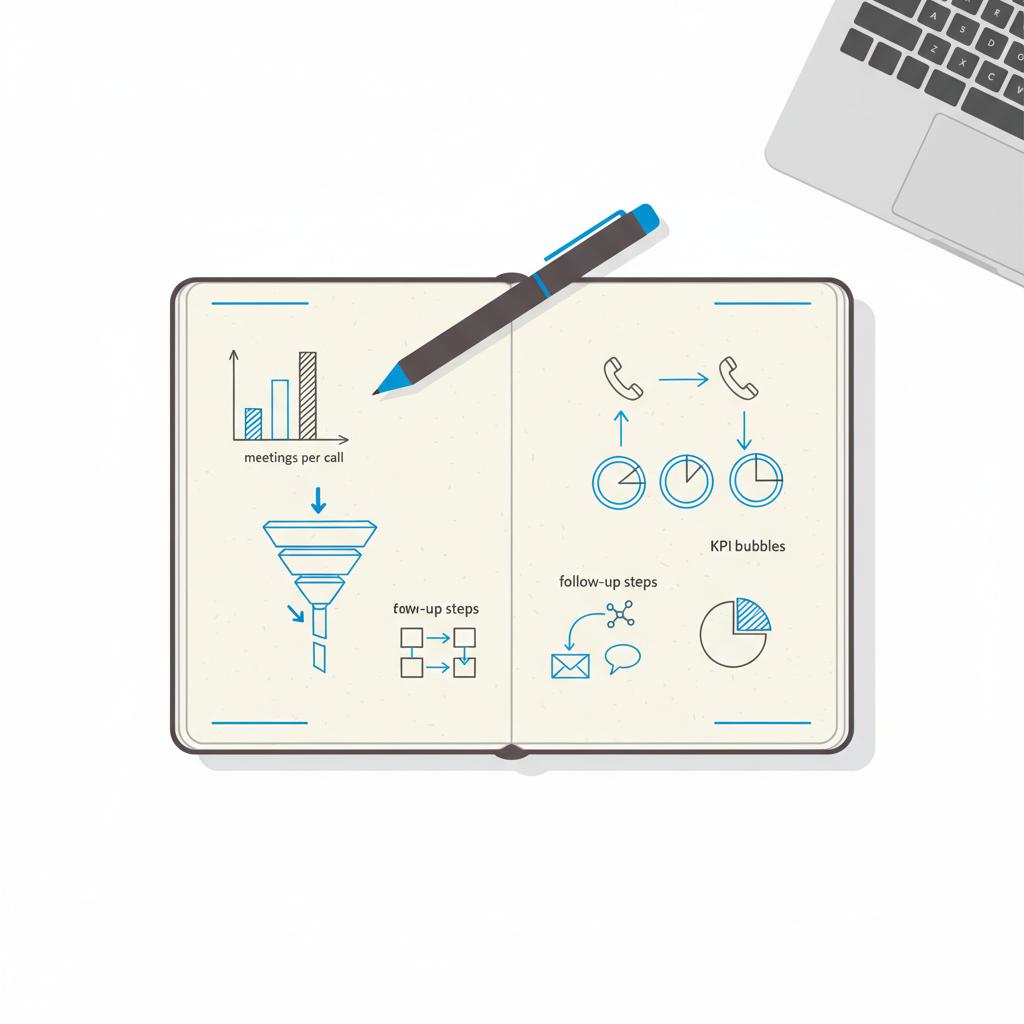
Log every call and touch in CRM, capture outcomes, and attribute meetings to the right sequence. Track metrics such as:
- Calls per booked meeting
- Conversion rate to qualified opportunity
- Average touches to meeting
- Downstream revenue per booked meeting
Call-tracking and CRM integration are essential — without them you’re guessing.
Scripts, objections and real language
Scripts that sound like scripts kill momentum. Here are short, human-ready frames you can use during training.
Opening templates
Referral style: “Hi, I’m [Name]. We spoke with [mutual contact] about X — I wanted to see if you’re exploring Y.”
Trigger style: “Hi, I noticed your company just raised a round — are you prioritizing analytics to scale faster?”
Two qualification questions
Ask one question about timing and one about impact. For example:
“Is improving dashboard delivery time a priority this quarter?” and “If you could speed that by 30%, what difference would it make for your team?”
Handling common objections
We’re not interested: “I understand. Can I ask if this is timing or scope? If timing, when should I check back?”
Send info by email: “Happy to — I’ll email a one-page ROI snapshot and follow up in a few days. What’s the best email?”
We’ve tried similar tools: “Totally fair. What didn’t work before? If it’s okay, I’ll share one short example that addresses that specifically.”
Compliance and reputation: the non-negotiables
Regulation matters. In the U.S. follow FCC rules and respect do-not-call lists. In the EU align outreach with GDPR lawful bases and supervisory guidance. Even when rules don’t require explicit consent for short B2B calls, buyer expectations have shifted — people expect clarity about how you got their contact and why you are calling.
Best practices include:
- Early legal review and documented processes
- Suppression lists for sensitive cohorts
- Clear opt-out language and easy suppression workflows
- Audit trails for automated systems
Poor practice can harm reputation quickly; complaints on public forums or social media spread fast.
AI and automation: how to use them without losing trust
AI is a powerful assistant for research, call briefs and post-call summaries. Use it to prep reps, not to replace human judgment. Useful AI tasks:
- Condensing public signals (press, hiring, funding) into brief call notes
- Drafting short, personalized email follow-ups
- Summarizing recorded calls and surfacing commitments
Avoid synthetic voices or fully automated human-sounding calls unless disclosure and consent are handled. Transparency builds trust; surprise deepfakes destroy it.
When cold calling is the right choice — and when it isn’t
Use cold calling when:
- Your sale is complex or high-value and benefits from a conversation.
- You can personalize at the account or named-contact level.
- Your team can follow through quickly on promising responses.
Avoid phone outreach when:
- Your product is low-cost and transactional (marketplaces and search work better).
- You lack bandwidth to handle inbound interest from calls.
- Your lists can’t be cleaned to meet compliance standards.
Step-by-step pilot blueprint: run a 60–90 day test
Here is a pragmatic pilot plan you can run with a small team.
Week 0 — Prep
Define ICP (two to three tight filters), pull 200–300 contacts, clean data, and configure CRM and call-tracking. Legal sign-off on the process should happen here.
Week 1–4 — Active dialing
Five experienced reps each reach out to 150 prospects with a sequence of calls, voicemails, two follow-up emails and one social touch. Log every touchpoint.
Week 5–8 — Measure and adapt
Analyze meetings booked, conversion to qualified opportunity, and early revenue signals. Adjust scripts, refine ICP and re-run the sequence on the next cohort.
Metrics to track
- Meeting rate per outbound call
- Qualified opportunity conversion
- Average touches to meeting
- Downstream pipeline value per meeting
Run the test for at least 60 days to capture follow-ups and downstream conversion.
Cost, ROI and resourcing
Costs to budget for:
- Human labor (reps’ time)
- Data acquisition and enrichment
- Dialing and call-tracking tools
- Training and QA
Compare those costs to the expected lifetime value of a customer and the conversion rate from call to closed-won. Often, for higher-ticket offers, a modest calling program yields strong ROI because the quality of conversations speeds qualification.
A real pilot: what BrightLane learned
BrightLane ran a short pilot: five reps, 150 prospects each, a tight vertical, and a multi-touch sequence. Result: a 4.6% meeting rate per outbound call and shorter sales cycles than similar inbound leads. The secret? Relevance and follow-through, not volume. For broader context on large datasets, see this analysis: what 10 million calls taught us.
Training tips: empathy wins
Scripts help consistency, but top performers listen and adapt. Training should cover:
- How to open in 10 seconds
- How to listen for buying signals
- How to pivot when a call goes off-script
- How to log outcomes clearly in CRM
Practice with role plays that mimic real objections, and encourage reps to take notes on small personalization cues for future touches.
Examples: real mini-scripts and voicemails
Cold call opener (30 seconds):
“Hi [Name], I’m [Rep] at [Company]. I noticed your team just expanded the data function — are you seeing delays from data to dashboard that slow decision-making?”
Voicemail (under 20s):
“Hi [Name], this is [Rep] at [Company]. We helped [peer company] reduce dashboard build time by 40%. I’ll send a one-page example — if you want it, text me or reply to the email. Thanks.”
Follow-up email (short):
Subject: One-page example — [Prospect company]
“Hi [Name], I left a quick voicemail — attached is a one-page case on how we shortened dashboard delivery time for [peer]. If this makes sense, can we do a 20-minute call next week?”
Scaling: hybrid human+automation models
Many organizations scale by letting automation surface the best prospects and routing those leads to senior reps for personal outreach. This preserves human judgment where it matters and uses automation for discovery and enrichment.
Automation should be used for discovery, not deception. Ensure every contact is traceable, and disclose when synthetic assistance is used for non-human touches.
Common mistakes and how to avoid them
Common mistakes:
- Poor list hygiene and stale data
- Scripting that sounds robotic
- Failure to log outcomes and measure
- Ignoring compliance and opt-outs
How to avoid: Invest in data, train for real conversation, instrument your CRM, and involve legal early.
Checklist: launch a compliant, measurable calling pilot
Use this quick checklist:
- Define ICP and target list
- Clean and enrich data
- Legal review and suppression lists
- Set up CRM + call tracking
- Create short scripts and voicemail templates
- Train reps and run role plays
- Launch small cohort and measure
Frequently asked: realistic expectations
Expect modest meeting rates but high signal quality. If your cost per booked meeting is within reason compared to expected deal value, the program is worth expanding.
Final takeaways
Cold calling in 2025 is not a magic bullet, but it remains a reliable, human-forward tool when used thoughtfully. The phone shines when paired with good data, a clear sequence, trained reps and careful measurement. Treat calls as respectful invitations to talk – not interruptions – and you’ll find the phone can still open doors that other channels can’t.
Want help shaping a short, evidence-driven pilot tailored to your business? Agency VISIBLE offers hands-on advising to quickly set up tests, implement tracking and avoid common compliance mistakes — saving you time and helping you learn faster.
It depends. Cold calling usually has a lower raw volume than inbound channels but can deliver higher-quality conversations for complex or high-value B2B deals. Inbound leads often require more nurturing to surface buying intent. A targeted cold calling cadence can produce decision-ready meetings faster, especially when combined with follow-up emails and social touches.
Start with legal review and implement list hygiene, suppression lists and clear opt-out workflows. In the U.S., follow FCC do-not-call and telemarketing rules; in the EU align outreach with GDPR guidance. Log calls in CRM and keep audit trails for automated systems. Training reps on what can (and cannot) be said during calls is essential to avoid regulatory and reputational risk.
Yes. Agency VISIBLE offers advisory services to design and run targeted phone outreach pilots. They help define ICPs, set up CRM and call-tracking, create measured cadences, and ensure compliance. Contact their team through the Agency VISIBLE contact page to discuss a short, practical pilot and examples from similar engagements.
References
- https://agencyvisible.com/contact/
- https://agencyvisible.com/
- https://agencyvisible.com/perspectives/
- https://agencyvisible.com/projects/
- https://www.cleverly.co/blog/cold-calling-statistics
- https://martal.ca/cold-calling-metrics-lb/
- https://leadsatscale.com/insights/cold-calling-statistics-2025-what-10-million-calls-taught-us/