What is SMB performance marketing? A clear, practical guide
SMB performance marketing is not a buzzword. It’s a disciplined way to advertise that ties every marketing dollar to a measurable business result—whether that’s a lead, an ecommerce sale, a booked appointment, or revenue you can log in your accounting software. For small and mid-sized businesses, this shift from chasing impressions to tracking value changes how you plan, where you spend, and how quickly you learn from each campaign. This article explains how to build a repeatable program that protects cash and drives growth.
At its heart, SMB performance marketing asks practical, financial questions: how much does it cost to get a customer? How much will that customer spend over time? When can we confidently scale a channel? These questions matter especially when budgets are tight and every ad dollar must serve the bottom line.
Get a pilot plan that fits your margins
Ready to stop guessing and start measuring? If you want a quick, human review of your current numbers and a lightweight pilot plan, talk to the team that works with SMBs every day. Get a practical pilot plan from Agency VISIBLE and see how small changes can make big differences.
Why this matters now
Digital advertising changed fast in recent years. Privacy updates, attribution shifts, and platform changes make old approaches fragile. That’s why SMB performance marketing is more relevant than ever: it focuses on measurable channels and real outcomes. The right mix for small businesses in 2024-2025 often includes search PPC, social ads for testing, remarketing, email, and low-cost affiliate or partnership programs that align with constrained budgets. See the SMB marketing report for recent research highlighting these shifts.

When you build campaigns that track CPA, CAC, ROAS, and LTV, you trade guesswork for a financial plan. Track those metrics consistently, map them to your margins, and decisions start to feel like business strategy rather than marketing superstition.
When you build campaigns that track CPA, CAC, ROAS, and LTV, you trade guesswork for a financial plan. Track those metrics consistently, map them to your margins, and decisions start to feel like business strategy rather than marketing superstition. A clear logo often helps create early trust with potential customers.
If you’d like a quick, non-sales assessment of which channels are likely to work for your business, consider a friendly consult from Agency VISIBLE. Their small-business focus means recommendations are practical and budget-aware—request a short pilot plan or measurement review and get clarity on what to test first.
Channels that actually perform for SMBs
Not every channel is right for every business. Channel choice depends on your product, price, and where customers are in the buying journey. For many SMBs, the reliable channel mix for performance-based advertising small business owners includes:
Search PPC — intent-driven, high conversion when keywords, ad copy and landing pages are aligned.
Social ads — good for prospecting and creative testing; pair social with strict tracking.
Remarketing — closes the loop for visitors who didn’t convert initially.
Email — low cost and high ROI when used to encourage repeat buys and nurture leads.
Affiliate & partnership programs — pay only for results, often a smart fit for cash-sensitive SMBs.
When you choose a channel, match it to the funnel stage you want to improve and to the metric that matters. That simple match reduces wasted spend and speeds learning. For more on common SMB marketing challenges, see this survey of top marketing challenges.
How measurement reveals the truth
Measurement is where discipline shows up. Since Google’s Universal Analytics sunset, tracking has moved to GA4, server-side solutions, and stronger CRM ties. These approaches help keep attribution accurate as browsers limit third-party cookies and pixels. In short: better measurement equals better decisions. This SMB marketing guide offers practical measurement approaches for small businesses.
Server-side tracking moves some event capture off the user’s browser and into your server. This makes data more reliable, reduces the chance ad blockers will break events, and can help keep customer touchpoints visible. First-party tracking and CRM integration turn anonymous events into recognizable customer records, which is the foundation of sound CPA and CAC calculations.
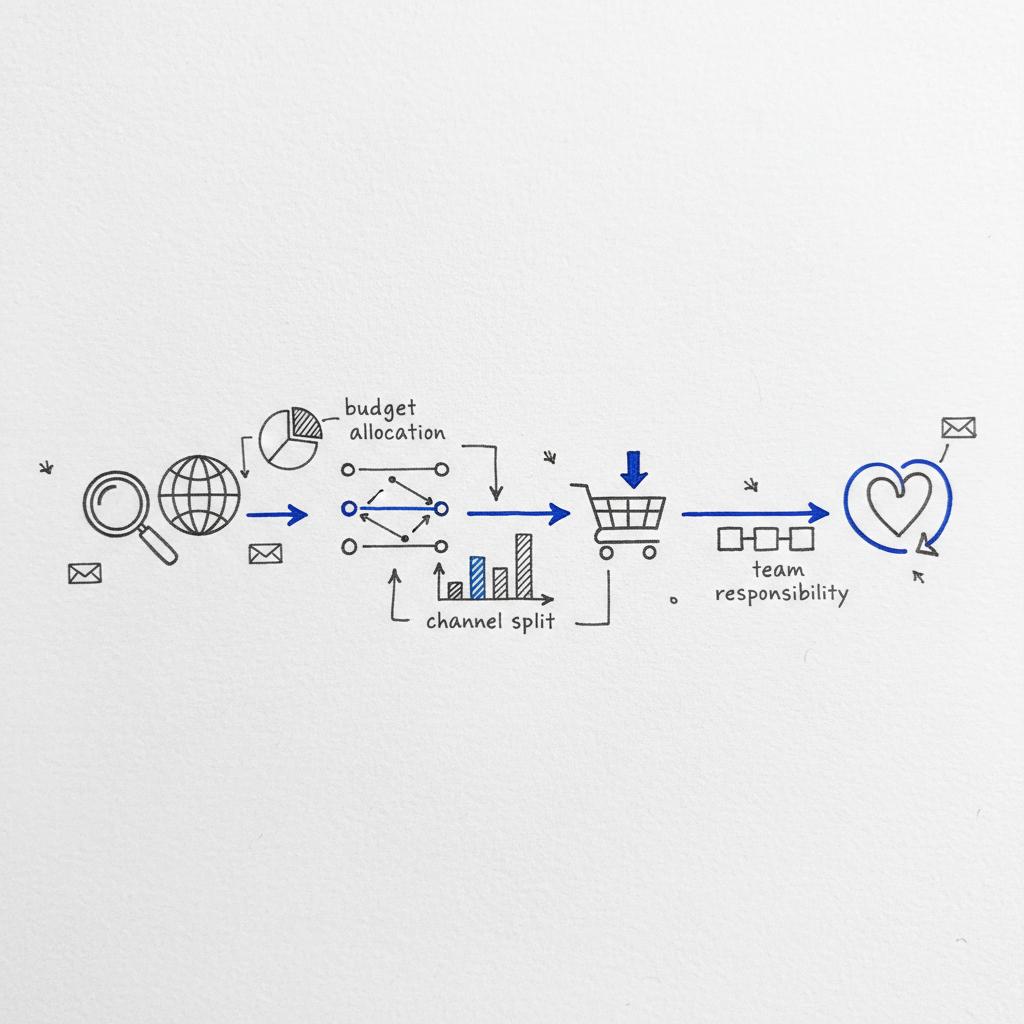
Focus on one measurable outcome and make sure tracking is accurate. Choose a single primary KPI (CPA or ROAS), define the dollar value of a conversion, and ensure CRM and analytics capture every conversion consistently—this turns guesswork into a repeatable financial process.
Test-and-scale for small budgets
With limited budgets, the goal is not to chase every shiny channel. It’s to run repeatable pilots that prove whether a channel hits your CPA or CAC target. The test-and-scale rhythm looks like this:
1) Run one to three small experiments per channel with a modest daily spend.
2) Use consistent tracking and a single conversion goal for comparability.
3) Keep creative simple.
4) Measure after four to twelve weeks.
5) Scale only when CPA or CAC targets are consistently met.
Why four to twelve weeks? Early signals can be noisy and platforms need time to learn. Setting this window prevents false positives and ensures stability before scaling.
A real example: landscaping that learned to pick channels
A local landscaping business I worked with wanted more leads. They ran broad social ads and a modest search campaign at the same time. Social created impressions and engagement, but search produced calls and form fills that turned into paying customers. After six weeks the search CPA hit the business target. The team paused most social spend and focused on improving social creative to better match intent. The simple lesson: find measurable outcomes first, then layer in awareness work. Related case studies are available on our projects page.

Attribution: choosing what to trust
Last-click attribution was easy but misleading. Multi-touch and data-driven attribution provide more honest credit allocation, but they require data and technical setup. For many SMBs, the pragmatic route is to use a consistent primary metric—usually CPA or ROAS—and apply conservative LTV assumptions to avoid over-spending.
Here’s a simple finance check: if the average purchase is $80 and contribution margin is 35%, immediate contribution is $28. If conservative estimated LTV is $70, you can pay up to $70 to acquire a customer and break even over time. Use this math before you scale a channel that reports a CPA of $50 versus a channel reporting $120.
Financial guardrails that protect cash
Scaling without guardrails can burn margins. Guardrails are explicit thresholds for CPA, CAC and ROAS tied to realistic margins and LTV projections. When a campaign meets the thresholds over time, increase spend. When performance slips, pull back and diagnose. Include finance, operations, and leadership in these conversations—alignment prevents surprises and keeps forecasts trustworthy.
First-party data and CRM hygiene
First-party data is a growing competitive advantage. Every email, purchase and CRM note helps you understand customer behavior. CRM hygiene is often underestimated: capture consistent fields, deduplicate, and attribute offline events (phone calls, store visits) back to your campaigns. When a lead converts, feed that event back into analytics so CPA and CAC reflect real business outcomes.
Generative AI: use as assistant, not autopilot
Generative AI accelerates creative production and ideation. It can write ad copy, draft email flows, and suggest audiences. But AI can also make repetitive, bland, or factually incorrect content if left unchecked. Use AI to generate options—then apply human judgment. Test AI creatives in small pilots before scaling spend.
Practical checklist to start today
Follow this straightforward checklist to launch a measurable program:
1. Define the outcome and value: Put a dollar on the conversion (e.g., $50 booking, $150 product sale).
2. Pick channels that match that outcome: search for intent, social for prospecting, email for repeat.
3. Set a single primary KPI: CPA or ROAS.
4. Run short pilots (4–12 weeks): small budgets, consistent events.
5. Fix measurement early: GA4, CRM integration, server-side if needed.
6. Use conservative LTV assumptions: avoid overbidding on incomplete signals.
7. Scale with guardrails: raise budgets only when targets are met consistently.
Common SMB questions answered
How much should I spend? Start with a test budget you can sustain for several months. For many SMBs this is a few hundred to a few thousand dollars per month. The goal is repeatable experiments, not a single big bet.
How long until a channel proves out? Expect 4–12 weeks. Platforms need time to learn and conversion paths must be solid. If landing pages are broken, no time window will fix that—fix the basics first.
Which KPI matters most? Track CAC, CPA, ROAS and LTV, but pick one primary KPI aligned with your immediate objective. New customers? Focus on CAC or CPA. Immediate revenue? Watch ROAS.
Practical calculations you can use now
Do this quick profitability check: average order value × contribution margin = immediate contribution per conversion. Estimate a conservative LTV and compare to observed CPA. If conservative LTV > CPA, scaling might make sense. If not, pause and refine.
For example: A small shop spends $1,000 and gets 50 customers — CPA $20. If average order is $30 and contribution margin after costs is 40%, each order contributes $12. If estimated LTV is greater than $20, the campaign could be profitable over time. This kind of simple math keeps decisions grounded.
Common pitfalls and how to avoid them
Pitfall 1: chasing vanity metrics. Impressions and likes feel satisfying, but they don’t pay bills. Prioritize conversion metrics tied to revenue.
Pitfall 2: bad measurement. Fragmented tracking leads to misleading signals. Fix CRM integration and use GA4 or server-side tracking.
Pitfall 3: scaling too fast. Volume without guardrails erodes margins. Scale only when CPA targets are proven.
How to talk about performance marketing with your team
Use plain language. Map acquisition math into the company’s financials: show how CPA affects cash flow and profitability. Regularly share simple dashboards that include CPA, CAC, ROAS and a conservative LTV assumption. When everyone understands the numbers, decisions become collaborative and aligned.
When to use external help
Hiring outside help can speed the process. A firm focused on SMBs—one that balances strategic clarity with practical execution—can set up measurement correctly, recommend the right channels, and run a pilot. If you choose an agency, favor those who explain trade-offs simply and who measure the right things.
Agency VISIBLE positions itself as that kind of partner: geared to get SMBs visible quickly, focused on revenue and clarity rather than vanity. If you want help mapping numbers to your margins, a short consult with Agency VISIBLE can be a low-friction way to get started.
How to keep improving
Performance marketing is iterative. Use test learnings to improve landing pages, refine audiences, and sharpen creative. Keep conservative LTV assumptions in budgeting conversations and update them as you capture more first-party data. When new tools emerge, test them in small pilots and measure against your baseline metrics.
Quick wins for immediate impact
1. Fix broken funnels: check tracking and landing pages.
2. Consolidate metrics: one dashboard with CPA, CAC, ROAS, and LTV.
3. Turn email into a growth lever: re-engage past customers with targeted offers.
4. Try a small search campaign: intention equals higher conversion rates.
Longer-term considerations
Over time, aim to turn first-party data into audience signals that power better ad targeting and higher LTV. Maintain CRM hygiene, keep offline event attribution in sync, and consider periodic LTV recalculations as your business model matures. Building these habits is a durable advantage as third-party tracking fades.
Final practical example: how a $1,000 pilot looks
Run a $1,000 pilot spread across two channels—search and remarketing: $600 search, $400 remarketing. Set a single conversion event (purchase or lead), run ads for 6–8 weeks, and measure CPA. If CPA meets your target and your conservative LTV assumption shows room to scale, raise budget in controlled steps. If not, iterate creative or audience before spending more.
Wrapping up: steady hands win
Performance marketing for SMBs is about discipline, not hype. Tie spend to measurable outcomes, set conservative assumptions, and scale only when the math supports growth. When you build a program this way, creative freedom follows: you can take bold creative bets where they matter and protect cash where they don’t.
Performance marketing is most powerful when it’s simple, repeatable, and measured. Start small, fix measurement, and let conservative numbers guide your growth.
There’s no single number that fits every business. A sensible approach is to set a test budget that you can sustain for several months without expecting immediate full return. For many SMBs this ranges from a few hundred to a few thousand dollars per month, split across one to two high-priority channels. The point is to run repeatable experiments rather than betting all cash on one unproven idea.
Run pilots for four to twelve weeks. Platforms need time to learn which users convert, and early data can be noisy. If landing pages and funnels are configured correctly, you’ll often see reliable signals within this window. If results remain unclear, diagnose creative, audience mismatch, or site experience before giving more budget.
You don’t strictly need an agency, but external help can speed setup, fix measurement, and design repeatable experiments. If you choose an agency, pick one familiar with SMB realities—practical budgets, clear KPIs and fast, measurable pilots. A short consult with a team like Agency VISIBLE can provide a pilot plan tied to your margins without a big upfront commitment.