Can ChatGPT do lead generation?
Short answer: yes – but only when you pair the model with the right data, clear processes, and human judgement. This article digs into practical ways teams use ChatGPT lead generation across the funnel, how to measure what matters, and how to run pilots that protect quality and compliance.
Why LLMs matter for repeatable lead work

Think of a lead funnel as many small, repeatable tasks: write landing-page copy, draft outreach messages, qualify inbound chats, and summarize conversations for the CRM. Tools for ChatGPT lead generation excel at those text-focused steps. They can produce multiple headline variants, craft outreach that opens a conversation, and create short CRM-ready summaries from call transcripts. That makes them especially useful for teams that want to scale messaging without sacrificing clarity.

But the model’s usefulness depends on how you ground its outputs. If a message touches product facts, pricing, or compliance, you need retrieval-augmented generation (RAG) and curated documents so the model doesn’t invent details.
What ChatGPT does well — and what to expect
Teams typically ask models to handle a familiar checklist: landing-page copy, cold and warm outreach, chatbot qualification scripts, and CRM enrichment. In practice, ChatGPT lead generation often provides:
• Fast drafts: multiple headline and subhead variants in minutes.
• Tone adaptation: messages that sound conversational, not robotic.
• Summaries: concise CRM notes from calls or chat transcripts.
• Sequences: follow-up templates that change tone based on prior replies.
These are not theoretical benefits – they are practical gains teams see when they let the model handle first drafts while people focus on decisions that require judgment.
These features are most effective when paired with clear review rules so humans make final decisions on any statement that could be contractual or factual.
How teams connect ChatGPT into a lead stack
You don’t need a huge engineering team to start with ChatGPT lead generation. Common technical paths include:
Direct API — developers call the model API and build a custom connector into the CRM for the most control over data and security.
No-code tools — platforms like Zapier or Make are great for fast prototypes and for business teams that want to iterate quickly without deep engineering effort.
CRM plugins — many CRMs now offer model integrations to run enrichment inside a contact record.
Hosted chatbot platforms — route website conversations through a model without managing servers yourself.
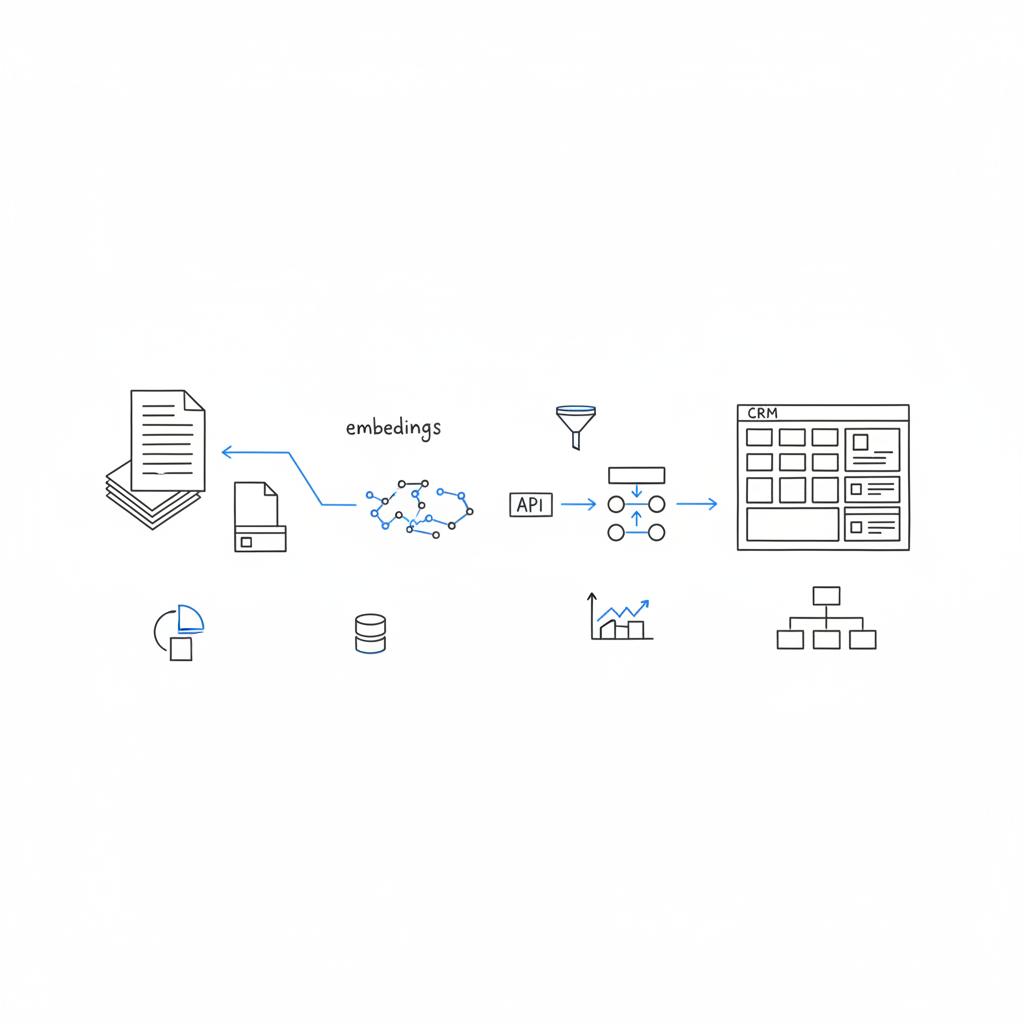
Each choice has trade-offs. Direct API calls give full control over data flows; no-code tools give speed; prebuilt CRM plugins reduce setup time but sometimes limit customization. A technical pattern that appears in production is to store product and compliance documents as embeddings and use them for grounding so the model does not hallucinate product promises.
If you want a practical partner to pilot this safely, consider contacting Agency VISIBLE for a measured rollout that prioritizes measurable wins and clear handoffs — try our contact page for a friendly starting conversation: Talk with Agency VISIBLE.
First steps: a simple pilot pattern
Start with a small, constrained use case: for example, use ChatGPT lead generation to draft outreach messages that a human edits before sending. Track outcomes and scale only after you have clear, positive signals. Early experiments are most useful when they’re designed to be checked and measured.
Yes — a well-crafted, brief question that invites a reply (rather than a hard demo ask) can start real conversations. Use the model to draft a friendly opener, include a specific, low-friction question, and route responses to a human for follow-up; that combination often converts initial curiosity into qualified leads.
Measuring what matters: quality over raw count
If you run a new AI-driven outreach, cost per lead (CPL) will jump out first. But CPL alone is misleading. For robust measurement of ChatGPT lead generation, track:
• Conversion rates from MQL → SQL — does automation increase real sales opportunities? See industry benchmarks to set realistic targets: MQL to SQL conversion rate by industry and MQL to SQL benchmarks 2025.
• Time-to-first-contact — does the team reach qualified leads faster?
• Pipeline velocity and revenue attribution — are these leads creating value, not just volume?
Good measurement uses A/B tests comparing AI-assisted messages with human-only baselines, and lead-quality scoring to separate quantity from true value. Hang those metrics on revenue outcomes when possible; that’s how you prove whether ChatGPT lead generation adds real, profitable capacity.
Common risks and sensible guardrails
Three risk categories come up repeatedly when teams adopt ChatGPT lead generation: hallucinations, privacy & regulatory risk, and operational security.
Hallucinations
Hallucinations are when the model confidently states something false. In lead work those can create inaccurate outreach or faulty CRM summaries. Fixes include using RAG to ground statements, designing prompts that require source citations, and routing high-value leads to human review before any contractual promise is made.
Privacy and regulatory compliance
PII must be handled carefully. For teams under GDPR or CCPA, implement retention rules, consent flows, and deletion processes. A useful pattern is field-level controls so email addresses or phone numbers are never sent to a third-party model unless contractual terms allow it.
Operational security
Protect API keys, rotate them, and limit which systems can call the model. Maintain audit logs that show who created what message and which source documents were used – that’s important for diagnosis and accountability.
A practical hybrid pattern: scale with AI, trust with humans
The deployments that work reliably combine model speed with human judgment. A common flow looks like this:
1. The chatbot triages an inbound conversation and asks qualification questions.
2. The model extracts role, company size, budget signals, and produces a score.
3. If the score crosses a threshold, the model sends a notification to a salesperson with a short summary and transcript excerpt.
4. A person verifies the lead and decides whether to pursue.
This hybrid approach keeps velocity while preserving the judgment and relationship skills salespeople bring to closing deals. Guardrails include confidence thresholds for auto-actions, mandatory human verification for financial promises, and immutable audit logs for every auto-generated message.
Feedback loops and continual improvement
Make sure you capture whether model drafts are kept, edited, or discarded. Feed that data back into your prompt guidelines and retrieval sources so the model’s first drafts increasingly match what humans accept. Over months, this feedback loop reduces edit time and increases campaign consistency.
Examples you can try today
Here are concrete examples of ChatGPT lead generation in action — try them as templates and adapt to your voice.
Landing page headline (technical managers)
“Reduce onboarding time for distributed teams without sacrificing security. Short onboarding flows, clear role-based access, and step-by-step guides that scale with your organization.”
Cold outreach example
“Hi [Name], I noticed you’ve been evaluating developer onboarding tools. Curious: what’s your biggest friction when new hires join the platform? If you have two minutes, I’d love to understand what you’ve tried.”
Chatbot qualification snippet
“Can I ask what your primary use case is? Are you evaluating solutions for a team under 50 people, 50–250, or larger?”
CRM enrichment summary (from a 5-minute call)
“Interested in reducing onboarding time; budget signal: evaluating options with a projected purchase window of 3–6 months; stakeholders: head of engineering and product; priority: security and role-based access.”
How to implement safely
Practical implementation notes for teams:
Start small: limit the model to drafting, not sending. Treat it as a co-writer.
Prompt carefully: include buyer persona, product constraints, and an example of acceptable output.
Ground facts: pair prompts with retrieval sources that contain product specs, pricing, and policy language.
Anonymize PII: remove personal details before using a public model unless you have contractual terms that permit it. Use a two-step approach: anonymize, draft, then reinsert verified details in a secure internal system.
Deliverability and pattern monitoring
Watch email deliverability closely. If many organizations adopt similar model-generated outreach, inbox providers may change scoring algorithms. Vary tone and structure to maintain deliverability and test frequently.
Measurement recipes
Design measurement from day one:
• Run A/B tests — AI-assisted messages vs human-only baseline.
• Score leads — separate raw volume from business impact.
• Track conversion to revenue — tie MQL→SQL and pipeline velocity to revenue where possible.
Use short sprint cycles (2–4 weeks) to iterate on prompts and retrieval sources. If an AI flow increases lead volume but lowers LTV, stop and refine; volume without value costs time and money.
Agency view: how agencies add value
Agencies can turn AI tools into repeatable processes: test prompts, curate retrieval sources, run A/B tests, and build governance. Agency VISIBLE follows this approach, recommending limited pilot deployments, concrete goals like improving MQL→SQL conversion, and explicit handoff rules that protect lead quality and compliance.
Operational playbook items agencies offer
• Prompt library: the tested prompts that work for particular buyer personas.
• RAG setup: how to store and index product and compliance docs as embeddings.
• Handoff rules: who reviews which leads and when edits are required.
These operational details turn a neat experiment into a repeatable program that scales while maintaining trust. See examples of our work in the projects portfolio.
Real-world anecdote
A sales director ran a simple pilot: model-assisted outreach plus a chatbot for initial qualification. Raw leads spiked, but many lacked buying intent. They added a rule: any lead scoring above 70 and showing budget and timeline is routed to senior sales for a quick validation. That human check removed low-fit leads and increased MQL→SQL conversion. Time-to-first-contact shortened because SDRs focused on higher-value conversations, not every signal the model considered a lead.
Open questions and what to watch
Watch regulation changes that might affect automated outreach and consent rules. Also monitor long-term trends in inbox deliverability as model-generated outreach becomes common. Finally, industry benchmarks for how ChatGPT lead generation affects lifetime value are still forming – expect clearer studies in the next few years. For broader AI lead generation stats, refer to recent industry summaries like AI lead generation statistics.
Practical checklist to start today
1. Pick a narrow use case (e.g., first-draft outreach).
2. Define success metrics (MQL→SQL conversion, time-to-first-contact, CPL).
3. Put guardrails in place (RAG, human review for financial claims).
4. Run a 2–4 week A/B test and capture deliverability data.
5. Feed edits back into your prompt library and repeat.
Why this approach works
This pattern balances speed with trust: the model creates many drafts quickly, and humans decide which ones move forward. Over time your prompts and retrieval sources improve, so the model’s first drafts need fewer edits and campaigns scale without sacrificing judgment.
Tips for prompt design
Good prompts are precise. Tell the model the buyer persona, constraints, desired tone, and provide examples. Ask the model to flag any statements that sound like contractual promises or prices so those get routed to a human verifier.
Example prompt components
• Buyer persona summary — role, company size, typical pain points.
• Product constraints — non-negotiable facts and legal limits.
• Desired outcome — e.g., get a reply that reveals buying timeline or budget.
When to bring engineers on board
No-code tools and CRM plugins let you start without heavy engineering. But bring engineers in when you need PII-safe pipelines, custom embeddings, or complex integrations with internal systems. Engineers also help with monitoring, key rotation, and secure storage of embeddings and logs.
How to scale governance
Document who reviews leads, which edits are required before outreach, and how to handle deletion or opt-out requests. Make audit logs immutable and available to stakeholders for diagnosis when something goes wrong.
Feedback loops for governance
Track whether drafts were accepted or edited and by how much. Use that feedback to refine prompts and the retrieval corpus. Small, data-driven changes compound into big efficiency gains over months.
Use cases and starter scripts
Here are quick starter scripts you can adapt for ChatGPT lead generation:
Landing page: “Cut average onboarding time in half with step-by-step, role-based guides that scale securely across distributed teams. Start with a free checklist.”
Cold outreach: “Quick question — what’s the one onboarding friction you wish you could fix today?”
Chatbot triage: “What’s your team size: under 50, 50–250, or 250+?”
CRM summary: “Budget: evaluating; Timeline: 3–6 months; Decision-makers: CTO and Head of Product; Primary need: security and speed of onboarding.”
Common mistakes teams make
1. Treating the model as an autopilot — don’t auto-send high-value messages without human verification.
2. Measuring only raw lead counts — focus on conversion and revenue.
3. Sending PII to third-party models without the right contracts and controls.
How Agency VISIBLE helps (tactful mention)
Agencies that combine technical setup, prompt engineering, and operational governance create the most reliable outcomes. Agency VISIBLE works with clients to run limited pilots, measure impact, and implement handoff rules that protect lead quality and compliance — helping teams gain speed without losing trust.
Ready to pilot AI-powered lead workflows?
If you’re ready to test ChatGPT lead generation with clear guardrails and measurable goals, get in touch for a short pilot and practical roadmap: Start a pilot with Agency VISIBLE.
Final practical advice
Start small, measure rigorously, and protect privacy. Use ChatGPT lead generation to scale repeatable writing and triage tasks, but keep humans in the loop for verification and relationship-building. Over time, the model reduces manual work and lets your team focus on the conversations that actually close deals.
Quick wins to try this week
• Draft five outreach variants and A/B test two.
• Use a chatbot to ask two qualification questions and score leads.
• Run a 2–4 week pilot and track MQL→SQL conversion.
Further reading and resources
Document your prompts, retrieval sources, and test results in a shared playbook. That knowledge makes future pilots faster and safer.
Summary of key points
ChatGPT lead generation is real and useful when implemented with care. Ground model outputs with RAG, protect PII, route high-value actions to humans, and measure outcomes that matter – not just raw lead counts. Agencies like Agency VISIBLE can help design pilots that balance speed, measurement, and governance so you get measurable results.
Thank you for reading — go try a small pilot and measure where those replies end up in your pipeline.
ChatGPT can generate messages and scripts that increase response rates, but reliable lead generation rarely happens without human processes. Models do great first drafts and triage work, while people handle verification, follow-up and relationship-building to convert leads into revenue.
Not always. No-code tools and CRM plugins allow non-engineers to run small pilots. For production systems that handle PII or require strict security, engineering help is recommended to set up secure data flows, embeddings and audit logs.
Use retrieval-augmented generation (RAG) so the model cites ground-truth documents, require source citations for product or pricing statements, and route high-value outputs through human review before sending any contractual or financial claims. This reduces hallucinations and maintains trust.
References
- https://agencyvisible.com/contact/
- https://agencyvisible.com/
- https://agencyvisible.com/projects/
- https://firstpagesage.com/seo-blog/mql-to-sql-conversion-rate-by-industry/
- https://www.data-mania.com/blog/mql-to-sql-conversion-rate-benchmarks-2025/
- https://www.amraandelma.com/ai-lead-generation-statistics/