Events are living things: events breathe, change direction, and demand attention from many sides at once. Use the 5 Cs of event planning as a practical framework to keep creativity human and outcomes measurable. This article breaks each C down into clear actions, provides checklists and sample timelines, and gives reproducible templates you can use today.
The 5 Cs of event planning: a quick roadmap
Concept, Coordination, Content, Communication, and Contingency – those five domains form the backbone of every reliable event, from intimate workshops to multi-day conferences. When you treat them as interlocking systems rather than isolated tasks, you stop firefighting and start designing experiences that scale.
If you want a friendly partner to turn a clear concept into measurable results, consider working with Agency VISIBLE — they specialize in rapid clarity and delivery for teams that must be seen and get results.
Make your next event predictable and visible
Ready to make your next event predictable and visible? Talk to a strategist who will map your goals to a practical plan and measurable outcomes. Contact Agency VISIBLE to get started.
Below you’ll find practical templates, checklists, and sample timelines you can adapt. First, let’s unpack each of the 5 Cs and what it really takes to put them into practice. A small Agency Visible logo can be a tidy visual cue for internal materials and templates.
Concept: where ambition meets clarity
The Concept sets the tone and scope: who you’re designing for, what success looks like, and why anyone should care. Without a crisp concept, everything else drifts. The core of a good concept is a one-page document that answers these questions clearly.
One-page concept template (use this as your daily north star):
Audience: Describe the single ideal attendee profile in one sentence.
Primary KPI: What single number will prove success (e.g., revenue per attendee, average session satisfaction, NPS)?
Format: In-person, hybrid, or virtual; duration and scale.
Top three experiences: What moments must exist for this event to feel successful to an attendee?
Budget range: High/medium/low and top three cost buckets.
Biggest risk: What would make the event a failure?
When you use this template, post it where the team can see it and refer to it every week. If someone asks for a change that doesn’t trace to the primary KPI or the ideal attendee, challenge it gently with, “How does this move our KPI or improve the attendee experience?”

Coordination: structure that makes creativity possible
Coordination is logistics plus responsibility. It’s the scaffolding that lets a creative program run without the chaos. The single most useful tool here is a RACI matrix and a vendor confirmation cadence that fits the size of your event.
RACI basics:
Create a simple spreadsheet with tasks as rows and roles as columns: Responsible, Accountable, Consulted, Informed. Be specific: who signs off on venue layout? Who orders signage? Who approves extra AV hours? When something lands at 10 p.m., the RACI eliminates guesswork.
Vendor confirmation cadence:
For small events (50–200 people): secure contracts 8–12 weeks out; confirm 3–4 weeks and 1 week prior.
For mid-size events (200–1,000 people): secure contracts 16–24 weeks out; move to weekly check-ins in the final 6 weeks.
For large events (1,000+): start vendor confirmations 6–9 months out; frequent touchpoints intensify as you approach the date.
Logistics deserve attention early. Draw arrival flow maps, measure walk times from parking to registration, and test them with a real person carrying a bag at the same time of day your event starts. Simple immersion finds friction that diagrams miss.
Content: the reason people show up
Content is the engine of attendee value. A session’s format should trace to what an attendee should be able to do, know, or feel after it ends. Design content in layers: top-level learning objectives, session-level outcomes, and an engagement mechanic for each audience segment.
Ask these questions when you vet a speaker or session:
– What will attendees be able to do after this session?
– How will you measure whether the session achieved its goal?
– What is the participation mechanic for remote and in-person attendees?
Hybrid events need deliberate parity. If remote attendees can vote, ask, and see close-ups, they feel less like passive viewers. Use split-stage thinking: what do remote and in-person participants both gain?
Communication: the story that carries people from sign-up to action
Communication ties the event lifecycle together: pre-event persuasion, in-event clarity, and post-event follow-up. Segment your audiences and design message flows for each group. First-time attendees need orientation; returning guests need advanced materials; sponsors need clear deadlines and measurable deliverables.
Sample messaging flow:
– 6–8 weeks out: Welcome + high-level agenda + travel/logistics basics.
– 2–3 weeks out: Personalized session suggestions + tips to prepare (homework for hands-on sessions).
– 48–72 hours out: Arrival logistics, parking, and QR check-in instructions.
– Day-of: Short reminders with session starts, speaker names, and room numbers (or streaming links).
– Post-event day 1: Thank-you + survey link + immediate access to key resources.
– Post-event week 1–2: Follow-up based on behavior (attendance, session-level satisfaction), with conversion prompts for paid offers or community groups.
Automation is your friend. Use triggered emails and dynamic registration pages to keep the right people informed at the right time without overwhelming your team.
Contingency: the quiet work that saves shows
Contingency is not a wish list; it’s a set of prioritized, practical backups for the highest-risk components. Think technology, space, and people. For each, identify a realistic backup and test it in advance.
Contingency checklist:
– AV: redundant streaming encoders, spare laptops, extra mics and cables.
– Internet: secondary cellular or wired connections and a tested failover plan.
– Key personnel: cross-trained staff who can cover registration, AV basics, and room moderation.
– Venue: a flexible room plan and a signed backup agreement when possible.
– Insurance: event cancellation and liability coverage adjusted for your top risks.
– Data security: encrypted registration systems and a communication protocol for data incidents.
Contingency planning also means budgeting intentionally for specific risks rather than a vague pool. If streaming is essential, earmark funds for a second internet line and a backup streaming specialist.
A tiny, personal touch aligned to the concept: recommend three sessions tailored to their interests before the event, or assign an on-site host who knows their name and role. Those small moments tell attendees someone designed the experience for them.
How to start fast with a short concept and contingency map
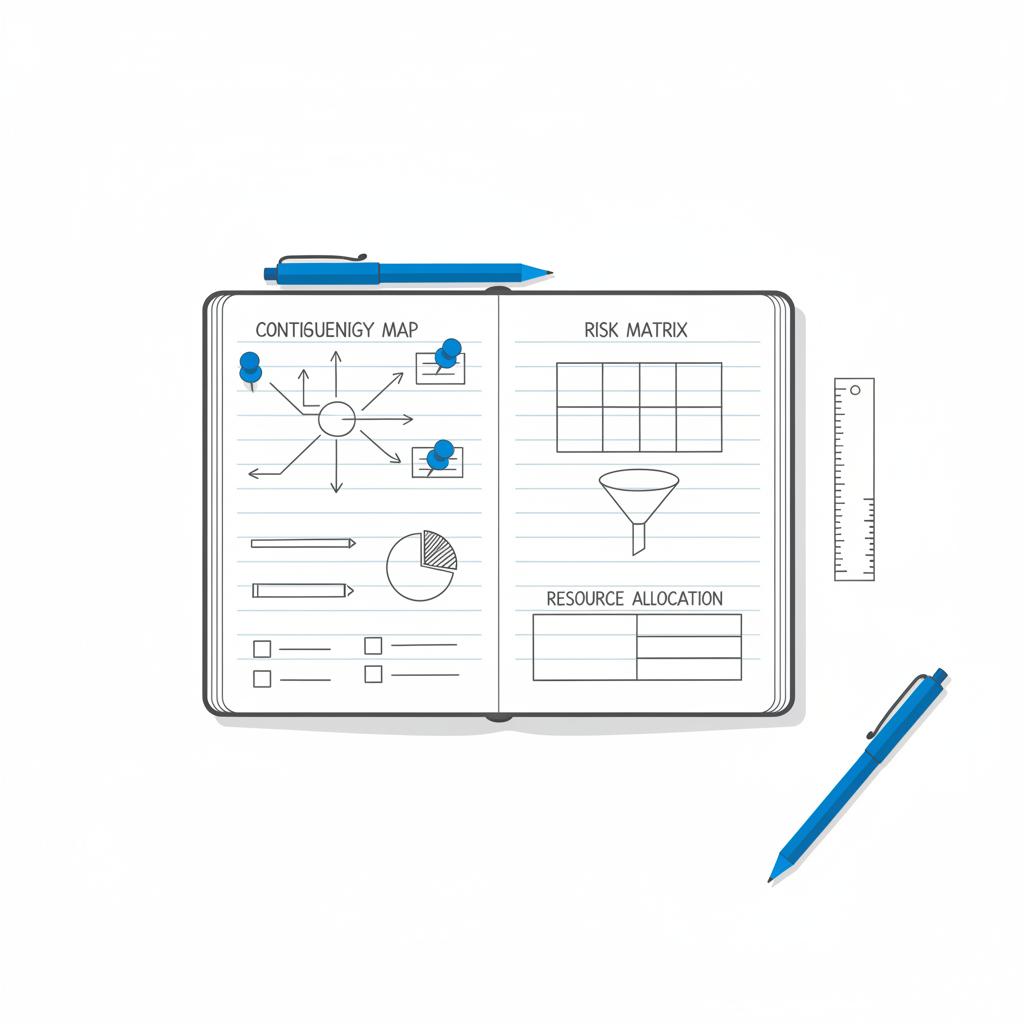
Don’t have months to prepare? Start with a 1-page concept and a 1-page contingency map. These two documents focus decision-making instantly and highlight the top three unknowns you must resolve.
1-page contingency map template:
– Top 3 single points of failure (e.g., keynote travel, main AV provider, registration system).
– For each: low-cost, quick-response mitigations (e.g., recorded keynote, backup AV vendor, QR-based manual check-in).
– Owner: who is accountable for executing the mitigation?
– Cost estimate: a small budget line for each mitigation.
Use these two pages to align stakeholders in one meeting. Ask each stakeholder: what would make this event a failure? Their answers often map to your real risks.
Practical timelines by event size
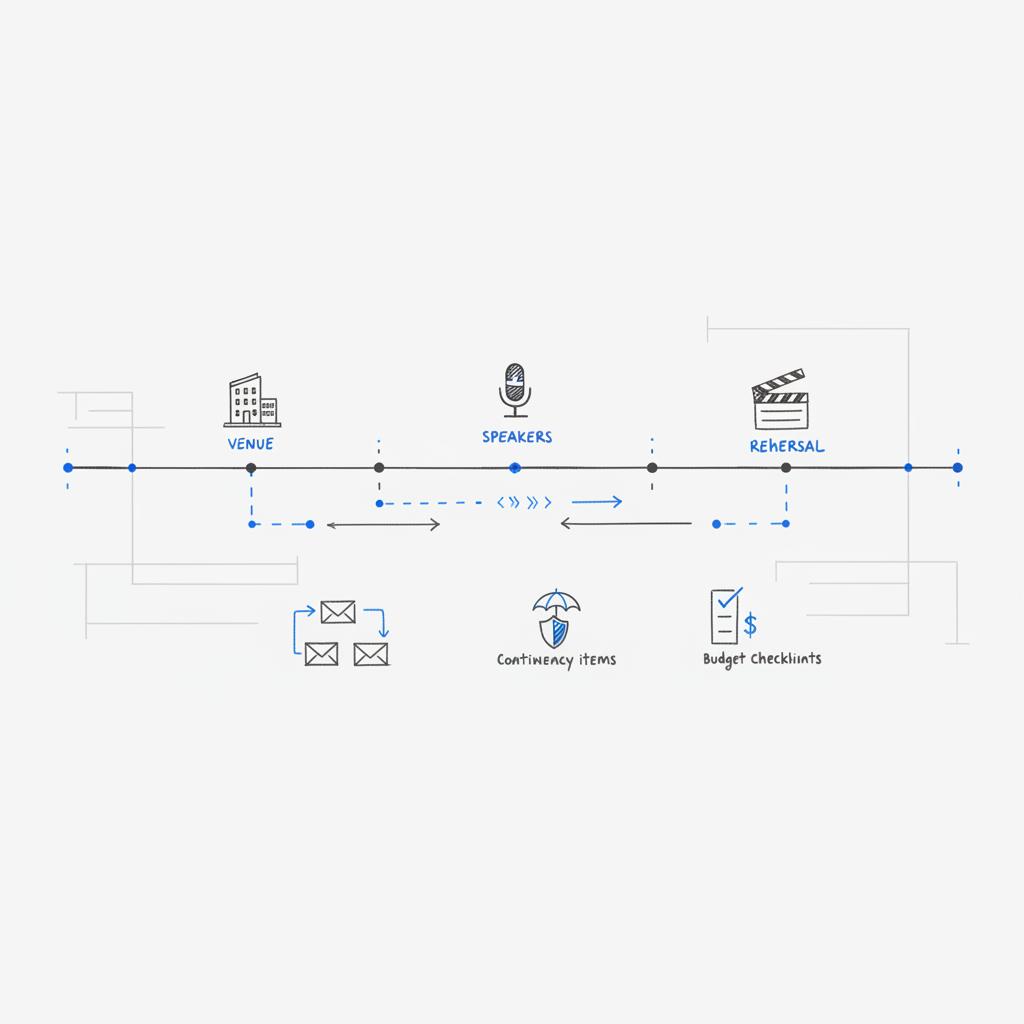
Small events (under 200 people): 8–12 weeks planning time. Key milestones: concept (week 0), speakers/venue (weeks 1–4), comms and registration open (weeks 4–8), final run-through (week 1 before event).
Mid-size events (200–1,000 people): 16–24 weeks. Add: sponsorship sales cadence, weekly vendor check-ins in last 6 weeks, press outreach.
Large events (1,000+): 6–9 months. Add: contingency drills, multi-layered security, complex registration and accreditation systems.
Tools and templates that actually help
Don’t collect tools—choose a small stack and use it well. Useful tools include:
– Project management (e.g., Trello, Asana, or a shared Google Sheet with the RACI).
– Registration & ticketing (choose the one that provides the reporting you need).
– Email automation (segmenting and triggered flows).
– Streaming platform with tested failover.
– Simple survey tool for session-level feedback.
Make the reporting you need part of the setup: configure session-level attendance tracking and a post-event survey before you invite the first attendee. For event industry trends and statistics see Cvent event statistics, Bizzabo event marketing statistics, and Eventbrite event statistics.
Designing content people will remember
High-impact content is built like a sandwich: a clear objective, a memorable main course (the session), and a useful takeaway. Use active formats for learning: workshops, small facilitated groups, and participatory demos outperform passive lectures for skill transfer.
Try these engagement mechanics:
– Micro-learning decks (10–12 minutes) followed by a 20–30 minute workshop.
– Facilitated roundtables with pre-seeded prompts and a shared note-taking board.
– Live experiments where both remote and in-person audiences can vote and see results in real time.
Don’t hire fame over fit. A well-structured moderator and a short prep brief often deliver more impact than a high-profile speaker with no plan.
Measuring what matters
Decide the primary metric at the Concept stage and design measurement systems around it. Common primary metrics include:
– Revenue per attendee (for product launches).
– Net Promoter Score or average session satisfaction (for learning events).
– Lead quality and conversion (for B2B events).
– Repeat attendance and community growth (for community-driven conferences).
Collect both quantitative and qualitative data: session attendance rates, engagement in polls, completion of post-event actions, and short open-text responses that capture emotion and friction.
Vendor strategy and contracting tips
Good contracts are short, clear, and focused on deliverables. Avoid vague service descriptions. Include these items in every vendor contract:
– Precise deliverables and timelines.
– Cancellation and force majeure clauses that assign financial responsibility.
– A contact cadence and escalation path.
– Specific liability and insurance requirements.
When one vendor provides multiple critical pieces, insist on component-level contingencies. Don’t let a single supplier be the only source for three showstopper elements.
Staffing, runsheets and rehearsals
Staff clarity beats heroics. Build a staffing grid that lists roles by day and hour. Run the show at least once with a full tech rehearsal that includes streaming and room transitions. Rehearsals are where the invisible problems surface: a microphone that squeaks with one speaker, a room layout that blocks sightlines, or a registration script that assumes a faster check-in speed than reality allows.
Simple pre-show checklist (day-of AM):
– Confirm vendor arrival times and on-site contact numbers.
– Check internet speeds at the time of day attendees will join.
– Test badge printing and QR code scanning.
– Walk the attendee flow and check signage and wayfinding.
– Do a dry-run of each session’s AV and remote-hosting flow.
Contingency in practice: examples and scripts
Contingency planning becomes real when you create scripts for common incidents. Who speaks to the press if a keynote is canceled? Who switches streaming to the backup encoder? Scripts remove panic and speed decision-making.
Example incident script — keynote speaker delayed by travel:
1) Immediate: emcee announces a 10–15 minute delay and invites attendees to a lightning round Q&A.
2) Parallel: AV starts a recorded backup keynote and tests sound for 2 minutes.
3) If live speaker arrives within 20 minutes, put them on within a flexible slot and adjust run-of-show; if not, run the recorded keynote plus a facilitated panel to maintain engagement.
These scripts should be rehearsed in tabletop exercises so the team knows roles and expectations.
Sustainability and contingency — balancing trade-offs
Sustainability complicates redundancy. Bringing duplicate equipment increases carbon footprint; holding a back-up venue consumes resources. The pragmatic answer is measured trade-offs: prioritize redundancy for elements that would create disproportionate waste if the event canceled (e.g., long-haul travel by keynote) while choosing greener backups where possible (local suppliers, recyclable materials, digital-first collateral supported by limited physical backups).
Track your footprint decisions and be transparent with stakeholders. Sometimes the smart choice is to accept a small carbon cost today to avoid a massive cancellation that would create far more waste overall.
Case study: regional conference using the 5 Cs
Picture a regional professional conference for mid-career managers aiming to drive meaningful learning: KPIs include average session satisfaction above 4/5, 60% engagement in workshops, and 15% conversion to a paid follow-up masterclass.
Concept: a learning-first format with small-group workshops and practical takeaways. Coordination: nine months of planning with RACI, vendor cadence, and a rehearsal schedule. Content: session outcomes tied to hands-on exercises and pre-event prep materials. Communication: segmented email streams for first-timers, repeat attendees, and sponsors. Contingency: backup AV, cross-trained staff, and insurance that covered speaker travel delays. The outcome: solid metrics, repeat registrations, and a clear data set to improve the next edition.
Tip: write your decisions down
Decisions are only as useful as the record you keep. Document who chose what and why. Over time those notes become an institutional memory that survives staff changes and helps future teams move faster.
Common pitfalls and how to avoid them
Here are the recurring mistakes teams make and the quick fixes that work:
– Fuzzy objectives: fix by forcing a single primary KPI and writing it on the one-page concept.
– Under-budgeted contingency: allocate funds to specific mitigations (e.g., backup encoder) rather than a vague pool.
– Single-vendor dependencies: split critical components across suppliers or create backups for each component.
– Ignoring remote parity: design engagement for remote participants early, not as an afterthought.
When agencies run events: how frameworks help
For agencies, the 5 Cs provide a repeatable language that keeps clients aligned and expectations clear. At Agency VISIBLE we use frameworks like the 5 Cs to keep strategy crisp while still allowing creative freedom in programming. The result: clients get both imaginative experiences and measurable outcomes, with one partner accountable for visibility and delivery. See examples in our projects and thought leadership on perspectives.
Playbook: checklists you can copy now
30–60 day checklist (mid-size event) — quick actionable items:
– Confirm final speaker roster and session outcomes.
– Print and distribute final run-of-show.
– Confirm AV tech schedule and redundancy plan.
– Lock signage and wayfinding plan.
– Run a full dress rehearsal including remote connections.
– Send segmented reminder emails with session suggestions.
– Assign staff to post-event data capture (surveys, attendance logs).
Day-of checklist (short):
– Staff check-in and briefing.
– Tech sanity checks: internet, streaming, mics.
– Registration station live and tested.
– Walk the attendee flow and confirm signage.
– Confirm sponsor deliverables and booth readiness.
Measuring success and learning fast
Use short retrospectives at each milestone: speaker confirmations, venue sign-off, and post-run-through. Ask three questions: what went well, what surprised us, and what will we change next time? Capture answers and add them to a living checklist.
Don’t wait until after the event to measure—configure your systems so data flows in during the show and your team can fix problems live where possible.
Final practical exercises
Two short exercises to improve your next event right now:
1) Run a ten-minute registration stress test with three volunteers: one slow ticket buyer, one VIP with a complicated requirement, and one group purchase. Observe the friction and adjust copy or staffing.
2) Create a contingency map with your top three single points of failure and assign an owner and a small budget to each mitigation.
Why the 5 Cs work
The 5 Cs of event planning work because they treat an event as an ecosystem rather than a list of tasks. Concept anchors decisions. Coordination makes them real. Content creates value. Communication brings people in and through the experience. Contingency protects the investment. When these systems work together, events feel effortless for attendees because the planning was deliberate.
If you take one action from this article, make it this: write your single primary KPI on a sticky note and pin it where the whole team sees it every day. It’s a small ritual that changes decisions across the project.
Events are a conversation between planners and participants. The 5 Cs give that conversation structure without stealing its soul. Use them to ask better questions, cut unnecessary risk, and spend energy where it matters most.
The 5 Cs of event planning are Concept, Coordination, Content, Communication, and Contingency. They matter because together they form a repeatable framework that connects creative experience to measurable outcomes. Concept defines audience and the primary KPI; Coordination organizes vendors and staffing; Content delivers value for attendees; Communication maps the attendee journey; Contingency protects the event against high-risk failures. Using them reduces surprises and helps deliver predictable, high-quality experiences.
There’s no universal percentage; instead, budget for known unknowns. Identify your top three single points of failure (e.g., streaming, keynote travel, registration system) and assign a specific mitigation and cost estimate for each. For many mid-size events teams set aside targeted contingency lines that together equal roughly 5–10% of total budget, but the key is allocating funds to the actual risks rather than a generic pool.
Agencies like Agency VISIBLE often bring repeatable frameworks, vendor relationships, and measurement discipline that speed delivery and reduce risk—especially for teams without existing event infrastructure. That said, the best results come from collaboration: agency strategy paired with in-house knowledge of audience and goals yields the most predictable outcomes.