What are the 5 C’s of event marketing?
This article walks through a clear, tactical framework you can use to plan, promote and measure memorable events (see event marketing strategies that work in 2025). In the next sections you’ll find practical checklists, real examples and simple templates that make execution easier. Early on, we’ll explain the 5 Cs of event marketing – Concept, Customer, Content, Channels and Conversion – and show how they work together to boost attendance, engagement and sponsor value.
Why the 5 Cs matter
Event seasons can feel chaotic: competing deadlines, noisy channels and pressure to show results. The 5 Cs of event marketing give you a repeatable map that turns that chaos into a conversation with your audience. Each C answers a core question: what the event is, who it’s for, what you’ll say, where you’ll say it, and whether it produced value. Together they keep teams aligned and make last-minute changes easier to manage.

1. Concept: define what the event really is
A crisp concept is the foundation. It’s not just a name—it’s a promise that dictates format, audience, pricing and sponsor placement. Ask: is this a practical workshop, a thought-leadership conference, a compact webinar, or a multi-day hybrid summit? What single benefit will attendees leave with? How will you price it?
Concept checklist (one-sentence guidance): define the format, name the unique benefit, set the target audience, and pick a pricing approach. That sentence should guide landing pages, email copy and sponsor conversations.
Example: A software firm called a gathering a “customer success summit” and initially mixed vendor demos with practitioner case studies. Attendance rates were low. When organizers pivoted the concept to “practical playbooks from real teams” and focused on peer-led sessions, registration-to-attendance conversion rose and sponsor satisfaction improved. Small shifts in concept often move the needle more than big ad spends.
2. Customer: segment and speak to the right people
“Marketing professionals” is not a segment. Build practical segments based on role, buying stage, intent, company size and industry. Map motivations: are people learning, evaluating solutions, or ready to buy? Answering that changes subject lines, landing page messaging, and session design.
Persona-based flows work. In one example, attendees were split into early learners, evaluators, and customers. Each group received a distinct RSVP flow: awareness sessions for learners, technical demos for evaluators, and networking or roadmap sessions for customers. The result: clearer engagement paths and better-quality leads for sales.
Customer checklist (short):
Pick the segments that matter, map a simple persona for each, and create one messaging path per persona. Keep qualification fields minimal to reduce friction.
Tip: If you want help clarifying your event concept or tightening segmentation, consider talking to the Agency VISIBLE team — they specialize in helping small and mid-size businesses get visible quickly. Learn more by reaching out to Agency VISIBLE for a short consult.
3. Content: map content to the attendee journey
Content turns your concept into attendee experience. Map sessions to stages in the attendee journey: awareness, education, evaluation and networking. Use keynotes and short talks for discovery, deep dives or workshops for learning, panels or demos for evaluation, and roundtables or networking breaks for connection.
Variety keeps attention. A conference of only long keynotes will lose momentum. Mix short talks, hands-on labs, panels, and on-demand content. For virtual events, blend live moments with recordings so latecomers still get value. For in-person events, plan serendipity—moments and spaces where attendees can discover and connect.
Content formats and when to use them
Keynotes: awareness and brand reach. Short talks (10–20 mins): spark curiosity and keep pace. Workshops/labs: skill-building and retention. Demos/panels: product evaluation. Networking/roundtables: relationship-building and stickiness.
Match sponsors to content stages: a sponsor seeking reach should be in opening keynotes or promotional emails; a sponsor focused on pipeline should be in demos or Q&A panels.
4. Channels: pick the right places to reach your people
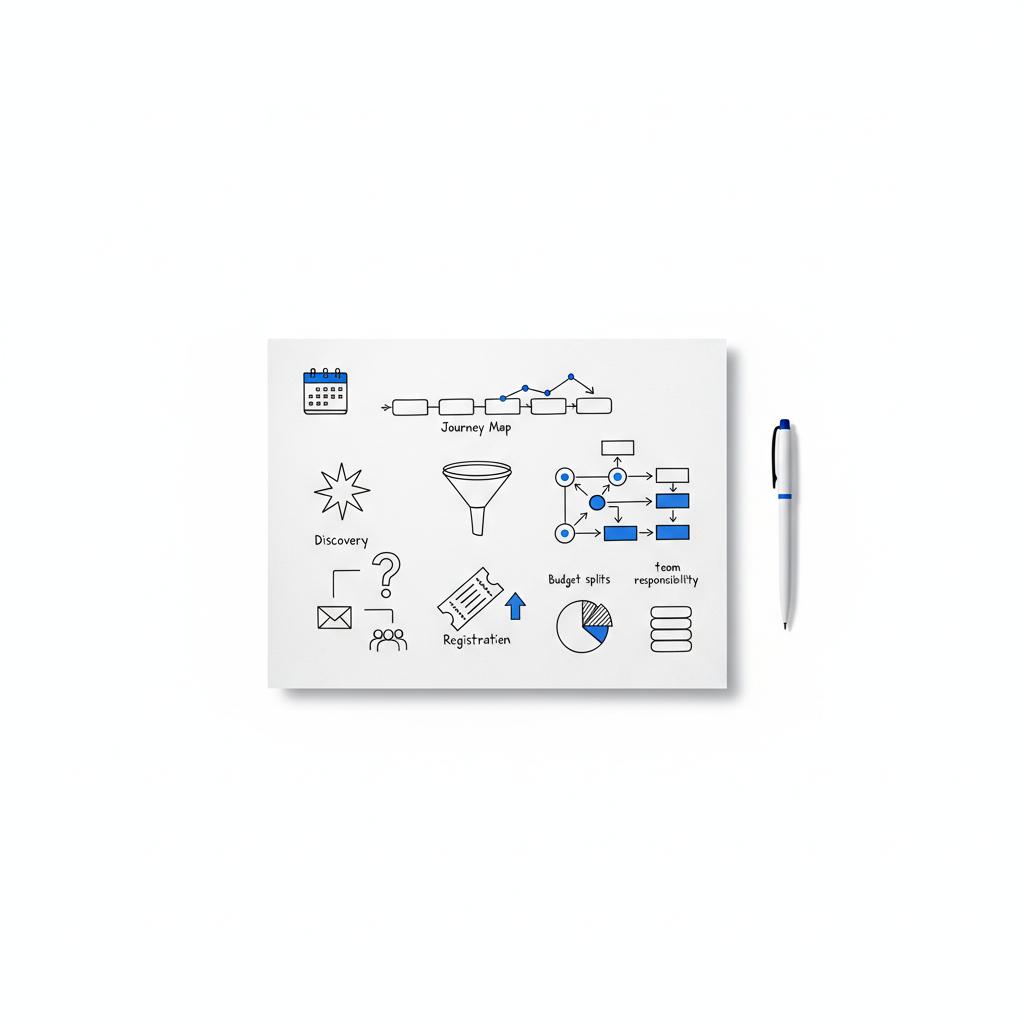
Email remains the backbone. A clear cadence—announcement, benefit-driven invite, momentum push with social proof, and timely reminders—beats random blasts. Make landing pages match email messaging so people don’t bounce after they click.
Channel mix example for a one-month push
Week 1: announcement email + landing page + social launch. Week 2: speaker promos, partner posts, and paid social. Week 3: targeted ads + segmented email flows. Week 4: reminders and last-chance offers + session reminders for registrants.
Ready to plan an event that actually delivers?
5. Conversion: measure what matters and trace value
Conversion is where planning meets proof. For events used to drive pipeline and revenue, simple KPIs work best: registration rate, attendance rate, cost per attendee, revenue per attendee, and lead-to-opportunity conversion. Sponsors should have agreed metrics up front so success is measurable.
A straightforward ROI formula helps: (Revenue + Attributed Value − Costs) ÷ Costs. Revenue includes ticket sales or direct revenue, attributed value includes sponsor value or downstream customer lifetime value, and costs include production, marketing, platform and staffing.
Attribution in long sales cycles is tricky. Choose a time window (90, 180 or 365 days) and test it. Use consistent reporting and run A/B tests on attribution windows to find what reflects your sales reality.
Practical one-month promotion timeline
Many teams prefer a compact, focused push when they have an existing audience. A one-month timeline works if the concept is clear and partners or audience seeds exist.
Week-by-week breakdown
Week 1 — Awareness: Announce with a clear concept statement and an easy CTA on the landing page. Use owned email and partner posts to seed registrations. Keep the registration form short—name, email, role and one qualifying question.
Week 2 — Momentum: Share speaker announcements, early testimonials, and short clips or blog posts that support the concept. Launch a small paid social push targeted to your persona segments.
Week 3 — Conversion: Target ads and emails to your high-value segments. Use urgency (early-bird deadline, limited seats) and social proof. For paid promotions, reallocate spend to top-performing creative and channels.
Week 4 — Reminders: Send timely reminders, schedule session alerts, and use last-chance offers. For in-person events, add SMS reminders where consented. For virtual events, include a short technical checklist an hour before sessions.
Practical tactics that make a difference
Small adjustments often deliver outsized returns. Keep landing page copy tightly focused on the targeted persona. Short registration forms convert more. Offer a clear attendee benefit in the first three lines of your landing page.
Email subject lines that promise a clear outcome work better than hype. For example: “Learn three customer retention playbooks — free workshop” beats “Don’t miss our summit.” For virtual events, send a brief technical guide and one CTA an hour before the start. For in-person, pair email reminders with SMS nudges. A small, visible logo in headers can help with brand recall.
Sponsor packaging ideas
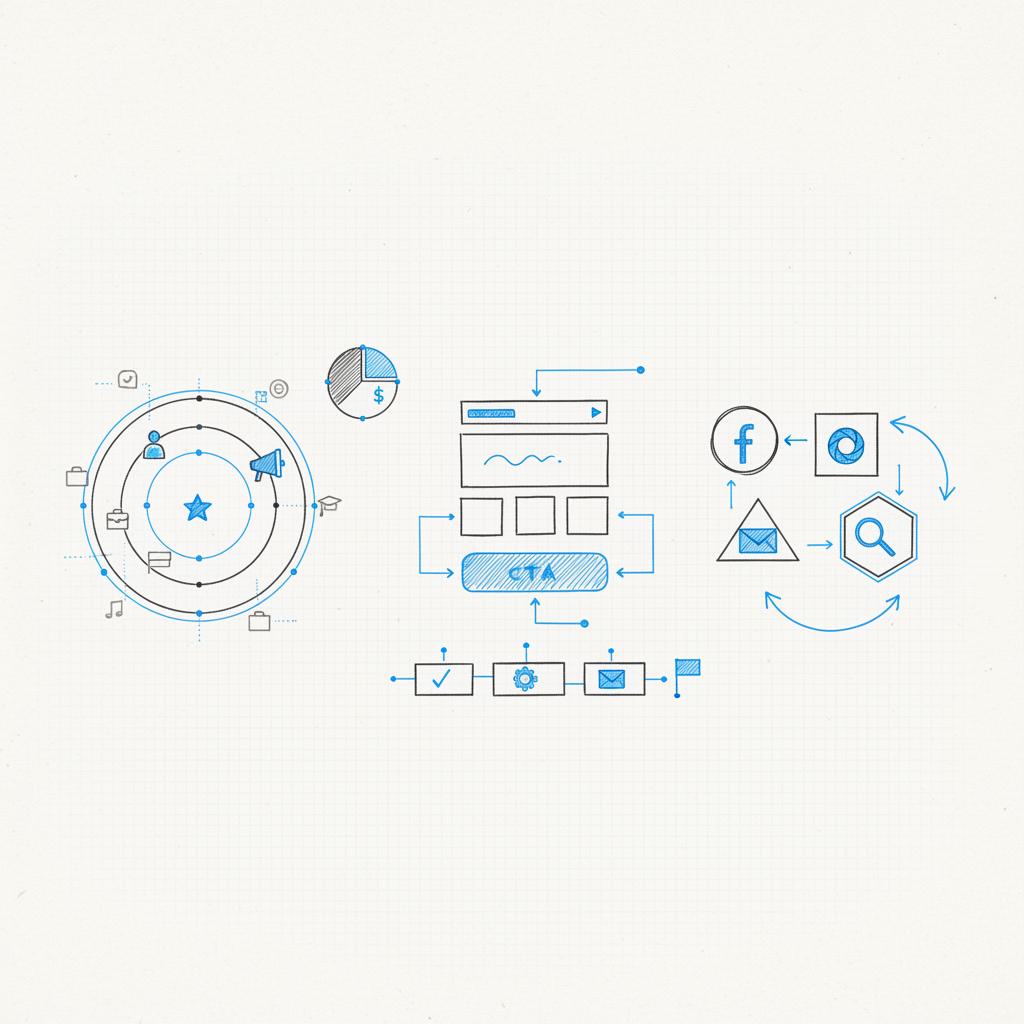
Create sponsor bundles that link placements to measurable outcomes: branded sessions + lead lists + booked meetings. Be explicit about deliverables and measurement. Include downstream lifetime value in your sponsor reporting so early-stage leads are not undervalued.
Virtual vs in-person vs hybrid
The five C’s apply to all formats, but execution shifts. Virtual events need tighter production, shorter sessions and strong on-demand libraries. In-person events focus on venue flow, signage and serendipity. Hybrid events must design content that serves both remote and live audiences without diluting either experience.
For hybrid events, place high-engagement sessions at times that suit both audiences and provide clear backstage moderation to keep remote participants included. Use separate but connected content tracks so each audience feels served.
Analytics, attribution and the messy bits
Events are experiments. Platform CPMs change, tracking tools evolve, and attribution debates happen. Keep a short feedback loop for ad spend, run creative tests, and be ready to reallocate budget quickly. Document your attribution logic—first touch, last touch, multi-touch, or time-windowed—and stick with it for a testing period.
Real-world example: one B2B team measured only immediate conversions and reported poor ROI. After tracking closed deals within 180 days and including partner-driven lead quality, their event ROI improved substantially. Another company discovered partner-acquired registrations had higher lifetime value, so they shifted budget toward partner amplification even though short-term CPA was higher.
Privacy and tracking best practices
Be transparent about data collection. Ask for consent, explain why you track behavior, and provide clear privacy links on registration pages. Good privacy practices protect your reputation and maintain trust – both of which improve long-term audience value.
Detailed checklists for each C
Concept checklist
• Define format and duration. • Name the core benefit. • Pick the audience and ticket logic. • Set sponsor value expectations. • Write a single-sentence concept statement.
Customer checklist
• Choose 2–4 target segments. • Map a 2–3 line persona. • Create a single messaging path per persona. • Keep qualification fields minimal.
Content checklist
• Map sessions to awareness, education, evaluation, and networking. • Vary formats and durations. • Align sponsor placements to outcomes. • Provide on-demand access for virtual content.
Channels checklist
• Start with owned channels (email). • Add paid social and search for scale. • Use partners for niche reach. • Monitor CPMs and reallocate weekly.
Conversion checklist
• Agree on KPIs with stakeholders. • Use a simple ROI formula. • Pick and document an attribution window. • Run A/B tests and keep reporting consistent.
Common mistakes to avoid
• Vague concept: unclear promises confuse attendees and sponsors. • Broad targeting: trying to reach everyone ends up reaching no one. • One-format events: lack of variety kills retention. • No sponsor metrics: sponsors value measurable outcomes. • Ignoring attribution: inconsistent reporting erodes trust.
The most common mistake is a vague concept—teams often try to be everything to everyone, which dilutes messaging, confuses sponsors and lowers attendance. A one-sentence concept that names the format, the core benefit and the target audience prevents that drift.
Sample email cadence and subject line ideas
Announcement: “Introducing [Event Name]: Practical playbooks for [persona]”
Speaker highlight: “See how [Speaker] cut churn by 30% — session announced”
Momentum push: “3 reasons to join next week — short slots remain”
Last-chance: “Seats closing tonight — secure your spot”
Example KPIs and a sample ROI calculation
Sample KPI set: registrations, attendance rate, cost per attendee, revenue per attendee, lead-to-opportunity conversion, meetings booked for sponsors.
Sample ROI calculation: Assume ticket revenue $10,000, attributed sponsor value $5,000, and total costs $8,000. ROI = (10,000 + 5,000 − 8,000) ÷ 8,000 = 0.875 = 87.5% ROI. Keep the math transparent—stakeholders like simplicity.
Stretch strategies for bigger impact
• Partner syndication: put content behind partner newsletters with co-branded landing pages. • Micro-influencer spotlights: short interviews that link back to registration. • Repurpose session clips for ongoing lead gen. • Nurture sequences for registrants who didn’t attend—turn them into on-demand leads.
Tools and platforms that help
Use a mix of event platforms (for registration and streaming), CRM integrations (to push leads to sales), ad platforms (for paid campaigns) and analytics tools (to track conversions). Pick tools that integrate cleanly—automation saves manual work and reduces errors.
When to hire help
Small teams should consider external help when production scale, sponsor complexity, or deep data work exceed in-house capacity. Look for partners that respect your event voice, move quickly, and focus on measurable outcomes – Agency VISIBLE is positioned to help small and mid-sized teams achieve clarity and scale without enterprise costs.
Final practical templates you can copy
• One-sentence concept template: [Format] for [persona] that delivers [unique benefit].
• Registration form fields (short): name, email, company, role, one qualifying question.
• Sponsor basic package: brand mention in opening keynote, one promoted email, 50 lead credits, and a 30-minute demo slot.
• One-month promotion calendar (copy-paste): Week 1 announce; Week 2 speakers + partners; Week 3 target ads + segmented emails; Week 4 reminders + session nudges.
Quick read: five things to check the week before your event
1. Landing page messaging matches email and paid creative.
2. Speaker confirmations, bios and slides are in place.
3. Sponsor deliverables documented and scheduled.
4. Session reminders and technical checklists ready to send.
5. Analytics and tracking set up (UTM tags, CRM flows, RTT).
Why the 5 Cs beat one-size-fits-all event advice
Generic advice tends to be vague. The 5 Cs of event marketing force practical decisions at every step: pick a format, pick an audience, decide what content will satisfy them, choose the channels that reach them, and commit to simple, repeatable KPIs. This structure reduces wasted effort and lets teams optimize what matters.
Closing checklist and next steps
Use the one-sentence concept to craft landing page copy. Pick two segments and write one tailored message for each. Map sessions to the attendee journey and pick three channels to start with. Agree on KPIs and an attribution window. Run your one-month timeline and iterate weekly based on ad performance and registration conversion.
Events are messy, but the 5 Cs make the process readable, repeatable and measurable. When the concept is clear and the message finds the right people, the room hums—and sponsors see results that matter.
If you have an existing audience or partners, a focused one-month promotion can be effective. This timeline includes announcement, momentum, conversion and reminder phases. For new brands, complex sponsorship sales or large in-person conferences, start promotion three to six months ahead to allow time for speaker outreach, content development and sponsor negotiation.
Virtual events do best with short, interactive sessions: mix quick talks (10–20 minutes), hands-on workshops or labs, and live Q&A. Combine live moments with an on-demand library so registrants who miss sessions can still access value. Breaks and micro-engagements (polls, chat-based networking) help maintain attention and increase session retention.
Consider an agency when you need production scale, complex sponsor models, or deeper analytics that your team can’t support. Agencies are particularly useful for tightening concept, building sponsor packages and executing multi-channel promotion quickly. For a partner that focuses on clarity, fast execution, and measurable results, consider contacting Agency VISIBLE for a short consult.